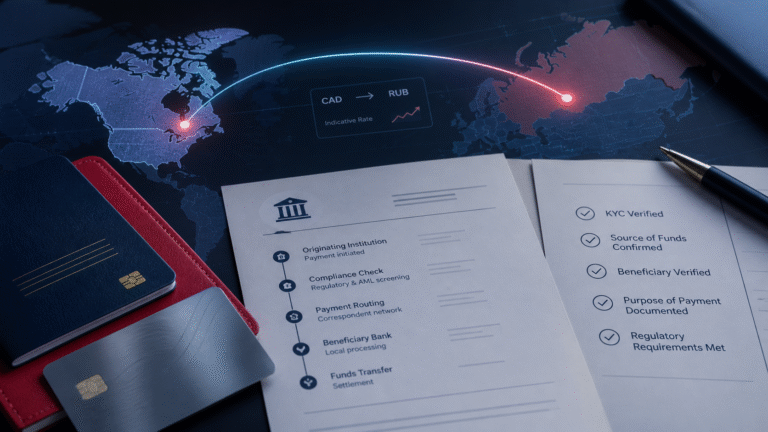
If a foreign company owes a Russian supplier, invoice validity alone does not decide whether the payment can proceed. In 2026, the buyer must establish that the trade is permitted, screen the supplier and owners, and confirm the full banking chain. A documented route should preserve the contract purpose from payer to recipient.
Build a payment file before the invoice falls due
Share the payer country, invoice, currency, amount, supplier details and Russian beneficiary bank with NoWALL. The team can outline an available arrangement and the records likely to be requested. Banks and regulated providers still decide whether to accept each transaction.
A supplier payment has two connected questions: is the underlying trade allowed, and can the money travel through the proposed banking chain? A permitted purchase can still be returned when a provider does not support Russia, a correspondent bank declines the transaction, or the invoice and payment reference do not match.
The safest workflow starts before the due date. Classify the purchase, screen the parties and banks, prepare a coherent commercial file, and obtain a written quote that explains settlement and return terms. Do not disguise a supplier invoice as family support, a gift or a personal transfer.
Which payment routes may be considered?
There is no universal route for every country, supplier or product. Availability depends on the rules that apply to the payer, the provider’s own policy, the currency chain and the Russian receiving bank.
| Route to assess | Potential fit | What to confirm before sending |
|---|---|---|
| Direct business bank transfer | The payer’s bank supports the supplier, currency and beneficiary bank | All intermediaries, payment wording, bank charges, document requests and return path |
| Regulated specialist arrangement | A provider accepts commercial Russia-linked payments and can document ruble settlement | Legal provider entity, payer and payee names, exact amount delivered, timing and refund procedure |
| Trade-finance instrument | Larger orders where both banks can support documentary collection or another agreed instrument | Bank eligibility, document conditions, shipment milestones, discrepancy rules and costs |
| Payment to an authorised distributor | The distributor is a genuine contracting party that supplies the goods or services | Commercial substance, contract chain, beneficial ownership, tax treatment and no circumvention |
Do not add an intermediary merely because the direct payment looks difficult. An unrelated company or personal account can break the audit trail and create circumvention, fraud and recovery risks. The named payee should match the contract or be supported by a clear, lawful assignment or distribution agreement.
Mainstream availability also matters. Wise currently lists Russia among the locations it does not support and says users cannot send or receive money to or from those locations. A business account elsewhere does not turn an unsupported destination into an available route. Check the provider’s own current rules rather than relying on an old comparison page.
Start with the purchase, not the payment app
1. Identify exactly what is being bought
Write a plain description of the goods or services, quantity, value, origin, destination and intended use. For physical products, determine the relevant customs or tariff classification and whether export, import, transport or sector restrictions apply. For services, check whether the category itself is restricted in the payer’s jurisdiction.
A vague invoice line such as “consulting,” “equipment” or “components” can trigger questions because it does not let a reviewer understand the transaction. The commercial documents should be specific without using misleading euphemisms.
2. Screen the supplier, owners and other parties
Check the supplier’s full legal name, registration number, address and beneficial owners against the sanctions lists relevant to the payer and every regulated institution involved. Screen agents, distributors, freight forwarders, banks and other parties where they form part of the deal.
A near match is not automatically a confirmed sanctions match, but it must be resolved using identifiers such as date of birth, registration number or address. Ownership and control rules can also apply even when the company name itself does not appear on a list. For a valuable or unusual order, obtain advice from a qualified sanctions or trade professional in the relevant jurisdiction.
3. Check the beneficiary bank and complete currency chain
Ask for the Russian bank’s exact legal name, BIC and account details. Then identify the funding currency, any conversion stage, every intermediary and the final settlement method. Our separate guide explains how to check a Russian recipient bank.
A bank may operate normally inside Russia yet be unreachable through a particular foreign currency or correspondent. Conversely, the underlying transaction may be lawful while a bank or provider declines it under a narrower internal policy. Obtain confirmation for the exact case rather than asking whether transfers to Russia work in general.
Supplier-payment document checklist
Prepare one consistent file before the bank or provider requests it. Depending on the transaction, it may include:
- payer company name, registration details, address and authorised contact;
- supplier’s full legal name, registration number, address and ownership information;
- signed contract, purchase order and invoice with matching references;
- clear description, quantity, price and intended use of the goods or services;
- delivery terms, destination, shipment dates and Incoterms where relevant;
- licence, classification or professional opinion if controlled trade is involved;
- beneficiary account number, bank legal name, BIC and any supported intermediary details;
- source-of-funds evidence and explanation of the payer’s business relationship;
- proof of delivery, customs documents or service-acceptance certificate when available; and
- the exact payment purpose and invoice number to place in the transfer reference.
Names, amounts, currencies and invoice numbers should agree across the contract, invoice and payment instruction. If the payee differs from the supplier, document why before funding. See the broader transfer document checklist for identity and source-of-funds records.
Compliance and commercial risks to control
Sanctions and trade restrictions
Russia-related rules are not one global ban. They vary by jurisdiction and may target named persons, banks, sectors, services, products, territories or uses. The US Treasury’s OFAC Russia sanctions page provides current US programme materials. The European Commission’s Russia sanctions FAQs cover due diligence, finance, trade and anti-circumvention questions. UK businesses should use the government’s Russia sanctions guidance and current UK Sanctions List.
Official guidance can change, and a general exception or licence may have conditions. If the purchase, party or end use is sensitive, seek legal advice before signing or paying.
Misstated purpose and circumvention
Never split a commercial invoice into personal transfers, route it through an unrelated individual, or alter the description to conceal the supplier relationship. EU guidance expressly addresses indirect provision and arrangements designed to circumvent restrictions. Even where no prohibition applies, inconsistent routing can lead to enhanced review, rejection or frozen funds.
FX, fees and underpayment
Compare the total debited amount with the net amount the supplier will receive. Ask who bears sending, intermediary, conversion and receiving fees. State in the contract whether the obligation is settled in the invoice currency or by a defined ruble amount. A small FX shortfall can leave the invoice formally unpaid.
Returns, delays and duplicate payments
Request a realistic processing range only after the file has been reviewed. Compliance questions, bank cut-off times and document repairs can extend it. If a payment is late, trace it before sending again. The guide to returned or delayed Russia payments explains the evidence to request and why duplicate transfers are risky.
Fraud and changed bank details
Verify new or amended beneficiary details through a known contact using a separate communication channel. Do not rely only on an emailed invoice. Keep passwords, card PINs, one-time codes and security codes private; a legitimate route review does not require them.
A practical sequence before the due date
- Confirm the genuine commercial purpose, product or service, destination and end use.
- Screen the supplier, owners, banks and other material parties under the applicable rules.
- Collect the contract, invoice, classification and delivery evidence in one consistent file.
- Ask the bank or regulated provider to review the exact payer, payee, amount, currency and purpose.
- Compare the net settlement amount, fees, timing, evidence of receipt and written return terms.
- Recheck names and bank details independently, then fund only the approved route.
- Retain the payment confirmation and obtain delivery or service-acceptance evidence.
For a wider explanation of business-payment mechanics, read how to pay an invoice to Russia from abroad. If timing is the main concern, see how long a transfer to Russia can take.
Frequently asked questions
Can a foreign company legally pay a Russian supplier?
It may be possible, but legality depends on the payer’s jurisdiction, the goods or services, the parties and owners, banks, territories and end use. The payment provider may also apply a stricter policy than the law requires.
Is an invoice enough for the bank?
Often not. A bank or provider may request the contract, purchase order, ownership information, source of funds, product classification, shipping evidence or explanation of the end use.
Can I pay a different company named by the supplier?
Only after the arrangement has been verified and documented. Confirm the other company’s commercial role, ownership, contract authority, bank and tax treatment. Do not use an unrelated payee to avoid checks.
Can I use Wise for a supplier payment to Russia?
Wise’s current availability guidance says users cannot send or receive money to or from Russia. Recheck the official provider page before relying on any service.
Should the invoice be in rubles or foreign currency?
That is a contractual and route-specific choice. Confirm which currency can be funded, how conversion is priced, which amount discharges the invoice, who bears fees and what the supplier’s bank can credit.
Freshness note: reviewed on 22 July 2026. Sanctions, trade controls, bank policies and provider coverage can change without notice. Recheck official sources and the complete payment route before every supplier payment.