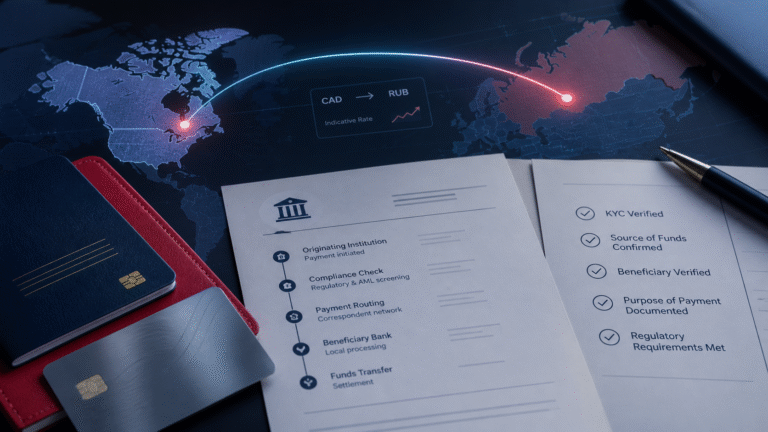
You can pay an invoice to Russia only when the underlying trade, both counterparties, every bank in the payment chain and the chosen route are permitted. Start with the contract and invoice, screen the supplier and bank, confirm the receiving currency, and obtain route approval before sending. A valid invoice alone does not make a payment possible.
Need to test a business payment route before the due date? NoWALL can review the sender country, supplier, recipient bank, invoice currency, payment purpose and supporting file against available payment options. The review can identify avoidable gaps, but it cannot override sanctions, bank policy or a compliance decision. Ask NoWALL to review your invoice payment.
What to check before paying a Russian invoice
Treat the invoice as one part of a commercial transaction, not as a payment instruction on its own. The safest sequence is to verify the deal first, the recipient second and the route third. If any one of those changes, repeat the check before releasing funds.
- Confirm that the goods or services may legally be supplied under the rules that apply to the sender.
- Screen the supplier, its beneficial owners and the recipient bank against current sanctions lists.
- Match the invoice to the contract, purchase order, delivery or acceptance evidence and agreed payment terms.
- Ask the recipient bank which currency and account details it can currently accept for this transaction.
- Get written confirmation from the sending bank or regulated payment provider that it supports the complete route and purpose.
This order matters. A bank may technically accept a currency but still reject the payment because of the supplier, product, service, intermediary bank or wording in the instruction.
Invoice payment routes: practical differences
There is no universal “Russia payment rail.” Availability depends on jurisdiction, counterparties, banks, currency and the nature of the trade. The table below is a decision framework, not a promise that a route is open.
| Route option | When it may fit | What to confirm | Main risk |
|---|---|---|---|
| Direct business bank transfer | The sender’s bank and recipient bank both support the payment | Currency, correspondent chain, purpose wording and bank screening result | An intermediary bank rejects or returns the transfer |
| Regulated specialist payment route | A direct bank route is unavailable, but the trade remains permitted | Provider licensing, disclosed payment chain, beneficiary amount, fees and evidence requirements | Using an opaque intermediary or misunderstanding who receives the funds |
| Alternative settlement currency | The contract allows it and both sides can document conversion | Contract amendment, exchange rate, fee allocation and final receipt currency | Invoice, contract and payment instruction no longer match |
| Escrow or staged commercial settlement | The contract and provider support milestone-based release | Escrow status, release conditions, licensing and refund procedure | Funds become trapped if conditions or compliance checks are unclear |
| Consumer remittance, card or wallet | Usually unsuitable for a company invoice | Whether commercial use is expressly permitted | Account closure, unsupported business purpose or weak audit trail |
A third-country bank is not a compliance shortcut. If a lawful route includes an intermediary, disclose the real supplier, payer, beneficiary and purpose. Do not relabel the transaction, substitute a personal recipient or split the invoice to avoid review.
Documents and recipient details checklist
Prepare one coherent file in which names, dates, amounts and descriptions agree. Our broader document checklist for transfers to Russia covers sender identity and source-of-funds evidence; a commercial invoice payment normally needs the following additional items:
- signed contract, purchase order or other document creating the payment obligation;
- final invoice with legal names, addresses, number, date, currency, amount and due date;
- clear description of the goods or services and the relevant period or quantity;
- delivery note, customs documents, timesheet, milestone report or acceptance certificate where relevant;
- supplier registration and tax details, plus beneficial-owner information if requested;
- recipient account name, account number, bank name, address and domestic bank identifiers;
- SWIFT/BIC and correspondent details if the approved route uses them;
- source-of-funds evidence and authority for the employee instructing the payment;
- any licence, exception or legal opinion required for the specific transaction.
Ask the supplier to obtain fresh bank details from its bank. Fraudsters often exploit invoice changes, so verify any new account through a known contact using a separate channel. Never rely only on an emailed “updated invoice” or a messaging-app request.
How to write the payment purpose
The payment purpose should connect the transfer to the underlying documents without adding vague or invented language. A useful description normally includes the invoice number and date, contract reference and a short factual description, subject to the bank’s formatting rules.
For example: “Payment for translation services under Contract 18, Invoice 104 dated 2 July 2026.” For goods, include the invoice or purchase-order reference and use the same product description that appears in the commercial file. If the bank requests a shorter format, keep the identifying references.
Do not describe a supplier payment as family support, a gift, a personal loan or consulting unless that is the true transaction. A mismatch can lead to a hold, a request for more information or a return. It can also create tax, accounting and sanctions problems.
Sanctions and compliance checks
Russia-related restrictions are not one universal ban. They vary by the sender’s jurisdiction and can apply to designated people, banks, ownership and control, particular goods or services, currencies, financing terms and indirect arrangements.
For EU-linked transactions, the European Commission’s consolidated Russia and Belarus sanctions FAQs are the best starting point for current guidance. Its specific payment-services FAQ also explains restrictions affecting certain payment and e-money services. The rules are detailed and have changed repeatedly, so a conclusion from an older transfer should not be reused automatically.
For a US nexus, use the Treasury’s Russian Harmful Foreign Activities Sanctions page, current lists and any relevant licence. For UK-linked payments, OFSI’s financial sanctions guidance for Russia explains restrictions involving designated persons, payment chains and correspondent banking.
Screening a company name is not enough. Check ownership and control, directors where relevant, the recipient bank, intermediaries, the actual goods or services and the final end use. If the legal position is unclear, pause and obtain qualified advice in the sender’s jurisdiction. No payment provider can turn a prohibited transaction into a permitted one.
Fees, exchange rates and the amount the supplier receives
The invoice amount and the delivered amount can differ because of sender fees, intermediary deductions, foreign-exchange spreads and recipient-bank charges. Agree in writing whether fees are paid by the sender, shared or deducted from the transfer. Ask for a quote that shows:
- the amount and currency debited from the sender;
- the exchange rate and how long it is valid;
- provider and banking fees;
- the expected amount and currency credited to the supplier;
- the refund currency and deductions if the transfer is returned.
If settlement will use a different currency from the invoice, amend the contract or obtain written agreement before paying. Record the agreed exchange-rate source and date so both accounting teams can reconcile the balance.
What happens after you send
Keep the payment instruction, provider confirmation, bank reference and complete document file. Send the supplier the traceable reference, not a screenshot that exposes unrelated account data. Ask the supplier to confirm the amount and currency actually credited.
If the payment is held, request the exact status and the institution currently reviewing it. If it is returned, obtain the return code or written reason before trying again. Our guide to delayed and returned transfers to Russia explains the evidence to collect. Repeating the same instruction without correcting the cause can produce another failure and more fees.
Frequently asked questions
Is it legal to pay a Russian supplier?
There is no single worldwide answer. A payment may be lawful only if the trade, supplier, owners, banks, intermediaries and financing terms are permitted under every rule that applies to the sender. Review the transaction individually and use current official sources. See our guide to legal checks for transfers to Russia.
Can I pay a Russian invoice in euros or US dollars?
Only if the contract, receiving bank, sending institution and full correspondent chain support that currency for the transaction. Availability can change, and an intermediary may reject a payment even when the recipient account is denominated in that currency.
Can I pay the director’s personal account instead?
Do not substitute a personal account unless the arrangement is lawful, contractually valid, accepted by the banks and fully documented. For a company debt, paying a different person creates serious ownership, fraud, accounting and compliance questions.
Does a stamped invoice guarantee acceptance?
No. A bank may still require the contract, delivery or acceptance evidence, source of funds, ownership details, sanctions analysis or a clearer payment purpose. It can also decline the route under its own risk policy.
Should I send a small test payment first?
A test payment does not prove that the full invoice will pass review, and splitting a transaction to avoid controls is not acceptable. Confirm the route and documentation for the full commercial amount before sending anything.
Last reviewed: 13 July 2026. Sanctions rules, bank coverage, provider policies and correspondent routes can change. Confirm the current legal and operational position with the institutions handling your payment before releasing funds.