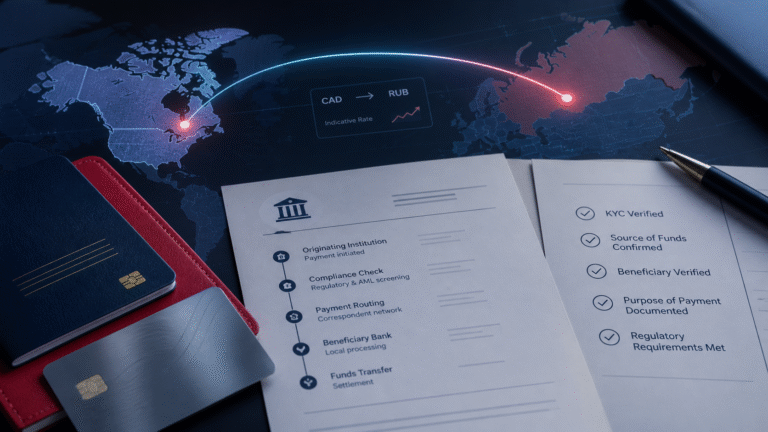
To send money to Russia, prepare accurate sender and recipient details, a clear payment purpose, and evidence that explains where the money came from and why it is being sent. The exact documents depend on whether the payment is family support, a gift, salary, services or an invoice. A complete file helps, but it does not guarantee bank acceptance.
Want to check the file before initiating a payment? NoWALL can review the sender country, recipient bank, currency, amount, payment purpose and supporting documents against the available route. This can reduce avoidable questions, but every bank and payment partner keeps its own compliance decision. Ask NoWALL to review your transfer details.
The short checklist
Most transfers need three layers of information: identity, payment details and evidence for the underlying reason. Keep clear, current copies ready even if the provider does not request all of them at the start.
| Document or detail | What it establishes | Common problem to avoid |
|---|---|---|
| Sender identity and address | Who is funding the payment | Expired ID or an address that differs from the payment account |
| Recipient’s bank details | Where the funds should arrive | Using a card number when the route needs bank account details |
| Payment purpose | Why the money is being sent | Vague wording that conflicts with the supporting evidence |
| Source-of-funds evidence | How the sender obtained the money | A statement that does not show the sender’s name or relevant transaction |
| Relationship or commercial document | Why the sender owes or gives money to the recipient | An invoice, contract or explanation with inconsistent names and amounts |
| Bank and route confirmation | Whether the chosen institutions support the payment | Relying on details from an earlier transfer without rechecking them |
Sender information and proof of identity
A regulated provider will normally identify the person or company funding the transfer. For an individual, this may mean a valid passport or national identity card, date of birth, residential address, phone number and tax residence. A recent utility bill, bank statement or government letter may be requested as proof of address.
The name on the funding account should match the verified sender. Payments funded by a friend, relative or unrelated company often trigger extra questions or may not be accepted. Wise, for example, states in its payment compatibility guidance that it generally cannot accept transfer funding from a third-party account. Other providers set their own rules, so confirm the position before someone else pays on your behalf.
A business sender may also need an incorporation document, registered address, ownership information, director identification and authority for the person instructing the payment. The bank can ask who ultimately owns or controls the company, not only whose name appears on the invoice.
Recipient and Russian bank details
Ask the recipient to obtain current details directly from their bank. Do not reconstruct them from an old receipt or assume that a Russian card number is enough. Depending on the route, you may need:
- recipient’s full legal name exactly as recorded by the bank;
- residential address and date of birth, if requested;
- bank account number and receipt currency;
- full bank name, address and domestic bank identifier;
- SWIFT/BIC or intermediary details when the route uses them;
- the recipient’s tax or company registration number for a commercial payment;
- a confirmation that the account can receive the proposed payment type and currency.
The account holder, contract party and invoice recipient should align. If the payment belongs to a company but the proposed receiving account is personal, stop and obtain a clear explanation and route approval before sending.
Which document fits each payment purpose?
Family support or maintenance
Prepare a short truthful explanation of the relationship and reason for support. A bank may request a birth certificate, marriage certificate or another document linking the parties, particularly for a larger or recurring transfer. If maintenance is ordered by a court or agreed formally, keep that document available.
Gift between individuals
A signed gift statement can identify both parties, the amount, date, currency and confirmation that no goods or services are being supplied in return. For a substantial gift, check tax and reporting obligations in both relevant jurisdictions. Labelling a commercial payment as a gift is not a shortcut and can create a serious inconsistency.
Repayment of a personal loan
Keep the loan agreement, original funding evidence, repayment schedule and balance calculation. The amount and payment wording should match the agreement. An unexplained transfer described only as “loan” may lead to questions about the parties and origin of funds.
Salary, freelance work or services
Typical evidence includes an employment or services contract, invoice or timesheet, acceptance certificate where used, payment period and tax information. The document should describe real work without broad or contradictory language. For recurring payments, keep a consistent trail showing how each amount was calculated.
Supplier or company invoice
A commercial file usually requires the signed contract or purchase order, invoice, description of goods or services, delivery or acceptance evidence, legal entity details and payment terms. Banks may ask about ownership, end use, transport route or classification of goods. Our guide to legal and sanctions checks for transfers to Russia explains why the parties and transaction must be reviewed together.
How to prove the source of funds
Source of funds means the immediate origin of the money used for this payment. It is different from a general statement that the sender has sufficient wealth. The most useful evidence clearly shows the sender’s name, date, amount and relevant transaction.
- Salary: payslips and a bank statement showing salary credits
- Business income: accounts, invoices, contracts and matching bank credits
- Property sale: sale agreement, completion statement and incoming bank payment
- Savings: statements showing how the balance accumulated over time
- Inheritance: probate or estate documents and the corresponding credit
- Investment proceeds: broker statement and withdrawal record
Do not crop away the account holder, date or transaction reference. If several documents form the trail, label them in order and add a brief explanation. A clear chain is easier to review than a large folder of unrelated statements.
Payment purpose: write what actually happened
The payment description should be specific enough to connect the instruction with the evidence. “Family support for July 2026” is clearer than “help”. “Invoice 104 dated 2 July 2026 for translation services under contract 18” is clearer than “services”. Use only facts and references that appear in the real documents.
Do not change names, conceal the end recipient, split one transfer to avoid a review threshold or route a prohibited payment through another person. EU guidance on the provision of payment services explains that indirect arrangements can fall within anti-circumvention rules and that financial institutions should mitigate those risks.
Compliance and route checks before you send
Documents do not make every transfer permissible. The sender, recipient, their banks, beneficial owners, payment purpose, goods or services, currency and intermediary institutions may all require screening. A lawful personal payment can also be declined because a provider does not support the route or applies a stricter internal risk policy.
For US-linked payments, OFAC FAQ 1202 says personal, non-commercial remittances are generally not the target of US sanctions on Russia, provided the transaction does not involve blocked persons and is not otherwise prohibited. This is not a blanket approval for every recipient bank or transaction.
For EU-linked payments, use the European Commission’s current Russia sanctions FAQs. Provider availability must be checked separately: Wise currently lists Russia among unsupported countries and says users cannot send or receive money to or from them in its country availability rules.
- Confirm the recipient and bank against the relevant current sanctions lists.
- Ask whether the provider supports the sender country, recipient bank, currency and payment purpose.
- Check where conversion occurs and which amount and currency the recipient expects.
- Make every name, amount, date and reference consistent across the instruction and evidence.
- Keep the full submitted file and payment reference after sending.
If a transfer is already held or returned, do not simply send it again. Use our guide to why transfers to Russia are delayed or returned to obtain the exact status and reason first.
Frequently asked questions
Do I always need proof of source of funds?
Not for every payment at the outset, but a provider may request it based on the amount, pattern, parties or risk review. Having a clear source-of-funds trail ready can prevent an avoidable delay.
Is a Russian card number enough?
Only if the selected service explicitly supports card-based receipt for that bank and card. A bank route normally needs account and bank details rather than only the 16-digit card number.
Can I use an invoice without a contract?
That depends on the transaction and provider. For a commercial payment, a bank may ask for the contract, order, acceptance evidence or a fuller description in addition to the invoice.
Should documents be translated?
Ask the reviewing institution. It may accept documents in the original language, request a plain translation or require a certified translation. Do not translate names or legal details inconsistently.
Does a complete file guarantee the transfer will arrive?
No. Complete documents help a bank understand the payment, but they do not override sanctions, provider coverage, correspondent-bank availability or an institution’s compliance decision.
Last reviewed: 10 July 2026. Sanctions rules, provider coverage and bank document requirements can change. Confirm the current requirements with the institutions handling your payment before sending funds.