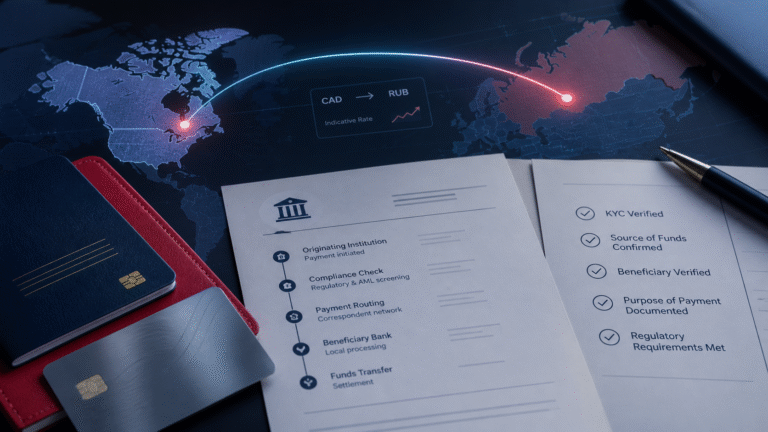
Sending money from Australia to Russia in 2026 may still be possible for a lawful payment, but it is not a normal international transfer. The workable route depends on the sender, recipient, purpose, Russian bank and every institution handling the funds. Confirm Australian sanctions, provider coverage, AUD-to-RUB conversion, documents and return terms before paying.
Need to move Australian dollars to a Russian recipient? Share the amount, payment purpose, funding method and recipient-bank details with NoWALL. We can review currently available operational routes and the records likely to be requested. The regulated institutions handling the payment make the final approval decision. Request a route review.
Start with the result the recipient needs
A transfer search often starts with an Australian bank or app, but the destination should come first. Ask whether the recipient needs rubles in a bank account, credit to a supported card, payment of a Russian invoice, or settlement of a personal obligation. Those outcomes require different details and may use different payment chains.
| Possible route | When it may fit | Confirm before funding | Main risk |
|---|---|---|---|
| International bank transfer | The Australian bank accepts the purpose and can identify a supported path to the beneficiary bank | Currency, correspondent chain, bank charges and recipient instructions | A sender, intermediary or recipient bank may reject the payment |
| Regulated specialist provider | The provider accepts Australian residents and explicitly supports the exact Russian payout | Registration, legal entities, rate, final amount, limits and refund procedure | Availability may change by recipient, amount or payment purpose |
| Supported ruble account or card credit | The service names the Russian bank and delivery method | Account versus card delivery, recipient-name match and settlement currency | A MIR logo or card number alone does not establish a cross-border route |
| Business invoice route | A genuine supplier or contractor payment has a clear commercial basis | Contract, invoice, ownership, goods or services and proof of performance | Commercial payments receive deeper sanctions and trade checks |
| Cash or informal intermediary | Not a sound default for a traceable international payment | Identity, licensing, custody, receipt and legal basis | Fraud, loss, weak records and possible evasion concerns |
Do not disguise Russia as the destination, relabel the purpose or route funds through an unrelated person. A lawful payment needs a coherent audit trail showing the real sender, final recipient, purpose, conversion and delivery method.
Why a standard Australian transfer may fail
Entering beneficiary details successfully does not mean a payment will be executed. Russia is outside Australia’s domestic payment rails, and an international bank transfer may rely on correspondent banks. Each institution can apply legal screening and a narrower internal risk policy.
A payment can therefore fail even when neither individual is sanctioned and the underlying reason is legitimate. The Australian bank may not support the corridor, an intermediary may refuse Russia-linked traffic, the receiving bank may not accept the currency, or the provider may exclude the beneficiary’s account type.
Ask the proposed provider four separate questions: can it accept your Australian funding method; does it serve the named Russian bank; does it permit the real personal or business purpose; and what amount and currency should arrive? Keep the answer and quote in writing where possible.
Check Australian sanctions before choosing a route
Australia maintains autonomous sanctions concerning Russia. The analysis is not simply “Australia to Russia.” The people and companies involved, ownership and control, banks, intermediaries, goods or services, and the direct or indirect benefit of the payment can all matter.
The Australian Government’s Department of Foreign Affairs and Trade explains the Russia sanctions regime. Its Consolidated List is a starting point for designated persons and entities, while the Australian Sanctions Office publishes guidance and permit information.
Search results are not a complete legal assessment. Ownership, control, sector restrictions and the underlying activity may require additional review. If a business payment involves controlled goods, professional services, a listed party or a possible permit, obtain qualified advice before sending.
Verify the provider and the complete payment chain
A professional website or an AUD quote does not prove that a provider is suitable. AUSTRAC maintains the Remittance Sector Register for relevant registered remittance providers. Registration is an important check, but it is not a promise that a particular Russia payment is permitted, supported or risk-free.
Map the chain before transferring:
- Funding: identify the Australian account or card and the amount debited in AUD.
- Processing: identify the regulated provider and any banks handling the funds.
- Conversion: confirm where AUD becomes RUB and which exchange rate applies.
- Delivery: verify the exact Russian bank, account or supported card endpoint.
- Return: learn where rejected funds go, in which currency, and which fees may be retained.
Mainstream brand recognition is not enough. For example, Wise currently lists Russia among places where customers cannot send or receive money in its country availability guidance. Check any other provider’s current corridor rules rather than relying on an old transfer or app screen.
Recipient details and documents to prepare
Ask the recipient for current incoming-payment instructions from the receiving bank. Reusing details from an older transfer is risky because supported currencies, correspondent instructions and bank policies can change.
- recipient’s full legal name, address and date of birth if requested;
- account number, receiving currency and exact bank name;
- bank address, BIC/SWIFT and valid intermediary instructions where applicable;
- card number or domestic bank identifiers only when the selected route requests them;
- a truthful and specific payment purpose;
- sender identity, Australian address and source-of-funds evidence;
- proof of relationship for family support or a personal obligation;
- contract, invoice, counterparty details and performance evidence for business payments.
Names, dates, numbers and purpose wording should match across the payment instruction and supporting documents. The broader document checklist for transfers to Russia explains how to organise the file before a provider asks for it.
Compare the real AUD-to-RUB cost
A “zero fee” label does not show the total cost. An AUD-funded route can include a card or bank charge, provider fee, exchange-rate margin, intermediary deduction and recipient-bank fee. Compare quotes by the rubles expected to reach the recipient, using the same send amount and delivery method.
- AUD amount debited and funding charge;
- AUD/RUB rate, rate source and quote-validity period;
- fixed and percentage provider fees;
- possible intermediary and recipient-bank deductions;
- expected RUB amount and realistic processing window;
- refund timing, refund currency and non-refundable charges.
For a fuller calculation framework, see the guide to the cost of sending money to Russia. If the recipient must receive a precise amount, ask whether the quote is guaranteed only for a limited time and who bears unexpected deductions.
Reduce delays and return risk
Manual review is not automatically a rejection. Respond through the provider’s verified channel, quote the payment reference, and answer questions consistently. Do not submit multiple conflicting transfers while one is under review.
- Confirm the final recipient, amount and real purpose.
- Obtain fresh receiving instructions from the Russian bank.
- Review Australian sanctions and the transaction’s underlying activity.
- Confirm that every disclosed institution supports the route.
- Prepare identity, source-of-funds and purpose-specific evidence.
- Check the delivered amount, timing and written return terms.
- Save the quote, receipts, correspondence and proof of delivery.
If a payment has already failed, use the guide to why transfers to Russia are returned. A small test can reveal operational problems, but it does not approve a larger payment; never split transactions to avoid checks or thresholds.
Frequently asked questions
Can I transfer money from an Australian bank to a Russian bank?
Possibly, but only if the Australian bank, any correspondent banks and the Russian beneficiary bank support the exact currency, recipient and purpose. Ask the bank to confirm the route before submitting an instruction.
Can I send Australian dollars directly to Russia?
Only when the payment chain and beneficiary account can accept AUD. Many routes convert AUD before delivery in rubles. Confirm where conversion occurs, the applied rate and the amount expected to arrive.
Can I send money from Australia to a MIR card?
A MIR card number alone is not an international route. Use a provider only when it explicitly supports the issuing bank and card delivery, or obtain supported account details from the recipient bank.
Is family support from Australia to Russia automatically allowed?
No. A family purpose may be legitimate, but the recipient, ownership, banks, payment chain, source of funds and any applicable restrictions still require review. Providers may also apply narrower policies.
How long does an Australia-to-Russia transfer take?
Timing varies by route, banking days, currency conversion and document review. Treat an estimate as conditional until the provider confirms the specific recipient bank, and plan for extra time if compliance questions arise.
Freshness note: Reviewed on 26 August 2026. Sanctions rules, bank policies, provider coverage and correspondent routes can change. Reconfirm the current position with the institutions handling your payment before sending funds.