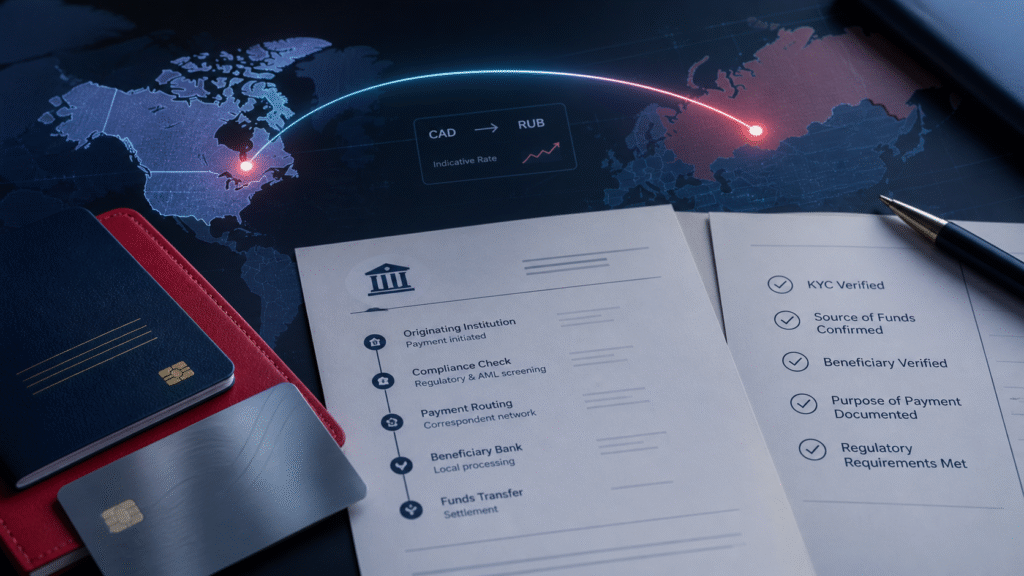
Sending money from Canada to Russia in 2026 may be possible when a regulated provider supports the exact CAD funding method, recipient, purpose and Russian bank. Check Canadian sanctions, every institution in the route, the conversion to rubles, required documents and refund terms before paying. Availability for one customer does not prove your transfer will be accepted.
Need to check a Canada-to-Russia payment route before you fund it? Share the CAD amount, payment purpose, sender profile, recipient bank and preferred delivery method. NoWALL can map the questions to resolve, explain the expected document trail and outline available arrangements. Banks and providers may still request additional evidence or decline a transaction. Check your route with NoWALL.
A transfer can pass through a Canadian bank, a money services business, a currency-conversion partner, one or more correspondents and the recipient’s Russian bank. Each participant applies its own legal and risk controls. That is why a provider accepting Canadian customers does not automatically mean it can deliver money to Russia.
What makes a Canada-to-Russia transfer different?
Canada has sanctions involving designated Russian people, entities and sectors. Canadian financial institutions also have a continuing duty to check whether they control property connected to listed persons. In practice, the sender, recipient, beneficial owners, banks, intermediaries and payment purpose may all be reviewed.
The operational question has four parts: can you fund the route in CAD, can the provider serve this specific Russia corridor, can the named Russian bank receive the payment, and what amount and currency will reach the recipient? Confirm all four before comparing speed claims.
Canada-to-Russia routes to compare
| Possible route | When it may fit | What to confirm | Main risk or limitation |
|---|---|---|---|
| International bank transfer | Your Canadian bank confirms it can reach the named Russian bank for the stated purpose | Currency, correspondent chain, payment wording, charges, trace and return process | A sender bank, correspondent or receiving bank may reject the route |
| Regulated money services business | The provider explicitly supports Canadian onboarding and the exact Russia destination | FINTRAC registration status, legal entity, CAD funding, payout method, delivered amount and refund terms | Registration in Canada is not government endorsement and does not prove Russia coverage |
| Documented local RUB payout | A disclosed provider accepts CAD and arranges a traceable ruble payment in Russia | Entities involved, conversion rate, final payer name, recipient-bank coverage and receipt evidence | Opaque agents or unexplained third parties weaken the audit trail |
| Commercial payment route | You are paying a Russian supplier, freelancer or contractor | Contract, invoice, service or goods category, ownership, tax records and sanctions screening | A consumer family-remittance route may prohibit business use |
| Cash, gift cards or an unrelated person’s account | Not a sound default for a documented transfer | Do not use another person or false purpose to disguise the transaction | Fraud, loss, weak records and compliance concerns |
Mainstream availability must be checked at the destination level. Wise currently lists Russia among places where users cannot send or receive money. Its country availability guidance illustrates why access to a CAD account or Canadian funding method is not the same as a working payout to Russia.
Check the provider and the complete payment chain
If you use a money services business, search its legal or trade name in the FINTRAC Money Services Business Registry. Confirm that the entry is current and that the website and legal entity match. FINTRAC states clearly that registration shows compliance with a registration requirement; it is not a licence, certificate or endorsement.
Then ask the provider route-specific questions:
- Which Canadian legal entity receives the CAD payment?
- Can the transfer be funded from your province and your type of account?
- Which currency is converted, and at what stage?
- Will the recipient receive RUB, another currency or a bank-account credit?
- Which Russian banks and recipient types are supported today?
- Will any correspondent or subcontractor handle the funds?
- What name will appear as payer on the recipient’s statement?
- What happens if screening stops the transfer after funding?
A legitimate provider should be able to explain the route and its records without asking you to hide Russia, alter the purpose or split a payment to avoid checks.
Recipient details and documents checklist
Use recent details obtained directly from the recipient. Verify any last-minute change through a separate channel, especially if the beneficiary name or bank changes. A card number by itself is rarely enough for an international route assessment.
Recipient and bank details
- full legal name exactly as held by the receiving bank;
- date of birth or company registration details when requested;
- residential or registered business address;
- account number and card-linked account details where relevant;
- current bank name, address and BIC/SWIFT if the route uses them;
- receiving currency and any correspondent instructions;
- relationship to the sender and truthful payment purpose;
- recent proof from the bank for new or changed details.
Sender and payment documents
- passport or Canadian identity document accepted by the provider;
- proof of Canadian address and, where relevant, immigration status;
- bank statement showing the source of CAD funds;
- employment, sale, savings or other source-of-funds evidence for larger payments;
- relationship evidence for family support when requested;
- invoice, contract or expense record matching the real purpose;
- a concise explanation consistent across every form and document.
Prepare the file before requesting a quote. The NoWALL guide to documents needed for transfers to Russia provides a broader checklist for personal and commercial payments.
Canadian sanctions and compliance risks
Canada’s Russia measures prohibit dealings in property owned or controlled by designated persons, facilitating those dealings, and providing related financial services. The current Global Affairs Canada Russia sanctions page summarizes the prohibitions, exceptions and recent amendments. The consolidated Special Economic Measures (Russia) Regulations contain the legal text.
This is not a blanket statement that every personal transfer is prohibited or permitted. The exact parties, ownership, banks, intermediaries, purpose, goods or services and sector connections matter. A transaction may be lawful yet still fall outside a bank’s internal risk appetite or a provider’s product rules.
Stop and seek qualified Canadian sanctions advice if a party may be listed or owned or controlled by a listed person, the payment has a restricted sector connection, the structure is unusually complex, or anyone suggests concealing the destination. Never mislabel an invoice as a gift, use an unrelated beneficiary, or route money through another country solely to avoid screening.
Compare CAD costs by the amount delivered
CAD may be converted directly or through an intermediate currency before final RUB settlement. Compare quotes using the same starting amount and record every stage. A low visible fee can be offset by a wider exchange-rate margin, correspondent deductions or a poor refund rate.
- CAD amount debited and funding fee;
- provider and sender-bank charges;
- correspondent and recipient-bank deductions;
- CAD conversion rate and any second conversion;
- exact RUB or other amount expected at destination;
- quote expiry time and estimated delivery window;
- refund currency, timing and non-refundable charges.
Do not apply domestic CAD limits or timing to the Russia leg. A provider’s Canadian funding guide may describe EFT, Interac, card or wire limits, but destination availability and payout rules are separate. Compare the whole route using the NoWALL guide to the cost of sending money to Russia.
A practical pre-transfer workflow
- Define the purpose. Record whether the transfer is family support, reimbursement, salary, contractor work or an invoice.
- Verify the recipient. Match the name, account holder, Russian bank and receiving currency.
- Screen the parties and banks. Check Canadian restrictions, ownership and every disclosed intermediary.
- Verify the provider. Confirm its legal entity and current FINTRAC registration where applicable.
- Confirm the complete route. Obtain written answers about CAD funding, conversion, payout and supported banks.
- Prepare documents. Keep identity, source-of-funds and purpose evidence consistent.
- Compare delivered value. Record total CAD cost, expected receipt, timing and refund terms.
- Save the audit trail. Retain the quote, instructions, payment reference, communications and proof of receipt.
If a payment is stopped, do not immediately resend it through a different person or with a different description. Ask which institution held or returned it, request the trace or return reference and correct the real issue. See the guide to why transfers to Russia are delayed or returned.
Frequently asked questions
Can I send money from a Canadian bank account to Russia?
Possibly, but only if the Canadian bank or provider and every intermediary support the named recipient, Russian bank, currency and purpose. Ask for confirmation of the exact route before funding it.
Can I use Interac e-Transfer to send money directly to Russia?
Interac is primarily a Canadian funding or domestic transfer method. A provider may accept Interac to collect CAD, but that does not make Interac the international payout rail. Confirm the separate conversion and Russia-delivery stages.
Can the recipient receive Canadian dollars in Russia?
It depends on the receiving bank and route. Many arrangements convert CAD before payout, sometimes through another currency. Ask for the supported receipt currency, conversion stages, fees and exact amount the recipient should receive.
Is family support from Canada automatically permitted?
No automatic conclusion applies. The sender, recipient, banks, ownership, amount and purpose still require review under current rules and provider policy. Keep relationship and source-of-funds evidence available.
How long does a Canada-to-Russia transfer take?
Timing depends on Canadian funding, identity and document review, bank cut-offs, intermediaries, conversion and Russian bank processing. Treat any estimate as conditional and ask when a trace or refund can begin.
Freshness note: Reviewed on 26 August 2026. Canadian sanctions, designated-party lists, provider coverage, bank routes and document requirements can change. Confirm the current legal and operational position before every transfer.