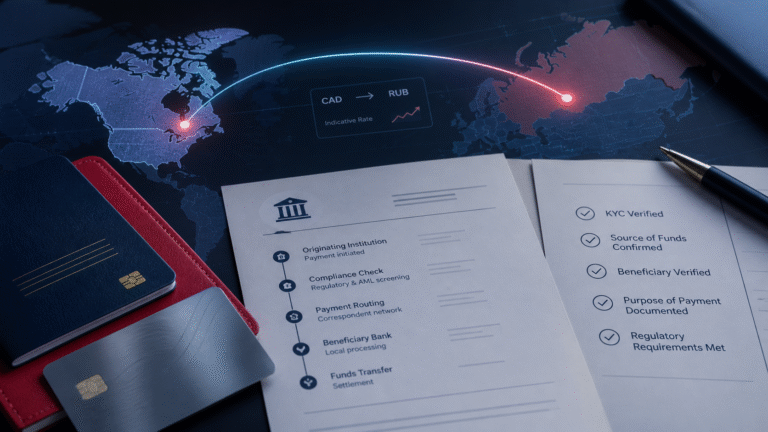
Before sending money to a Russian bank account, check the bank’s exact legal name and BIC against the sanctions rules that apply to you, then confirm that every intermediary and payment provider accepts the route. A bank can be operational in Russia yet unavailable to a particular sender, currency, or correspondent chain. A five-minute name check is useful, but it is not the whole decision.
NoWALL can review the sender country, currency, recipient bank and payment purpose before you commit funds. Share the recipient details without passwords, PINs or card security codes, and ask which route is currently available. Request a transfer check.
Why the recipient bank check matters
“Can this bank receive money?” sounds like a yes-or-no question. In practice, there are at least four separate checks: whether the sender may deal with the bank, whether the payment provider supports Russia, whether correspondent banks will carry the chosen currency, and whether the recipient account can accept the final credit.
These checks can produce different answers. A Russian bank may process domestic ruble payments while being blocked by a US, EU or UK institution. A provider may refuse all Russia-linked transfers even when the underlying payment is not prohibited. An intermediary may also return a payment because the recipient name, purpose or account details are incomplete.
This guide is a practical screening workflow, not legal advice. Sanctions depend on the sender’s location, nationality, business presence, payment purpose and the parties involved. If a possible match appears, pause and obtain guidance from your bank, provider or sanctions adviser.
What to collect before checking a Russian bank
Ask the recipient for bank details copied from their banking app or an official account-details document. Do not rely on a shortened brand name in a message.
- Recipient’s full legal name exactly as shown on the account
- Recipient type: individual, sole proprietor or company
- Full legal name of the recipient bank in Russian and, if available, English
- Russian BIC (БИК), normally nine digits
- Account number and any required correspondent account
- Bank city, branch or address if the provider requests it
- Currency the recipient account accepts
- Payment purpose, such as family support, invoice number or contractor services
- Contract, invoice or proof of relationship where relevant
A card number alone is not enough for sanctions screening. MIR identifies a payment-card system, not the legal identity or international availability of the issuing bank. If the recipient wants a card credit, first identify the issuing bank and read our guide to sending money to a MIR card from abroad.
A practical bank-check workflow
1. Confirm the bank’s identity
Match the name and BIC, not just the logo. Banks may use abbreviations, translated names, former names or related entities. The Bank of Russia publishes information on credit institutions and payment-system identifiers; use the BIC supplied by the recipient to resolve the exact institution. If the name on an invoice differs from the BIC result, ask for corrected details before proceeding.
2. Check the sanctions list for your jurisdiction
Use the official list that applies to the sender or payer. US persons and payments touching the US financial system should use the OFAC Sanctions List Search. EU operators should consult the EU Sanctions Map and applicable EU regulations. UK persons and businesses can use the UK Sanctions List search.
Search the full legal name, alternative spellings and known aliases. A clean name search is not conclusive: restrictions may extend to an entity owned or controlled by a designated person. OFAC’s 50 Percent Rule guidance explains why an entity may be blocked even when it is not separately named. UK guidance likewise warns that prohibitions can apply to unlisted entities owned or controlled by a designated person.
3. Check sectoral and transaction-specific restrictions
Not every restriction is a full asset freeze. Some rules limit particular securities, loans, payment services, currencies, exports or services. The result can depend on what you are paying for, not only who receives it. A family-support transfer and a payment for controlled goods should never be treated as the same risk.
If you are paying a business invoice, check the supplier, beneficial owners, goods or services, end use and payment purpose. Use the document checklist in our guide to paying an invoice to Russia.
4. Ask the sending provider about the exact route
Give the provider the recipient bank’s legal name, BIC, currency and payment purpose. Ask whether the provider supports that bank today and whether an intermediary bank is involved. Do this before funding the transfer.
Provider policy can be stricter than the law. Wise lists Russia among the countries where customers cannot send or receive money. A sanctions-list search therefore cannot prove that a specific commercial service will accept the payment.
5. Confirm receipt conditions with the recipient bank
The recipient should ask their bank whether the account accepts the proposed currency and transfer type, what reference must appear, and whether conversion to rubles is automatic. For a business payment, confirm whether the bank needs a contract, invoice, act of services or transaction code.
6. Recheck immediately before payment
Sanctions lists and provider routes change. Save the date, source and result of each check, then screen again on the day of payment. Do not reuse a months-old answer for a new transfer.
Which route checks are needed?
| Possible route | What to verify first | Main limitation |
|---|---|---|
| Direct international bank transfer | Recipient bank, SWIFT/correspondent availability, currency and payment purpose | A listed or unsupported intermediary can stop the payment |
| Specialist transfer service | Supported sender country, recipient bank, limits, identity checks and final payout method | Coverage can change faster than published sanctions lists |
| Ruble payout to bank account or card | Issuing bank, BIC, recipient name match and domestic receipt conditions | A card number does not identify the full compliance route |
| Business invoice payment | All parties, beneficial ownership, contract, invoice, goods/services and purpose code | Commercial payments usually face deeper document review |
For the broader route picture, see how to send money to Russia in 2026. If an earlier transfer failed, the troubleshooting guide explains why transfers are delayed, rejected or returned.
Red flags that mean you should stop
- The bank name and BIC point to different institutions.
- The recipient asks you to describe the payment inaccurately.
- A third party with no clear connection to the recipient is introduced at the last minute.
- The provider asks you to split one payment to avoid a limit or review.
- The bank or an owner produces a possible sanctions match that you cannot resolve.
- The invoice, contract and beneficiary names do not agree.
- No one can explain which entity will deliver the rubles to the recipient.
Do not try to conceal a Russia connection, rename the purpose or route funds through unrelated people. Accurate information protects both sender and recipient and gives compliance teams a chance to assess the real transaction.
Common mistakes in sanctions-list searches
The most common mistake is searching one English spelling and treating “no result” as approval. Transliteration varies, corporate suffixes are often omitted, and ownership rules may capture an unlisted company. Another mistake is checking only the recipient bank while ignoring the recipient, supplier, beneficial owners and intermediaries.
Do not confuse legal permissibility with operational availability. An official list answers whether a party is designated under that regime; it does not promise that a bank or transfer service will process the payment. The provider still applies its own risk rules, supported-country policy and correspondent-bank requirements.
What to do if the bank cannot be used
Ask the recipient whether they have another account in their own name at a bank that your provider supports. Repeat the complete check for the alternative bank and keep the payment purpose unchanged. For a company, amend the invoice or bank-details letter so the beneficiary data matches the new account.
If you need a specialist route, provide NoWALL with the sender country, amount, currency, recipient type, bank name, BIC and honest purpose. Availability depends on compliance review and current banking access; no route or delivery time can be guaranteed.
Frequently asked questions
Does a bank missing from a sanctions list mean it is safe to use?
No. The bank may be restricted through ownership or sectoral rules, unsupported by the provider, or unreachable through the necessary correspondent chain. A list search is one part of the check.
Can I check a Russian bank using only a card number?
Not reliably. Ask for the issuing bank’s full legal name and BIC. The card scheme or first digits may help identify an issuer, but they do not confirm the account, route or current acceptance.
Should I check the recipient as well as the bank?
Yes. Screen the recipient and, for business payments, relevant owners and counterparties. Banks and providers may also request supporting documents to resolve similar-name matches.
Why can a provider refuse a payment that appears legal?
Providers can set narrower risk policies, exclude countries or banks, and depend on intermediaries with their own rules. A refusal does not by itself mean the underlying transaction is prohibited.
How often should I repeat the check?
Repeat it immediately before every payment. Recheck sooner if the bank details, recipient, amount, currency, purpose or route changes.
Freshness note: checked on 20 July 2026. Sanctions designations, ownership information and provider coverage can change without notice. Reconfirm all parties and the complete route before sending.