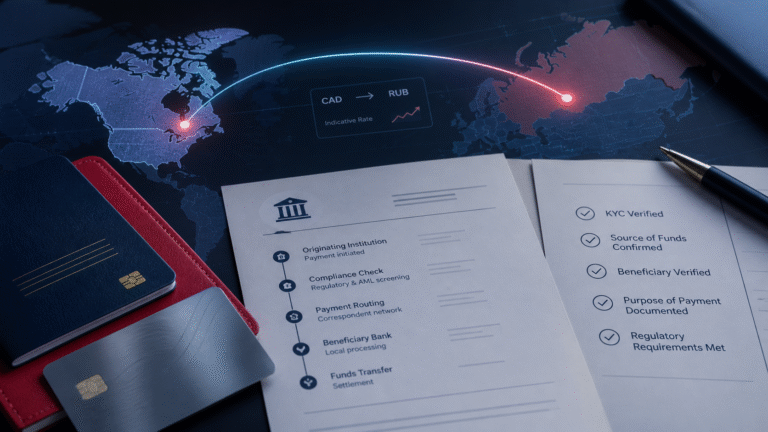
Yes, a SWIFT transfer to Russia may still be possible in 2026, but only through a supported bank chain. SWIFT access alone does not make a payment available or lawful. The sender’s bank, every correspondent bank, the Russian recipient bank, the parties and the payment purpose must all pass current sanctions, compliance and internal risk checks.
Check the full route before sending. NoWALL can review the sending country, currency, amount, purpose and Russian beneficiary details, then explain an available payment arrangement and the information likely to be requested. Availability, timing and final acceptance remain subject to provider and bank checks.
The common statement that “Russia was removed from SWIFT” is too broad. Designated Russian banks have been disconnected, and other institutions face transaction bans or limited correspondent access. Yet SWIFT is a messaging network, not a guarantee that money can move. A payment succeeds only when the complete banking path is both legally permitted and operational.
Can you send a SWIFT transfer to Russia now?
Sometimes. The practical answer depends on four institutions: the originating bank, any intermediary or correspondent bank, the beneficiary bank in Russia and, where relevant, the bank that performs currency conversion. A refusal by any one of them can stop or return the transfer.
SWIFT explains that it disconnected entities designated under EU rules. This does not mean that every Russian bank is connected or disconnected in the same way. It also does not oblige an overseas bank to accept Russia-bound instructions. Banks may apply policies that are stricter than the legal minimum.
| Route | When it may be considered | Main limitation |
|---|---|---|
| Direct international bank transfer | The sender and recipient banks confirm the currency, purpose and beneficiary | A correspondent may still be required and may decline the payment |
| Transfer using an intermediary bank | The recipient bank provides current, currency-specific routing instructions | Extra screening, fees, deductions and return points |
| Specialist arranged payment route | An ordinary bank does not support the corridor but the underlying payment is permitted | Must be documented and confirmed for the exact sender, recipient and purpose |
| Card or local RUB receipt | The recipient needs rubles rather than foreign currency in a Russian account | Not a SWIFT transfer; availability depends on the provider and recipient bank |
What SWIFT does—and what it does not do
SWIFT carries standardised financial messages between institutions. In a typical international wire, the message identifies the payer, beneficiary, banks, amount, currency and payment reference. Settlement may happen through accounts that banks hold with each other. When the originating and receiving banks lack a direct relationship, one or more correspondents can sit between them.
A valid BIC therefore answers only one question: the institution has or had an identifier in the network. It does not prove that the bank can receive your currency, that a correspondent will carry the payment, or that your own bank permits the destination. An online form accepting a BIC is not route confirmation.
SWIFT is also separate from sanctions screening. The European Commission summarises restrictions affecting Russia’s financial sector and maintains detailed implementation guidance. A transfer can fail even when neither endpoint is listed because an intermediary, beneficial owner, underlying activity or bank policy creates a problem.
How to verify a proposed bank route
1. Ask the Russian bank for incoming-transfer instructions
The recipient should request instructions for the exact incoming currency and payment type. Do not reuse details from an old transfer. Correspondent relationships can change, and a bank may accept one currency but not another. The instructions should name the beneficiary bank, BIC, account number and any required intermediary.
2. Confirm the route with the sender’s bank
Give the originating bank the complete details before funding. Ask whether it currently supports the Russian beneficiary bank, payment purpose, sender type and chosen currency. If customer service gives only a general answer, request review by the international-payments or compliance team.
3. Identify the correspondent path
Some banks will not disclose every internal routing choice in advance, but they should be able to say whether they have a supported route. If the recipient bank supplied a named intermediary, verify that your bank can use it. Never invent or substitute an intermediary just to make the form proceed.
4. Agree on fees and the final currency
International wires can carry an originating fee, correspondent deductions, receiving fee and conversion spread. Ask whether charges are set as OUR, SHA or BEN and whether those instructions are honoured throughout the path. If the recipient needs rubles, compare the expected RUB credit rather than the headline transfer fee.
For a fuller comparison, read how fees and FX affect the cost of sending money to Russia.
Recipient details and documents to prepare
Accurate information reduces avoidable follow-up, although it cannot guarantee acceptance. Prepare:
- recipient’s full legal name exactly as held by the bank;
- beneficiary address and, if requested, date of birth or registration details;
- beneficiary account number and account currency;
- recipient bank’s legal name, address and BIC/SWIFT code;
- current correspondent-bank instructions for the selected currency;
- a clear, truthful payment purpose;
- invoice, contract, salary record, gift explanation or proof of relationship, as applicable;
- source-of-funds evidence, especially for a large or unusual payment;
- sender identification, address and tax details if requested.
Names, amounts and purpose should agree across the transfer form and supporting evidence. A vague reference such as “services” may be insufficient for a commercial wire. A concise description that matches the contract and invoice is easier to assess. See the complete document checklist for transfers to Russia.
Compliance and sanctions checks
Do not treat a non-sanctioned recipient bank as the whole compliance test. Screening normally covers the sender, recipient, beneficial owners, all financial institutions, payment purpose, related countries and the underlying goods or services.
For US-connected transfers, OFAC FAQ 1202 states that personal, non-commercial remittances are generally not the target of US sanctions, provided the transfer does not involve blocked persons or another prohibition. That is useful context, not blanket permission for every bank or transaction.
For EU-connected payments, use the European Commission’s current Russia sanctions FAQs and its specific guidance on payment services. Rules, exemptions and authorisation mechanisms are jurisdiction-specific. A bank may request legal analysis for a business payment even when the invoice looks routine.
Stop if a proposed route requires a false payment description, an unrelated third-party account, hidden beneficial ownership or payment splitting intended to avoid controls. Those are not harmless shortcuts. They create legal, fraud and recovery risks.
Why a SWIFT payment can be delayed or returned
A transfer may pause while a bank asks for the source of funds, the relationship between the parties or the economic purpose. Transliteration differences, incomplete addresses and inconsistent invoice wording can also trigger manual review. A correspondent may reject the payment even after the sender’s bank debits the account.
Returned funds can arrive days or weeks later and may be reduced by fees. Currency conversion can create an additional loss if the money is converted on the way out or back. Do not send a duplicate while the first payment is unresolved. Ask the originating bank for the payment reference and, if available, a copy or trace of the relevant SWIFT message.
Our troubleshooting guide explains why transfers to Russia are delayed or returned and what evidence to collect.
When another receipt method may be more practical
A bank wire can make sense for a documented invoice, salary or larger transfer when both banks confirm the path. For family support or a recipient who only needs rubles, a compliant arranged route may be clearer and less exposed to correspondent deductions. The right comparison is the delivered amount, required evidence, expected timing and return procedure.
If the recipient shares only a card number, do not put it into an international wire form. Check whether receipt should be to a bank account or through a supported local card arrangement. The guide to Russian bank-account versus card receipt explains the difference.
A practical pre-payment checklist
- Define the real payment. Record the sender, beneficiary, purpose, currency and supporting document.
- Screen the parties and banks. Include beneficial owners and any named intermediary.
- Get current recipient instructions. Use details issued for the exact currency and incoming route.
- Obtain route confirmation. Ask the sender’s bank or specialist to review the complete chain.
- Compare the final receipt. Include fees, deductions, conversion and likely timing.
- Keep a payment file. Save the quote, instructions, evidence, reference and correspondence.
For a wider view of available methods, start with the 2026 guide to sending money to Russia.
Frequently asked questions
Is Russia completely disconnected from SWIFT?
No. Designated Russian institutions have been disconnected or restricted, but the position is not identical for every bank. A bank’s network identifier does not prove that it has an operational correspondent route for your transaction.
Does a Russian bank having a SWIFT code mean I can send to it?
No. A BIC identifies an institution; it does not confirm support from the sender’s bank, available correspondents, currency acceptance or compliance approval.
How long does a SWIFT transfer to Russia take?
A supported transfer may take several business days, but manual review can extend that period. Timing depends on cut-off times, correspondents, document requests and the recipient bank. No provider can responsibly guarantee a universal delivery time.
Can I send USD or EUR to a Russian account?
Sometimes, if the account and full correspondent route support that currency. Confirm the exact instructions first. The recipient may face conversion or withdrawal limits, and another currency may produce a different route.
Is a personal SWIFT transfer to Russia legal?
It can be, but legality depends on the jurisdictions, parties, banks and purpose. Personal remittances are not automatically exempt from every restriction, and banks may decline lawful transactions under their own policies.
What should I do if the transfer is stuck?
Ask the originating bank for the current status, payment reference, any information request and, where available, a SWIFT trace. Do not send a duplicate until the first instruction is credited, cancelled or returned.
Freshness note: checked on 31 July 2026 against current SWIFT, EU Council, European Commission and OFAC information. Sanctions, bank policies and correspondent routes can change; confirm the complete path immediately before sending.