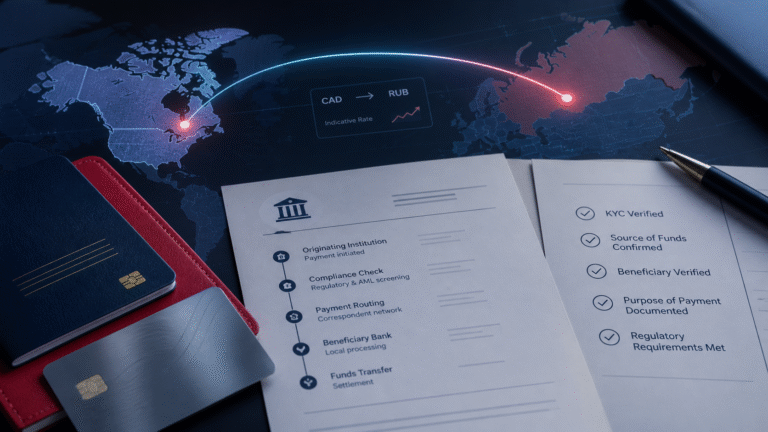
No, you cannot send a SEPA transfer directly to a bank account in Russia because Russia is outside the Single Euro Payments Area. A Russian bank may still receive euros through a separate international correspondent-bank route, but only when every bank in the chain supports the payment and the sender, recipient, purpose and institutions pass current compliance checks.
Need to check a real payment? NoWALL can review the sending country, currency, recipient bank and payment purpose before you fund a transfer. The route is confirmed case by case; availability, timing and final acceptance depend on the banks and compliance review.
The distinction matters. “SEPA” is not another name for every euro-denominated bank transfer. It is a set of payment schemes used by participating institutions within a defined geographical area. If the beneficiary account is at a Russian bank, entering a Russian account number or bank code into a SEPA form will not turn the payment into a SEPA Credit Transfer.
SEPA to Russia: the practical answer
The European Central Bank’s current SEPA overview and country list define where the schemes operate. SEPA covers EU countries and a number of participating non-EU countries, but Russia is not in that geographical area.
This means a euro payment to Russia, if a bank is prepared and legally able to process it, follows a cross-border international route rather than the ordinary SEPA rail. It may involve the sender’s bank, one or more correspondent banks, and the recipient bank. Each institution can screen, delay, reject or return the payment.
| Route | Can it reach Russia? | What the sender should expect |
|---|---|---|
| SEPA Credit Transfer | No, not to a Russian bank | The beneficiary bank must participate in the SEPA scheme; Russian banks do not. |
| SEPA Instant | No, not to a Russian bank | The same geographical limitation applies, even though eligible SEPA payments can settle quickly. |
| International EUR bank transfer | Sometimes, route dependent | Requires a supported recipient bank, correspondent path, accurate purpose and successful screening. |
| Specialist arranged payment route | Case by case | The provider should confirm the route, recipient format, expected conversion and documents before funding. |
Why a euro transfer is not automatically a SEPA transfer
Currency and payment scheme are separate questions. A transfer can be denominated in euros without being a SEPA payment. SEPA standardises euro credit transfers and direct debits among participating payment service providers. An international EUR payment outside that area normally uses correspondent banking arrangements and different pricing, data fields and processing times.
This is why a bank app may show two choices: “SEPA transfer” and “international transfer.” Selecting the international option does not guarantee that Russia is supported. It only opens the workflow in which the bank can ask for a BIC/SWIFT code, intermediary-bank information, a detailed payment purpose and supporting documents.
Do not substitute a nearby-country IBAN or an unrelated beneficiary merely to make a form accept the transfer. The account holder, economic beneficiary and stated purpose need to match the real transaction. Inconsistent details are a common reason for enhanced review or a returned payment.
What can work instead of SEPA?
1. An international bank transfer confirmed in advance
Some non-restricted banks may retain specific correspondent channels for certain currencies and payment types. Availability can differ between personal support, payment for services, salary, invoice settlement and movement between your own accounts. It can also change without much notice.
Before sending, ask the originating bank to confirm all of the following in writing where possible:
- it accepts the Russian destination and the exact recipient bank;
- it supports the payment purpose and sender type;
- it has a correspondent route for the chosen currency;
- it does not require an intermediary-bank field that you do not have;
- it can explain likely sender, correspondent and recipient fees.
A “payment submitted” screen confirms only that your bank accepted the instruction. It does not prove that the correspondent or recipient bank will credit the beneficiary.
2. A route that settles to the recipient in rubles
For family support or other permitted personal payments, a specialist service may collect funds in the sender’s available currency and arrange compliant local receipt in rubles. The important questions are not only the headline fee, but also the quoted exchange rate, recipient bank, documentation, settlement method and what happens if the payment cannot be completed.
If the recipient only has a card, read our guide to sending to a Russian bank account versus a card. A card number is not a substitute for bank details on an international transfer form.
3. A case-specific route check
A route check is useful when an ordinary provider does not list Russia, the bank cannot give a clear answer, or the payment has a commercial purpose. It should happen before money is sent. No legitimate provider can promise that every recipient, bank, purpose or amount will be accepted.
Readers sending from the EU can also use the broader guide to sending money from Europe to Russia to compare practical route types.
Recipient details and documents to prepare
Gather the information below before asking a bank or payment specialist for a quote. Complete data helps the provider determine whether a route exists and reduces avoidable follow-up.
- recipient’s full legal name exactly as held by the bank;
- recipient’s address and, if requested, date of birth;
- Russian bank name, address and BIC;
- beneficiary account number and currency of that account;
- correspondent or intermediary details supplied by the recipient bank, if applicable;
- clear payment purpose in plain language;
- invoice, contract, salary record, gift explanation or proof of relationship, as relevant;
- source-of-funds evidence, especially for larger or unusual payments;
- sender identification and current address evidence.
For a fuller preparation list, see documents needed to send money to Russia. Business senders should also make sure the invoice, contract, parties and goods or services all describe the same transaction.
Compliance checks that matter in 2026
Russia’s exclusion from SEPA is a scheme-membership issue. Sanctions and bank risk policies are separate layers. A payment may be outside SEPA yet still lawful; it may also be prohibited or unsupported because of the parties, banks, goods, services, location or applicable jurisdiction.
EU rules change and contain targeted restrictions, exemptions and authorisation mechanisms. The European Commission maintains consolidated Russia sanctions FAQs and a specific payment-services FAQ. These are useful starting points, but they do not replace advice for a particular transaction.
At minimum, the provider or bank should screen:
- the sender, recipient and any beneficial owner;
- the originating, correspondent and beneficiary banks;
- the real purpose of the payment;
- the underlying goods or services for a commercial transfer;
- the locations connected to the transaction;
- whether a licence, exemption or supporting evidence is required.
Provider availability is another constraint. For example, Wise states that customers cannot send or receive money to or from Russia through its service. A provider’s own restriction can be narrower than the law, and a bank can decline a payment that is not expressly prohibited.
Never describe a payment as something else to avoid a review. Avoid third-party accounts whose connection to the transaction cannot be documented. If a proposed route depends on hiding the beneficiary, changing the purpose or splitting a payment to escape controls, do not use it.
Fees, conversion and timing
A cross-border EUR payment to Russia can cost more than a domestic or SEPA transfer because several institutions may deduct charges. Ask whether fees are charged to the sender, shared, or deducted from the beneficiary amount. Even when the sender chooses to cover fees, an intermediary deduction may still affect the credited sum.
If the recipient account is in rubles, compare the final ruble amount—not only the transfer fee. The exchange rate and receiving-bank conversion can matter more than a low advertised fee. Our guide to the cost of sending money to Russia explains how to compare the total result.
Timing is also less predictable than SEPA. A supported route may take several business days, while additional questions can extend processing. Weekends, bank cut-off times, correspondent review and incomplete documents all matter. If a transfer stalls, use the guide to why transfers to Russia are delayed or returned before sending a duplicate payment.
A safer pre-payment sequence
- Identify the real transaction. Record who pays whom, why, in which currency and under which document.
- Check the recipient bank. Confirm its current details and whether it can receive the proposed currency and route.
- Ask for route confirmation. Do not rely on an app merely accepting the beneficiary form.
- Compare the delivered amount. Include the exchange rate and all known fees.
- Prepare evidence before funding. Keep names, purpose, invoice or relationship evidence consistent.
- Save the payment record. Retain the receipt, reference, correspondence and any SWIFT message supplied by the bank.
Frequently asked questions
Is Russia in SEPA?
No. Russia is not within the geographical scope of the SEPA payment schemes, so a transfer to an account at a Russian bank cannot be processed as a SEPA Credit Transfer or SEPA Instant payment.
Can I send euros to a Russian bank account?
Sometimes, but that would be an international EUR transfer rather than SEPA. The sender’s bank, any correspondent bank and the recipient bank must support the route, and the transaction must pass applicable legal and compliance checks.
Can I use a Russian card number for a SEPA payment?
No. SEPA credit transfers use eligible beneficiary bank accounts at participating institutions. A Russian card number does not make the account SEPA-accessible and should not be entered in place of valid bank details.
Why does my bank app reject the Russian beneficiary?
The app may restrict the destination, reject a non-SEPA account in the SEPA form, lack a correspondent route, or require manual compliance review. Ask the bank whether an international transfer workflow exists for that exact recipient bank and purpose.
Is a non-SEPA transfer to Russia legal?
“Non-SEPA” does not by itself mean illegal. Legality depends on the sender’s jurisdiction, the parties, banks, payment purpose and underlying activity. Banks may also apply their own risk policies and decline transactions they are not legally required to process.
What should I do before sending?
Confirm the beneficiary bank, currency, route, payment purpose, documents, fees and return procedure. For a case-specific option, ask NoWALL to review these details before you transfer funds.
Freshness note: checked on 30 July 2026 against current European Payments Council, European Central Bank, European Commission and provider information. Payment availability and restrictions can change; confirm the exact route immediately before sending.