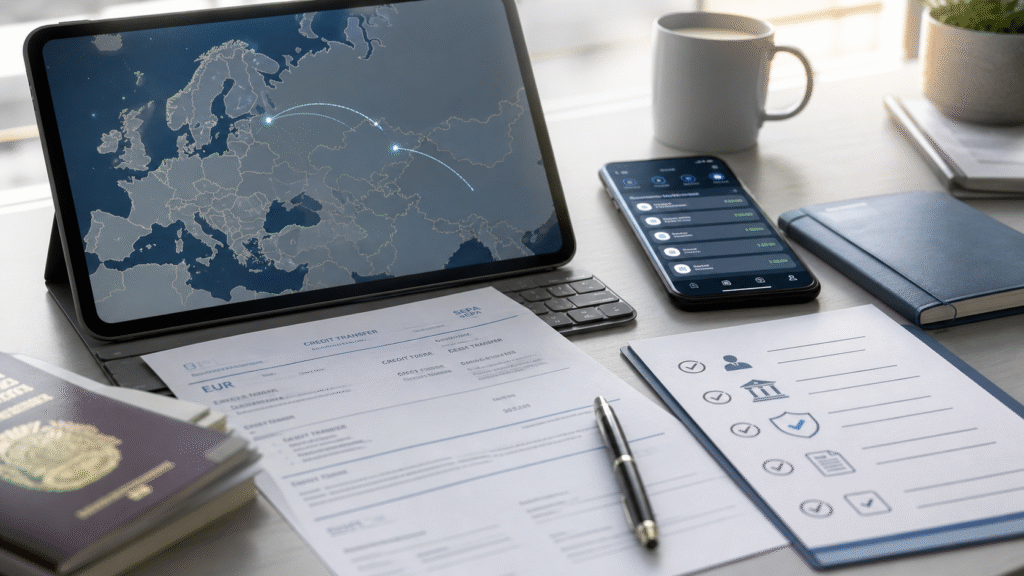
Last updated: July 9, 2026. Sending money from Europe to Russia is still possible in some cases, but it is no longer a routine EUR transfer. Before you send money, check the sender country, purpose of payment, recipient bank, sanctions exposure, provider restrictions, currency path, and what the recipient can actually receive in Russia.
For most EU-based senders, the safest first step is not choosing an app. It is confirming whether the exact route can be handled before money leaves your account.
Need to check a Europe-to-Russia payment route?
NoWALL helps private clients and businesses review practical payment routes to Russia, including recipient details, bank acceptance, ruble receipt options, invoice context, and compliance questions. The check cannot make every bank or provider approve a payment, but it helps you avoid sending money into an obviously blocked, unsupported, or high-return path.
Contact NoWALL before you send funds if the payment is urgent, business-related, or involves a Russian bank card or invoice.
What changed for Europe-to-Russia transfers?
Before 2022, many European senders could use ordinary bank transfers, card payments, or global money transfer providers with limited preparation. In 2026, the route is more fragmented. EU sanctions, bank risk controls, provider exits, correspondent-bank screening, and Russian-side acceptance rules all affect whether a payment can move.
This does not mean every personal payment to Russia is prohibited. It does mean that a transfer cannot be judged only by the sender’s bank balance or by whether an app lets you start a transaction. A route can fail later if the receiving bank is restricted, the payment purpose is unclear, the provider no longer supports Russia, or intermediary banks refuse the flow.
For EU residents, the main question is practical and legal at the same time: can this exact sender, recipient, bank, purpose, and currency path be processed without creating a sanctions or bank-compliance problem?
Europe-to-Russia transfer options in 2026
The options below are not universal recommendations. They are the route categories people usually ask about when they need to support family, pay a Russian recipient, settle a private obligation, or handle a business invoice.
| Route | When it may fit | Main checks before sending | Common failure point |
|---|---|---|---|
| Specialist route check and assisted payment | Personal support, urgent payments, card or ruble receipt, business invoices | Sender country, recipient bank/card, payment purpose, documents, timing, fees | Recipient bank or compliance mismatch discovered too late |
| Bank transfer from an EU bank | Clear, documented payments where both banks can process the flow | Sanctions screening, bank policy, correspondent path, beneficiary details | Return, delay, or manual compliance review |
| Money transfer or fintech provider | Only if the provider explicitly supports the relevant Russia route | Current country support, account restrictions, card restrictions, payout method | Provider no longer supports Russia-related flows |
| EUR-to-ruble conversion path | Recipient needs rubles rather than foreign currency | Rate, commission, payout bank or card, proof of source and purpose | Hidden FX cost or unsupported receipt method |
| Business invoice payment | Supplier, contractor, agency, or service invoice connected to Russia | Contract, invoice, goods/services, counterparty screening, tax and bank documents | Insufficient purpose-of-payment evidence or restricted counterparty risk |
Start with the country, not just «Europe»
Searches often say «from Europe to Russia», but banks do not process payments from a generic Europe. A sender in Germany, France, Italy, Spain, Poland, the Netherlands, or another EU country may face the same EU-level sanctions framework, yet local bank policy and account-level risk checks can differ.
If you are sending from Germany, start with the dedicated Germany to Russia guide. If you are sending from the UK, use the UK to Russia guide, because the UK is not under the EU framework and has its own sanctions regime. If the sender is in the United States, the USA to Russia guide is a better match than this Europe overview.
For other EU countries, use the same logic: identify the sender country, sender bank, recipient bank, recipient card or account type, payment purpose, and required currency before comparing providers.
Why ordinary providers may not work
Many mainstream international transfer brands reduced or stopped Russia-related services after 2022. Fintech apps can also restrict customers based in Russia, Russian-issued cards, or certain Russia-connected flows. Wise, for example, publishes a Russia restrictions page that should be checked before assuming a Wise balance, card, or transfer route will work for a Russian recipient.
The practical risk is that the user interface may not explain every downstream problem. A payment can be blocked at onboarding, card level, transfer creation, intermediary bank screening, recipient-bank acceptance, or manual compliance review. For a deeper provider-specific explanation, read Does Wise Work in Russia in 2026?.
Documents and recipient details to prepare
A clean transfer file reduces delay risk. It does not guarantee success, but it gives banks, providers, or a specialist route checker the information needed to reject unsuitable paths before money moves.
For personal transfers
- Sender full name, country of residence, and account country.
- Recipient full name in Latin and Cyrillic if available.
- Recipient bank name, account or card details, and whether a MIR card is involved.
- Purpose of payment, such as family support, personal repayment, rent, education, or medical costs.
- Amount, currency to send, and currency the recipient needs to receive.
- Evidence of relationship or purpose if the payment is likely to be reviewed.
For business payments
- Invoice, contract, act of services, or other commercial document.
- Counterparty legal name, registration details, and bank details.
- Description of goods or services, including whether they are restricted or sensitive.
- Sanctions screening of the recipient, bank, owners, and payment purpose.
- Tax, accounting, and reporting requirements in the sender country.
If the payment is connected to a company, contractor, supplier, software subscription, logistics, dual-use goods, or a public-sector counterparty, do not treat it like a family transfer. Business payments need a stricter review.
Compliance checks that matter for EU senders
EU sanctions are not a simple yes-or-no list for every private payment. The European Commission publishes guidance on sanctions against Russia, including payment-services questions under Council Regulation (EU) No 833/2014. The EU framework can affect payment services, restricted banks, specific people and entities, goods, services, and economic sectors.
For a Europe-to-Russia payment, check at least four layers:
- Recipient screening. Is the recipient, company, owner, or connected party subject to sanctions?
- Bank screening. Is the Russian recipient bank restricted, disconnected from a needed network, or rejected by the sender’s bank?
- Purpose screening. Is the payment for personal support, a private obligation, salary, services, goods, software, transport, or something regulated?
- Route screening. Can every bank, provider, card, and conversion step in the chain process the payment?
For US-linked senders or payments touching US persons, US sanctions rules can also matter. OFAC guidance should be checked separately where a US person, US bank, US dollar correspondent bank, or US-regulated provider is involved. That is why a payment from an EU account can still need more than EU-only thinking.
How recipients can receive money in Russia
The recipient’s preferred method often decides the route. Some recipients need rubles in a Russian bank account. Others ask for a card top-up, a MIR card receipt, or a cash-equivalent arrangement. Each method has different constraints.
Before promising the recipient a delivery method, confirm:
- whether the recipient bank or card can receive funds from the selected route;
- whether the recipient needs rubles, euros, dollars, or another currency;
- who pays conversion and intermediary fees;
- what proof the sender and recipient may need if the bank asks questions;
- what happens if the transfer is returned after several business days.
If the recipient specifically asks for a Russian bank card or MIR card, do not assume a normal European card transfer will work. Treat that as a separate route-check question.
Fees, exchange rate and timing
The cheapest-looking route is not always the best route. A payment can show a low upfront fee but lose value through FX spread, intermediary deductions, return fees, or a poor ruble conversion rate. It can also cost more if a failed transfer takes days to come back while the recipient still needs funds.
Ask three questions before choosing:
- How much will the sender pay in total, including bank, provider, intermediary, and FX costs?
- How much should the recipient receive, in which currency, and through which bank or card?
- What is the fallback if the route is delayed, rejected, or returned?
For urgent transfers, speed should be balanced against traceability and compliance. A route that cannot explain its bank path, recipient details, fees, or document requirements may create more risk than it solves.
When to use NoWALL before sending
Use a route check before sending if any of these apply:
- the payment is above a small personal-support amount;
- the recipient bank or card is unfamiliar;
- the sender has already had a transfer returned;
- the payment is for an invoice, contractor, salary, or supplier;
- the recipient needs rubles or a Russian card receipt;
- the sender is unsure whether EU, UK, US, or other sanctions rules apply.
NoWALL can help review the practical route and explain what information is needed before you move funds. It is still important to follow the rules that apply to your own country, bank, tax position, and payment purpose.
FAQ
Can I still send money from Europe to Russia in 2026?
In some cases, yes, but it depends on the sender country, recipient, bank, purpose, route, and sanctions exposure. Do not assume a normal EUR transfer or money transfer app will work without checking the details first.
Is it legal to send money to Russia from the EU?
It is not automatically illegal, but EU sanctions can restrict specific banks, people, entities, goods, services, and payment-service activity. For the legal framework, read the dedicated guide: Is It Legal to Send Money to Russia in 2026?.
Does Wise work for Europe-to-Russia transfers?
Wise should not be treated as a reliable Russia transfer route unless its current official restrictions clearly support your exact use case. Check the provider’s restrictions and the recipient method before relying on it.
Can I send euros directly to a Russian bank account?
Sometimes this may be possible through specific banking paths, but many transfers face compliance review, correspondent-bank issues, or Russian bank restrictions. Confirm the recipient bank and route before sending.
What is the safest way to send money to Russia?
The safer approach is to screen the recipient, bank, purpose, documents, currency path, fees, and fallback plan before sending. Any route should still be treated as conditional on bank and compliance review.
Freshness note
This article was reviewed on July 9, 2026. Russia-related payment rules, provider restrictions, bank policies, and sanctions guidance can change quickly. Check the official sources and the exact route before sending money.