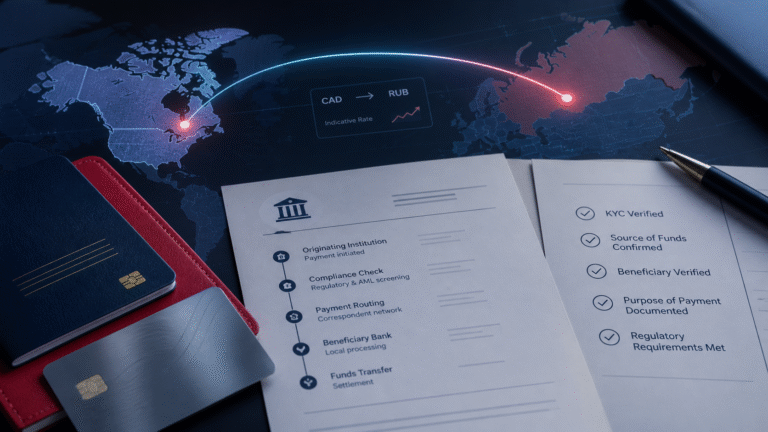
You can still send family support money to Russia in some cases, but the route must be checked before every transfer. A personal payment to a parent, child or other relative is different from salary or a business invoice. Confirm the recipient, Russian bank, sending country, payment purpose, fees and final ruble amount before you fund it.
Check a family-support route before you send
Tell NoWALL where the money starts, the currency and amount, who will receive it, the Russian bank or card, and whether this is a one-off gift or regular support. We can help you identify the details and documents needed for a compliant route check.
Family support is often time-sensitive: it may cover rent, medicine, groceries or help for an elderly parent. That urgency can make the first available payment link look attractive. A safer approach is to separate three questions: is the payment lawful, does the provider support the exact corridor, and can the recipient’s bank accept the final credit?
What counts as family support?
In this guide, family support means a genuine personal, non-commercial transfer where the sender is not buying goods or services. Common examples include a monthly allowance for a parent, help with living costs, a birthday gift, emergency medical support or money for a child’s expenses.
Do not label a salary, freelance fee, supplier payment, loan repayment or property transaction as family support. The payment description should match the real economic purpose and the documents behind it. If you are paying for work, use the appropriate contractor-payment or salary-payment process instead.
Family-support routes to compare
| Route | When it may fit | What to verify |
|---|---|---|
| Supported money-transfer service | The service offers a live quote from your country to the recipient’s location | Exact payout method, recipient bank or cash partner, total fee, FX rate and amount received |
| International bank transfer | Your bank confirms a supported correspondent chain to an eligible Russian account | All banks in the chain, currency, transfer instructions, fee option and return policy |
| Specialist assisted payment route | Mainstream channels do not support the corridor and the case can be reviewed individually | Provider identity, licensing or legal basis, quote validity, settlement method, records and support process |
| Card or local-ruble receipt | The recipient needs rubles and the service explicitly supports the named bank or card | Whether the payout is to a card or account, card network, limits, recipient name match and final RUB amount |
A provider’s country page is not the same as an executable quote. Availability can differ by the sender’s residence, funding method, recipient bank and amount. Check the route with the real details, not a test identity or a misleading payment purpose.
Is it legal to send personal money to Russia?
There is no single worldwide answer. The sender’s jurisdiction, the parties, the banks and the purpose all matter. In the United States, OFAC says that personal, non-commercial remittances are generally not the target of U.S. sanctions, provided a transaction does not involve blocked persons and is not otherwise prohibited. That is useful context, not a guarantee that a bank or provider must process the payment.
EU rules are also more specific than a blanket statement that all transfers are banned. The European Commission’s March 2026 payment-services guidance explains that the relevant restriction targets particular payment services and does not itself prohibit every direct bank transfer. Other sanctions duties still apply, and the EU expanded financial restrictions again in July 2026. UK senders must apply current UK financial-sanctions rules and check the designated-person list.
Before sending, review the rules that apply where you live and where your payment provider operates. For a larger amount, an unusual family relationship, a sanctioned-bank concern or unclear source of funds, seek advice from the provider’s compliance team or a qualified sanctions professional.
Details to collect from your relative
Ask for the exact receipt details before requesting a quote:
- recipient’s full legal name, matching the bank account or card;
- date of birth and residential address if the provider requests them;
- relationship to the sender;
- bank name, account number and BIC/SWIFT details for an account transfer;
- card number and card network only when the route explicitly supports card payout;
- preferred receipt currency and whether conversion to rubles is required;
- recipient phone number or email if needed for notification or collection.
A Russian card number alone does not identify the full bank route. Use the recipient-bank checklist and confirm whether the quoted method pays a bank account or a card. If the recipient mentions MIR, review the separate MIR card guide.
Documents that can explain the payment
A routine small transfer may need only identity and recipient details. A bank or provider can still ask for more information, especially for a first payment, a larger amount or a pattern that differs from your normal account activity. Prepare:
- your passport or other accepted identity document;
- proof of address or tax residence if requested;
- a bank statement, payslip, tax return or sale document showing the source of funds;
- a short truthful explanation such as “monthly living support for my mother”;
- evidence of the family relationship if the provider asks, such as a birth or marriage certificate;
- medical invoice or other supporting record when the reason is a specific expense;
- the quote, payment receipt and confirmation of the final credit.
Names may appear differently after transliteration. Resolve spelling differences before funding the transfer. Do not alter documents or split a payment merely to avoid a provider’s review. See the broader documents guide for common bank requests.
How to make a recurring family payment safer
- Define the real purpose. Record who receives the money, why, how often and the expected amount.
- Screen the route. Check the recipient and every known financial institution against the rules applicable to you.
- Confirm availability. Obtain a live quote for the exact origin country, funding currency, amount and payout method.
- Start with a sensible test. If permitted by the provider, a smaller first transfer can confirm the recipient details and operational path. It does not replace compliance checks.
- Compare the delivered amount. Record the fee, exchange rate, intermediary deductions and rubles received.
- Recheck before the next transfer. Bank support, sanctions and provider rules can change. Do not assume last month’s successful route still works.
Fees, exchange rates and timing
Compare the amount your relative actually receives, not only the advertised fee. The total cost can include the provider charge, funding fee, FX margin, correspondent-bank deductions and the receiving bank’s conversion rate. A low visible fee can still produce a poor ruble result.
Timing estimates should begin after compliance review and successful funding, not when you first open the order. Delays can arise from name mismatches, requests for source-of-funds evidence, intermediary screening, weekends or a recipient-bank query. The guides to transfer costs and transfer timing explain these variables in more detail.
Common reasons a family transfer fails
- the provider does not support the sender’s country or the named Russian bank;
- a sender, recipient, bank or intermediary triggers sanctions screening;
- the stated purpose is vague or conflicts with the account activity;
- the recipient name or bank details do not match;
- the transfer exceeds a provider, bank or corridor limit;
- the funding card rejects an international or high-risk transaction;
- a correspondent bank returns the payment after its own review.
If money is delayed or returned, ask for the provider’s reference, status, deductions and reason code. Do not immediately resend through the same chain. Use the returned-transfer guide to decide what to check next.
FAQ
Can I send money to my parents in Russia?
Potentially, yes. A genuine personal, non-commercial transfer may be possible when it is lawful in the sender’s jurisdiction and the provider, banks, recipient and payment purpose pass current checks. Confirm the exact route before sending.
What should I write as the payment purpose?
Use a short, truthful description that matches the facts, such as “family support for my mother” or “personal gift to my brother.” Follow the provider’s format and never disguise payment for work or goods as family support.
Can I send support directly to a Russian card?
Only if the provider explicitly supports the card network and the recipient’s issuing bank. A card number does not prove the route is available. Confirm the named bank and the final payout method.
Do I need proof that the recipient is my relative?
Not for every transfer, but a bank or provider may request it. Keep a birth certificate, marriage certificate or another reliable relationship record available, together with identity and source-of-funds evidence.
Can I automate a monthly transfer?
Automation may be available, but it should not replace a route recheck. Provider support, bank acceptance and sanctions can change, so review the route and delivered amount before each recurring payment.
Freshness note: reviewed 14 August 2026. Sanctions, provider coverage, bank acceptance and payout methods can change without notice.