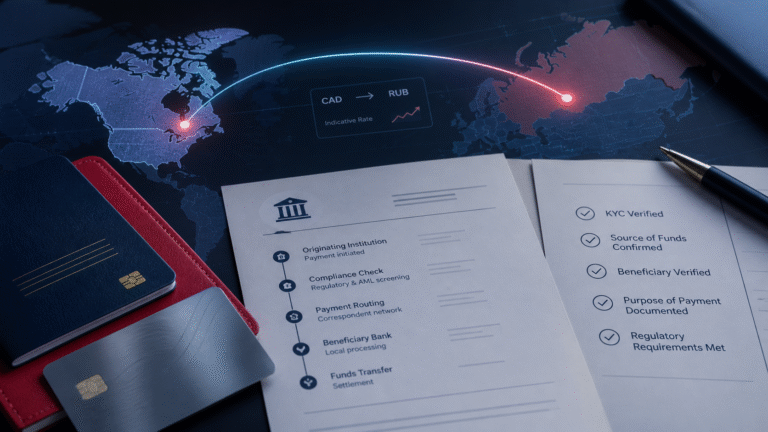
Direct answer: You can still send money to Russia in 2026 when the transfer has a permitted purpose and every party in the payment chain can lawfully handle it. The workable route depends on your country, the recipient’s bank, the currency, the amount and the supporting documents. Verify the complete route before releasing funds.
Check the route before you send
NoWALL can review your sender country, funding currency, amount, payment purpose and Russian recipient-bank details, then explain an available payment arrangement and the documents likely to be requested. Banks and regulated payment partners retain the final approval decision, so availability is confirmed for each transfer rather than promised universally.
Sending money to Russia is no longer a matter of choosing the cheapest app and entering a card number. Some familiar providers do not serve Russia, many banks apply their own risk policies, and sanctions differ by jurisdiction. A lawful family payment may therefore fail because the beneficiary bank, an intermediary or the stated purpose does not fit the selected route.
The practical solution is to start with the recipient and work backwards. Confirm how the person or company can receive funds, identify every institution involved, and compare the amount that will arrive in rubles—not just the advertised sending fee.
What routes can still work in 2026?
There is no single method that works for every sender. The following options describe route types, not guaranteed products. Availability can change with the sender’s residence, nationality, bank, transaction purpose and the recipient’s details.
| Route | Best suited to | What to confirm first | Main risk |
|---|---|---|---|
| Supported bank transfer | Documented personal or commercial payments | All banks and intermediaries accept the parties, currency and purpose | An intermediary rejects or returns the payment |
| Regulated payment arrangement with ruble payout | Family support, gifts and other supported personal payments | Provider coverage, recipient bank, RUB amount and payout format | Route availability or compliance requirements change |
| Invoice or contractor-payment route | Goods or services with a genuine commercial basis | Contract, invoice, service description, counterparty and bank screening | A personal-payment route does not accept commercial purpose |
| Card or account-based ruble receipt | Recipients who need local RUB access | Issuing bank and account details, not merely the MIR logo | Assuming an international card-to-card transfer will work |
| Cash or informal intermediary | Rarely appropriate | Licensing, identity checks, written terms and source of funds | Fraud, loss, poor records or sanctions exposure |
Major brands are not a dependable shortcut. Wise lists Russia among unsupported countries and regions, while Western Union says its Russia operations remain suspended across all channels. A provider appearing in a search result or app store does not prove that it supports your exact route today.
A safer way to plan the transfer
1. Define the real payment purpose
State why the money is moving in plain language: family support, a gift, reimbursement, salary, contractor services or an invoice. Do not relabel a business payment as a personal transfer. The purpose determines which route is appropriate and which documents may be needed.
2. Identify the recipient and receiving bank
Ask for the recipient’s full legal name, account or card details, bank name and BIC or other required bank code. For a company, collect its registered name, address, tax details and contract information. A card logo alone is not enough; the issuing bank is what matters for screening and settlement.
3. Screen the complete chain
Check the sender, recipient, beneficial owners where relevant, receiving bank and any known intermediary. Rules are jurisdiction-specific. The US Treasury’s OFAC FAQ 1202 explains that personal, non-commercial remittances are generally not the target of US Russia sanctions, but transactions must not involve blocked persons or otherwise prohibited activity.
EU senders face their own framework, including restrictions affecting listed banks and sanctioned parties. The European Commission publishes a dedicated payment-services FAQ for the current rules. When facts are unclear, consult your bank, regulated provider or qualified legal adviser before paying.
4. Confirm currency, payout and total cost
A quote should show the funding currency, exchange rate or margin, provider fee, possible bank deductions and the amount expected in rubles. Ask who bears intermediary charges and what happens if the payment is returned. Our guide to fees and FX costs for Russia transfers explains how to compare routes on the amount received.
5. Get confirmation before funding
Do not treat an old receipt, a friend’s successful transfer or a provider’s general homepage as approval. Confirm that the route currently accepts your sender profile, amount, purpose and recipient bank. For a new route, a smaller first transfer can limit operational loss, but it does not replace compliance checks or guarantee that later payments will be accepted.
Recipient details and documents checklist
Prepare the following before asking for a quote or initiating a transfer:
- sender’s full legal name, residence and contact details;
- recipient’s full legal name exactly as held by the bank;
- recipient bank name, BIC and account or card details required by the route;
- amount, funding currency and desired amount in rubles;
- clear payment purpose and relationship between sender and recipient;
- source-of-funds evidence, such as payslips, statements or sale records;
- for family support or a gift, evidence of the relationship if requested;
- for salary or services, the employment agreement, contract, invoice and acceptance evidence;
- for a company, registration, beneficial ownership and tax details where required.
The exact file depends on the route and amount. A complete document package reduces avoidable questions, but it cannot ensure approval. See the fuller document checklist for transfers to Russia.
Why a transfer may be delayed or returned
A permitted payment can still be stopped for operational or policy reasons. Common causes include a mismatch in the beneficiary name, an unsupported bank, a vague purpose, missing source-of-funds evidence, a restricted intermediary, a limit breach or a provider policy change.
If the payment stalls, do not immediately send the same amount through several channels. Ask where it stopped, request the reason or reference code, preserve the transfer receipt and clarify whether the funds are pending or being returned. Then correct the actual problem before trying again. Our troubleshooting guide explains why Russia transfers are delayed or returned.
Personal transfers and business payments are different
Family support and gifts usually need a personal-payment route and an honest explanation of the relationship. Salary, supplier, freelancer and invoice payments require a commercial route that accepts the underlying activity. They may also require contracts, tax records, proof of delivery and beneficial-owner checks.
Never split a commercial invoice into personal transfers or use misleading descriptions to avoid review. Besides creating legal and compliance risk, inaccurate records can make a refund, audit or tax reconciliation much harder. Businesses should start with the guide to paying an invoice to Russia.
How to avoid common mistakes
- Do not choose by fee alone. Compare the final RUB amount, timing, deductions and return terms.
- Do not assume every Russian bank is treated alike. The beneficiary bank and any intermediary must be checked individually.
- Do not rely on a provider’s old availability page. Confirm the exact corridor before funding.
- Do not hide the purpose. Accurate information gives the provider a chance to assess the correct route.
- Do not send to an unknown individual. Verify the recipient and use a regulated, traceable arrangement.
- Do not treat “MIR card” as sufficient detail. Check the issuing bank and required account data; read our MIR card receipt guide.
Frequently asked questions
Is it legal to send money to Russia in 2026?
Some personal and commercial payments can be lawful, but legality depends on the sender’s jurisdiction, the parties, banks, payment purpose and applicable sanctions. A lawful purpose does not force a bank or provider to accept the transfer. Review the specific facts before sending.
Can I use Wise to send money to Russia?
Wise’s current availability guidance lists Russia as unsupported and says customers cannot send or receive money to or from unsupported countries and regions. Check Wise’s own help pages for the latest status rather than relying on old comparisons.
Does Western Union send money to Russia?
Western Union’s official Russia page says its operations in Russia are suspended across all channels. Its historical suspension took effect on March 24, 2022.
Can I send money directly to a MIR card?
International card-to-card payment is not the only—or necessarily the available—route. A supported arrangement may instead deliver rubles to the account linked to the card. The issuing bank, recipient details and current route coverage must be checked.
How long does a transfer to Russia take?
Timing depends on screening, funding, currency conversion, intermediaries and local payout. Ask for an estimated range and the point at which a delay should be investigated. Compliance review can extend the estimate.
What should I do before sending a large amount?
Confirm the purpose, parties, bank chain, documents, exchange rate, fees, payout amount and written return procedure. Consider independent legal or tax advice when the amount or commercial exposure is significant.
Freshness note: This guide was reviewed on July 19, 2026. Sanctions, bank policies and provider coverage can change without notice. Recheck official sources and the exact route immediately before sending.