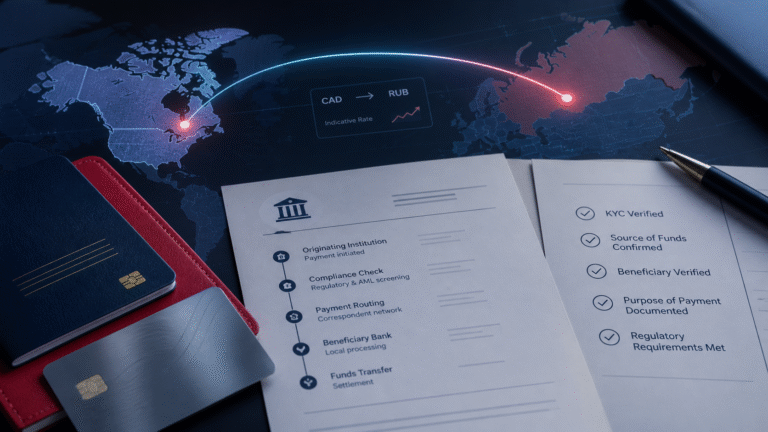
Sending money from Turkey to Russia in 2026 may be possible, but there is no universal route. The workable option depends on the Turkish sender, the real payment purpose, the Russian recipient and bank, the funding currency, and every intermediary involved. Confirm availability, compliance checks, fees, conversion and refund terms before you transfer any money.
Need a Turkey-to-Russia route check?
NoWALL can review the sender profile, amount, payment purpose, funding currency and Russian recipient-bank details, then outline available arrangements and the records likely to be requested. Banks and regulated providers make the final approval decision.
Turkey is outside the EU, so a transfer from a Turkish account is not simply an EU payment with a different starting point. Turkish banks and payment companies apply their own customer checks, while correspondent banks and the recipient bank may apply additional sanctions, anti-money-laundering and internal-risk rules. A route can therefore be legally permissible yet operationally unavailable.
What makes a Turkey-to-Russia transfer different?
The first difference is currency. A sender may hold Turkish lira, euros or US dollars, but the recipient often needs rubles. Each conversion adds a price, a provider and another possible compliance check. A quote that begins in TRY and ends in RUB is easier to compare than a route with an unclear intermediate currency.
The second difference is the payment chain. A Turkish bank may accept your instruction but still rely on a correspondent institution to move the funds. That intermediary can reject the Russian bank, the currency or the purpose. The recipient bank may also ask for documents before crediting the account.
Finally, familiar global brands are not necessarily available. Wise says users cannot send or receive money to or from Russia, and Western Union states that its money-transfer services in Russia have been suspended since March 2022. Check the official coverage page on the day you plan to send rather than relying on an old comparison article.
Routes to compare before sending
| Route | When it may fit | What to confirm first |
|---|---|---|
| Bank transfer | A supported recipient bank and a well-documented personal or commercial purpose | Currency, correspondent banks, recipient-bank acceptance, charges and return procedure |
| Regulated payment service | A provider explicitly supports Turkey funding and Russia payout for your transaction type | Licence, sender eligibility, payout format, limits, required evidence and refund terms |
| Assisted payment arrangement | The direct route is unavailable and the transaction requires a reviewed operational chain | All parties, contracts, source of funds, exchange rate, delivery method and written terms |
| Cash handover or informal intermediary | Rarely appropriate | Identity, legality, consumer protection and traceability risks; avoid unverified agents |
A card number alone is usually not enough. If the recipient wants rubles on a MIR card, the relevant question is whether the route can credit the underlying Russian bank account or arrange a supported domestic payout. Read the practical guide to sending money to a MIR card from abroad before choosing the payout format.
Choose the route by the real payment purpose
Family support or another personal transfer
State the genuine relationship and reason for the payment. “Personal transfer” is not a magic exemption, and it should never be used to disguise salary, goods or services. The bank or provider may ask how you know the recipient, where the money came from and why the amount is reasonable.
Personal remittances are not automatically prohibited everywhere. For example, OFAC explains that personal, non-commercial remittances are generally not the target of US Russia sanctions when blocked persons are not involved and the transaction is not otherwise prohibited. That US guidance does not replace Turkish law or the rules of the institutions handling your transfer, but it shows why the exact parties and purpose matter.
Invoice, supplier or professional payment
A commercial transfer needs a stronger file: contract, invoice, description of goods or services, delivery or acceptance evidence, beneficial-owner details where relevant, and an accurate payment reference. The parties should also check whether the underlying trade or service is restricted, not only whether the names appear on a sanctions list.
Do not break a business invoice into personal payments or send it to an unrelated card to make the transfer look simpler. That creates mismatched records and may increase the risk of rejection, account restriction or a later compliance inquiry. For a business scenario, use the separate guide to paying an invoice to Russia from abroad.
Recipient details and documents checklist
Ask the recipient for current details copied from their bank application or an official bank document. Do not reuse details from an old successful payment without checking them.
- Recipient’s full legal name, exactly as held by the bank
- Date of birth and address if the provider requests them
- Russian bank name, account number and BIC
- Card number only when the chosen route specifically supports card payout
- Recipient-bank confirmation that the proposed currency and route can be accepted
- Honest payment purpose and the sender-recipient relationship
- Sender identification and proof of Turkish address when requested
- Recent bank statement or another source-of-funds record
- Contract, invoice and acceptance records for a commercial payment
- Tax or payroll documents when the payment relates to work
The Central Bank of the Republic of Türkiye explains that IBAN use is designed to reduce errors and delays in account transfers. A Russian account does not necessarily follow the same IBAN format as a Turkish account, so use the exact beneficiary fields required by the chosen provider rather than forcing Russian details into a Turkish or EEA template. The broader documents checklist for transfers to Russia can help you prepare for follow-up questions.
Compliance checks: screen the whole chain
Checking only the recipient’s name is not enough. Screen the recipient, recipient bank, sender, beneficial owners where relevant, every disclosed intermediary and the underlying purpose. Also ask whether the route touches an EU, UK or US institution, because that institution may apply rules from its own jurisdiction even when the payment starts in Turkey.
The European Commission’s Russia sanctions materials are useful when an EU institution is involved. Its March 2026 payment-services guidance addresses restrictions under Article 5b(2) of Regulation 833/2014, while its consolidated FAQ page tracks updates across the wider sanctions regime. These rules are detailed and fact-specific; a provider’s refusal does not by itself prove that every possible route is illegal.
Use official screening information and current provider terms. Do not accept a promise that a route is “sanctions-proof,” guaranteed or free of compliance checks. Legitimate payments can still be delayed, rejected or returned because a bank lacks sufficient information or does not support the corridor.
Compare the amount delivered, not the headline fee
For a TRY-to-RUB transfer, ask for one complete quote. It should state the amount debited in Turkey, every service charge, the exchange rate or margin, any intermediary deduction, the payout currency, and the estimated amount the recipient receives. If the route converts TRY to EUR or USD before RUB, ask who controls each conversion.
Also request the refund method. A returned transfer may come back after fees and exchange-rate movements, so the refunded amount can be lower than the original debit. Confirm who pays bank-recall costs and what happens if the recipient bank asks for more documents.
A practical transfer workflow
- Define the payment. Record the amount, purpose, parties, deadline and desired ruble receipt.
- Collect fresh recipient details. Confirm the Russian bank and account, not only the card network.
- Check the route end to end. Ask the Turkish provider, intermediaries where disclosed and recipient bank about support.
- Prepare evidence. Keep identity, source-of-funds and purpose documents consistent.
- Compare complete quotes. Focus on rubles delivered and the written refund terms.
- Use accurate references. Never relabel a salary or invoice as family support.
- Keep records. Save confirmations, receipts and correspondence until the recipient has usable funds.
If a transfer is held or sent back, do not immediately repeat it through the same chain. Find out which institution rejected it and why, then use the guide to returned or delayed transfers to Russia.
Frequently asked questions
Can I send money from a Turkish bank account to Russia?
Possibly, but only if the Turkish bank or provider supports the Russian recipient bank, currency, purpose and parties. Ask for route confirmation before funding; an international-transfer option in your banking app does not prove that this corridor is available.
Can I send Turkish lira directly to a Russian card?
Direct TRY card-to-card delivery should not be assumed. Many workable arrangements involve conversion and a bank-account or supported domestic payout in Russia. Confirm the final ruble amount and the recipient-bank requirements.
Do Wise or Western Union send money from Turkey to Russia?
Wise’s official help page says transfers to and from Russia are not supported. Western Union says its Russia money-transfer services have been suspended since March 2022. Verify current official coverage before relying on any named provider.
Is a personal transfer from Turkey automatically legal?
No. The answer depends on the parties, banks, purpose, route and applicable rules. Personal support should be described honestly, and it must not involve prohibited parties or conceal a commercial payment.
How long does a Turkey-to-Russia transfer take?
Timing depends on document review, currency conversion, intermediary banks and recipient-bank processing. Treat estimates as conditional and allow extra time for a first transfer or a commercial payment.
Freshness note: This article was reviewed on 17 July 2026. Provider coverage, bank acceptance and sanctions guidance can change. Recheck the exact route and official sources before every transfer.