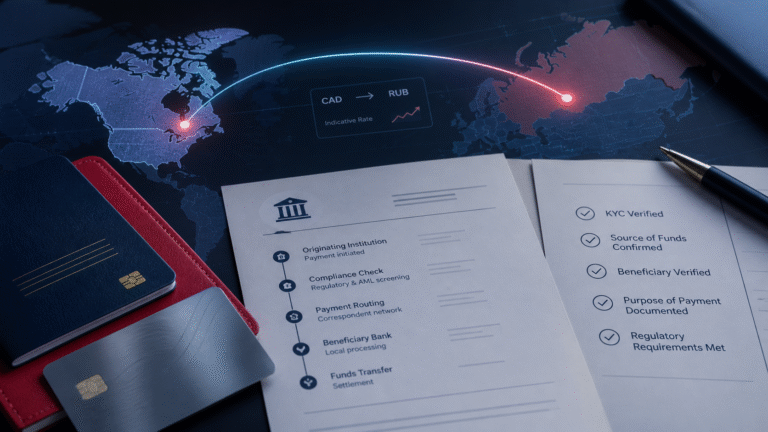
Sending money from Italy to Russia in 2026 is not a routine SEPA payment. A permitted personal or commercial payment may still be possible, but only through a provider and bank chain that support the exact recipient, purpose and currency. Verify sanctions, beneficiary details, EUR-to-RUB conversion, fees and return terms before funding.
Have an Italian account, a Russian beneficiary and no clear route? Send NoWALL the amount, purpose, source bank and recipient-bank details. We can check current operational options and identify the records likely to be requested. The regulated institutions handling the funds make the final approval decision. Request a route review.
Choose the route by the recipient’s actual needs
Start with the result in Russia, not with the payment app on your phone. Ask whether the recipient needs rubles in a bank account, credit to a supported card, payment of a bill or settlement of a business invoice. The answer determines which details, documents and providers are relevant.
| Possible route | Best fit | Confirm before paying | Typical obstacle |
|---|---|---|---|
| Bank transfer from Italy | A bank accepts the purpose and can reach the beneficiary bank | Currency, intermediary chain, charges and beneficiary instructions | The Italian bank or a correspondent may not process Russia-linked payments |
| Regulated specialist provider | The provider supports funding in Italy and delivery to the exact Russian bank | Licence, rate, delivered amount, document requests and refund procedure | Availability can change by amount, purpose and beneficiary |
| Supported card or account credit | The service names the recipient bank and payout method | Whether the destination is a card, account or local payment rail | A card number or MIR logo alone does not establish a cross-border route |
| Consumer remittance app | Only when current terms explicitly cover Italy-to-Russia transfers | Sender residence, Russia coverage and personal or business-use rules | Well-known services may accept Italian customers but exclude Russia |
| Informal intermediary | Not a suitable default for a documented international payment | Identity, authorisation, custody of funds and proof of delivery | Fraud, loss, weak records and possible sanctions-evasion exposure |
Do not treat a detour through another country as a compliance solution. Hiding the final beneficiary, relabelling the purpose or using an unrelated person’s account can create legal and fraud risks. A legitimate route should show who receives the money, who converts it and what amount arrives.
Ask your Italian bank the right questions
An IBAN form accepting the beneficiary details does not mean the transfer will be executed. Russia is outside SEPA, and an international payment may depend on one or more correspondent banks. Each institution can apply its own controls and may decline a transaction even when the payment is not expressly prohibited.
Before creating an instruction, ask your bank whether it processes payments to the named Russian bank, in which currencies, and for your stated purpose. Request the likely fee model and ask whether charges can be deducted by intermediaries. For a business payment, confirm which contract, invoice, ownership and delivery records the bank expects.
Keep the answer in writing when possible. “We do not support this corridor” is an operational refusal. It is not the same as a finding that the recipient is listed or the purpose is prohibited. If a previous payment is stuck, first identify its exact status with our guide to transfers to Russia that are delayed or returned.
Map every institution in the payment chain
A payment can pass the sender bank’s review and still fail later. The receiving bank may be unable to accept the currency, a correspondent may reject the instruction, or the provider may not support the beneficiary’s account type. Check the route as a chain rather than a single brand name.
- Funding: identify the Italian account or card and the currency debited.
- Processing: ask which regulated provider or banks will handle the funds.
- Conversion: confirm where EUR becomes RUB and which rate applies.
- Delivery: verify the Russian bank, account or supported card endpoint.
- Return: learn where funds go, in which currency and with which deductions if rejected.
This is especially important for a quote that promises “local” delivery. Local payout may reduce the number of visible international-bank steps, but it does not remove the need to identify the provider, screen the parties and document the purpose.
Recipient details and documents to prepare
Ask the recipient to request current incoming-payment instructions from the bank. Old details from a successful transfer may no longer work. Depending on the route and reason for payment, prepare:
- the recipient’s full legal name, date of birth and address when requested;
- the account number, receiving currency and exact bank name;
- the bank address, BIC/SWIFT and any valid intermediary instructions;
- the recipient bank’s domestic identifiers for a local payout;
- a truthful payment purpose that matches the supporting evidence;
- the sender’s identity, Italian address and source-of-funds records;
- proof of relationship for family support or a personal obligation;
- a contract, invoice, company details and performance evidence for business payments.
Spelling and numbers must match across the instruction, invoice and identity documents. A shortened name, stale address or generic description can trigger manual review. The separate document checklist for transfers to Russia explains how to organise these records.
EU and Italian compliance checks
Italian senders operate under EU restrictive measures, Italian implementation rules and the controls of their bank or payment provider. The analysis is not limited to a country name. The recipient, ownership and control, banks, intermediaries, goods or services, payment purpose and any indirect benefit may all matter.
The European Commission publishes consolidated Russia and Belarus sanctions guidance and a focused FAQ on the provision of payment services. Italy’s Ministry of Foreign Affairs also maintains a page on restrictive measures, exemptions and due diligence, including guidance for companies dealing with Russia-related transactions.
Check current official sources on the day you send. Do not rely on a forum post, a past transfer or a provider’s checkout screen as legal confirmation. If the payment involves a company, professional services, controlled goods, a listed party or a possible authorisation, obtain qualified advice. Our overview of legal and bank checks for transfers to Russia provides a practical starting point.
Why familiar transfer brands may not work
A provider can be fully available to customers in Italy while excluding Russia as a destination. Wise lists Russia among places where customers cannot send or receive money in its current country availability guidance. Western Union states that it suspended operations in Russia and Belarus.
Other services should be checked individually. Confirm four separate facts: the service can take funds from an Italian resident, it supports the specific Russian beneficiary bank, it allows the real personal or commercial purpose, and it can deliver the required currency or account credit. A currency shown in an app is not proof that the corridor is active.
Compare cost by rubles received, not the headline fee
The visible service fee is only one part of the cost. A EUR-funded transfer can include an exchange-rate margin, sender-bank charge, provider fee, correspondent deduction and recipient-bank fee. Ask for the amount expected to reach the recipient after all known charges.
- EUR amount debited and any card or bank funding charge
- EUR/RUB rate, rate source and quote-validity period
- fixed and percentage provider fees
- possible intermediary and recipient-bank deductions
- expected RUB amount and realistic processing window
- refund timing, refund currency and non-refundable charges
Compare two quotes using the same send amount and the same final delivery method. A service with a zero-fee label can be more expensive after conversion. For recurring support, also ask whether later transfers will require renewed documents or a fresh route review.
A practical pre-transfer plan
- Record the real sender, final recipient, amount and purpose.
- Obtain fresh instructions from the Russian recipient bank.
- Screen the parties and underlying transaction using current EU and Italian resources.
- Confirm that every institution in the proposed route supports the payment.
- Prepare identity, source-of-funds and purpose-specific evidence.
- Review the full delivered amount, timing and return conditions.
- Send only when the route and documents describe the same transaction.
For a supplier or contractor payment, use the more detailed invoice-payment guide. For personal support, keep a clear record of the relationship and reason for payment. In both cases, recheck the route if the beneficiary account, currency or intermediary changes.
Frequently asked questions
Can I transfer money from an Italian bank to a Russian bank?
Possibly, if the Italian bank, correspondent chain and Russian beneficiary bank support the exact currency and purpose. Many institutions decline the corridor under their internal policy, so obtain confirmation before submitting the payment.
Can I send euros to Russia and let the recipient convert them?
Only when the beneficiary account and every bank in the chain can receive and process EUR. In many routes, conversion occurs before local delivery. Ask for the expected credited currency and amount.
Can I send money from Italy to a MIR card?
A MIR card number alone is not an international transfer instruction. Use a route only when the provider explicitly supports that card and issuing bank, or request supported account details from the recipient bank.
Is family support from Italy to Russia automatically permitted?
No transfer is automatically cleared by its label. The recipient, banks, payment chain, source of funds and real purpose still require review, and the provider may apply a narrower policy than the law.
Should I send a small test transfer first?
A test can confirm some operational details but does not approve a larger transfer. Different amounts may trigger different checks, and splitting a payment to avoid review is not acceptable. Disclose the intended total from the start.
Last reviewed: 13 July 2026. Sanctions rules, Italian bank policies, provider coverage and correspondent routes can change. Confirm the current position with the institutions handling your payment before sending funds.