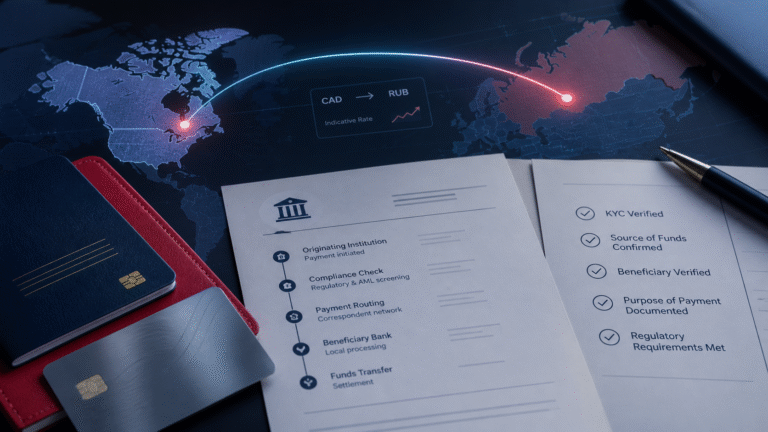
Russian clients can still pay some legitimate international invoices in 2026, but there is no universal route. The workable option depends on the payer, the recipient country, the goods or services, the banks and payment providers involved, and current sanctions. Confirm acceptance before sending funds, disclose the real payment purpose, and keep a complete documentary trail.
If you need to collect a genuine invoice from a customer in Russia, NoWALL can review the payer, recipient, currency, invoice and supporting documents before suggesting an available route. A route check is not a guarantee of settlement: banks and providers make their own compliance decisions, and availability can change.
Why invoice payments from Russia need a route check
A payment may be lawful in principle yet fail operationally. The payer’s Russian card may not work abroad, a correspondent bank may refuse the transfer, or the recipient’s payment provider may not serve Russian residents. Banks can also pause a payment while they verify the parties, beneficial owners, invoice purpose or source of funds.
The distinction between a personal remittance and a commercial invoice matters. An invoice payment compensates a supplier for goods or services; it should not be described as family support, a gift or another personal purpose. An inaccurate description can create compliance concerns and make a return more likely.
Sanctions are targeted rather than a single global ban, but they differ by jurisdiction and change over time. The European Commission publishes detailed guidance on Russia-related restrictions, including payment services, while the US Treasury’s Office of Foreign Assets Control maintains separate rules and lists. The recipient should apply the law of its own country and any rules that affect its bank or provider.
Options for paying an international invoice from Russia
The practical options below are categories, not a promise that a particular transaction will be accepted. Start with the invoice recipient’s bank or payment provider and work backwards to the Russian payer.
| Route | When it may fit | What to confirm first | Main risk |
|---|---|---|---|
| Direct bank transfer | The payer and recipient banks can process the currency and the transaction is permitted | Bank status, correspondent path, beneficiary details and payment-purpose wording | Intermediary rejection, delay or return |
| Invoice-payment service | A specialist can accept the payer’s available method and settle a verified supplier invoice | Provider eligibility, onboarding documents, fees, exchange rate and settlement method | Route availability can change after screening |
| Local or regional payment partner | The seller already has an authorised partner or distributor serving the payer’s market | Written commercial basis, correct contracting party, tax treatment and refund process | Poor documentation or an unnecessary intermediary |
| Card payment | The merchant’s acquirer expressly accepts the payer’s card and location | Issuer, card network, merchant country, recurring-payment rules and refund support | Most Russia-issued international network cards do not work abroad |
| Digital assets | Both sides may lawfully use them and can document acquisition, transfer and conversion | Local law, platform restrictions, wallet screening, accounting and tax treatment | Compliance, custody, pricing and off-ramp risk |
Do not add an intermediary merely to conceal the Russian connection. Third-country routing is not automatically prohibited, but it must have a legitimate commercial basis and preserve the true parties and purpose. Obscuring a payer, beneficiary or transaction can turn a difficult payment into a serious sanctions and anti-money-laundering problem.
What changed for cards and payment services
Visa states that cards issued by Russian financial institutions no longer work outside Russia, while cards issued abroad no longer work inside Russia. That makes a normal foreign checkout unreliable for many Russian customers even when the underlying purchase is not prohibited.
EU rules also require careful provider-level analysis. The European Commission’s payment-services guidance, updated in March 2026, explains restrictions affecting certain payment, e-money and crypto-asset services supplied to Russian nationals, Russian residents and Russia-established entities. The exact result depends on the service, the customer and any applicable exception; it should not be reduced to “all payments are banned” or “all payments are allowed.”
A merchant’s published checkout page is not proof of eligibility. The acquiring bank, card issuer, payment processor and merchant may each apply separate restrictions. Ask the recipient to confirm that its chosen collection method accepts the payer’s residence, card or bank before the customer initiates payment.
Invoice and payer details to prepare
A clean file helps a bank or payment service understand the transaction without repeated follow-up. Prepare:
- The supplier’s legal name, registered address and company number.
- The payer’s full legal name and address; for a company, include registration details and beneficial owners when requested.
- An invoice number, issue date, due date, currency and exact amount.
- A plain description of the goods or services, service period and delivery status.
- The contract, order form or accepted proposal supporting the invoice.
- Beneficiary bank details copied from a current official document.
- The commercial relationship and reason for payment.
- Source-of-funds evidence when the amount or risk profile requires it.
- Any licences, end-use documents or sanctions analysis relevant to controlled goods or services.
- A contact person on both sides who can answer compliance questions quickly.
Descriptions such as “consulting services under invoice 1042 for June 2026” are more useful than “services” or “payment.” Keep the contract, invoice and bank instruction consistent. If the invoice changes, issue a corrected version rather than explaining a mismatch after the transfer has been flagged.
A practical payment process
1. Screen the transaction before choosing a route
Check the payer, recipient, beneficial owners, banks, goods or services, destination and end use against the rules that apply to the recipient and its financial institutions. Screening a name alone is not enough: ownership and control can matter, as can sectoral restrictions and prohibited services.
2. Ask the recipient what it can accept
The foreign supplier should confirm its bank or provider will accept the payer type and country. It should also confirm the supported currency and whether the beneficiary name must match the invoice issuer exactly. A payment to an employee, shareholder or unrelated company is not an equivalent substitute.
3. Compare the full delivered cost
Compare the amount the supplier will actually receive, not just the advertised fee. Include the exchange-rate spread, sending fee, intermediary deductions, receiving fee and any refund cost. Agree in writing who bears bank charges and what happens if the payment arrives short.
4. Run a route check before funds move
For a specialist route, provide the documents first and obtain a written quote or instruction. Verify the provider’s legal identity, contracting entity, refund procedure and support channel. Do not rely on a screenshot, social-media username or an instruction to misstate the payment purpose.
5. Reconcile and retain evidence
After settlement, match the received amount to the invoice and retain the payment confirmation, exchange calculation and correspondence. If the payment is returned, request the return reason and bank deductions before trying a different route.
Compliance risks that deserve extra attention
- Blocked or restricted parties: a transaction may be prohibited even if the invoice itself looks ordinary.
- Ownership and control: an unlisted company may still be affected through sanctioned owners or controllers.
- Restricted goods or services: software, professional services, technology and dual-use items can face specific controls.
- False payment purpose: disguising a commercial payment as a gift or personal transfer creates risk.
- Unverified intermediaries: extra parties increase fraud, documentation and return risk.
- Provider eligibility: an account or service can be unavailable based on residence, nationality or entity location.
- Refund mechanics: a return may take time and can arrive net of fees or at a different exchange rate.
For US-connected transactions, OFAC distinguishes personal, non-commercial remittances from commercial activity and requires parties to avoid blocked persons and otherwise prohibited dealings. A business invoice should be assessed on its own facts. For EU-connected transactions, use the current European Commission guidance and obtain professional advice for material or unusual payments.
How NoWALL can help with an invoice route
NoWALL can review a legitimate invoice-payment scenario and explain what information is needed for an available route. The review normally starts with the payer country and status, the recipient country, the amount and currency, the invoice purpose, and the banks or providers on both sides.
You should receive the fee and exchange-rate basis before committing funds, together with the expected settlement path and document requirements. NoWALL does not replace legal or tax advice, and neither NoWALL nor any bank can guarantee that every transaction will pass third-party checks.
For the opposite direction, see how to pay an invoice to Russia from abroad. If a payment was already sent and did not settle, read why transfers to Russia are delayed or returned. You can also review the broader 2026 guide to sending money to Russia.
Frequently asked questions
Can a Russian company pay a foreign supplier in 2026?
Sometimes. The answer depends on the parties, ownership, goods or services, banks, currency, recipient country and applicable sanctions. The supplier should confirm acceptance with its bank or payment provider before the payer sends funds.
Can a Russian customer pay a foreign invoice by card?
Often not with a Russia-issued Visa or Mastercard used abroad. Even where another card product exists, the merchant and its acquirer must accept the issuer, payer location and transaction type.
Is it legal to use a third-country intermediary?
A legitimate intermediary is not automatically unlawful, but it must not hide the real payer, recipient or purpose or facilitate a prohibited transaction. Document the commercial role and screen every party.
What is the safest payment description?
Use a truthful, specific description that matches the contract and invoice, such as the service type, invoice number and period. Never relabel a commercial invoice as a personal remittance or gift.
How long can an invoice payment take?
Timing varies by route and screening. A payment can settle quickly after approval or remain pending while a bank requests documents. Ask for an estimated range and a clear escalation process before sending.
Sources and freshness
Last reviewed: 24 July 2026. Payment availability and sanctions can change. Confirm the current position with the relevant bank, provider or adviser before acting.