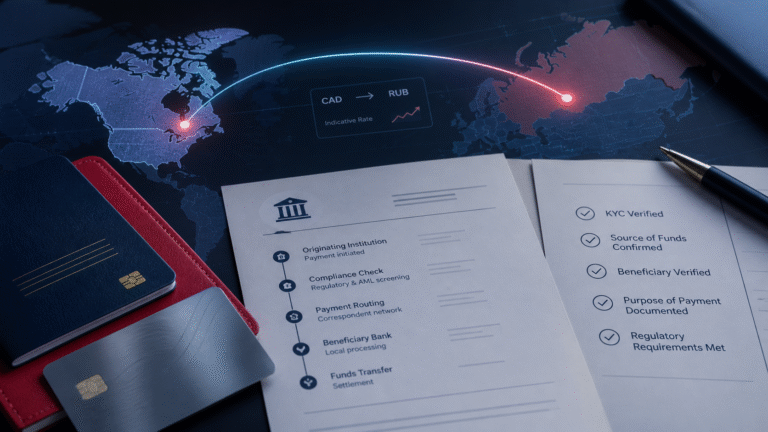
Direct answer: You may be able to pay rent in Russia from abroad, but the workable route depends on your country, the landlord or property manager, the recipient bank, the currency and the lease. Confirm the full payment chain before sending, use the real rental purpose and keep a receipt that identifies the rental period.
Check a Russia rent-payment route before it is due
Tell NoWALL where you are paying from, the currency and amount, who receives the rent, and whether the beneficiary is a private landlord or a company. We can help review an available payment arrangement, the recipient details and the records likely to be requested. Final acceptance remains subject to provider and compliance checks.
Rent creates a practical problem that an ordinary transfer guide does not fully solve. The payment is tied to a lease, a due date and a specific beneficiary. A successful transfer must both reach an acceptable Russian account and leave evidence that you paid the correct month, property and amount.
Do not assume that a route used for a gift or family allowance also accepts rent. The provider may classify rent as a contractual payment and ask for the lease, proof of funds or information about the landlord. The right starting point is the agreement, not the payment app.
Ways to pay rent in Russia from abroad
No single method is available from every country. Compare only routes that support the actual sender, beneficiary, bank and payment purpose.
| Route | When it may fit | What to confirm | Record to keep |
|---|---|---|---|
| Supported bank transfer | The landlord has an eligible Russian account and the sending bank confirms a usable chain | Beneficiary bank, intermediaries, currency, charges and payment wording | Bank receipt showing beneficiary, amount and reference |
| Specialist payment arrangement with RUB receipt | The corridor supports a lawful rent payment to the named recipient | Provider entity, landlord type, recipient bank, rate, fees and return terms | Quote, funding record and confirmation of ruble credit |
| Payment to a property manager | The lease or written instruction authorises a management company to collect rent | Company identity, authority, ownership, invoice and bank details | Lease plus manager instruction and payment receipt |
| Payment by an authorised local representative | A documented agent can pay on the tenant’s behalf under applicable law | Authority, source of funds, fees, receipt wording and tax implications | Written authority, agent statement and landlord acknowledgment |
| Card-linked ruble receipt | A provider expressly supports the issuing bank and rental purpose | Whether payout reaches an account or card, name match and final RUB amount | Receipt identifying the beneficiary and transaction |
A card number or the MIR logo does not establish a route. The issuing bank and the provider’s payout chain matter. If the landlord asks for card receipt, read the guide to sending money to a MIR card from abroad and verify the bank before sharing or funding any payment.
Start with the lease and payment instructions
Read the rent clause before requesting a quote. Note the monthly amount, currency, due date, named payee, bank account and required reference. If the lease says the landlord must receive a fixed ruble amount, exchange-rate movement and deductions can leave a shortfall even when you sent the expected foreign-currency amount.
Ask for written confirmation before paying a different account. A message from an unfamiliar address that replaces the landlord’s bank details may be fraud. Confirm any change through a known phone number or another established channel, then make sure the new beneficiary is permitted under the lease or a signed amendment.
If a property manager collects the money, request the management agreement, landlord instruction or invoice that explains its authority. Paying an unrelated friend or intermediary without documentation can weaken both compliance review and your evidence in a rent dispute.
Landlord and recipient details checklist
- landlord’s or property manager’s full legal name;
- beneficiary address and, for a company, registration and ownership details if requested;
- Russian bank’s legal name, BIC and account details required by the route;
- property address and lease date;
- rental period covered by the payment;
- amount due, currency and any utilities or service charges included;
- exact payment reference agreed with the landlord and provider;
- landlord’s written instruction for a new account or collecting agent.
Names should match the lease and bank record. Resolve transliteration differences before sending rather than guessing. The practical guide to checking a Russian recipient bank explains why the beneficiary bank and intermediaries should be reviewed separately.
Documents to prepare
A provider may request only identity and recipient details for a routine payment, or it may ask for a fuller file. Preparing the following records before the due date reduces avoidable delays:
- your passport or other accepted identity document;
- the signed lease and any current amendments;
- the landlord’s invoice, rent schedule or written payment request;
- proof that the recipient account belongs to the landlord or authorised manager;
- a bank statement, payslip or other evidence of the source of funds;
- a calculation showing the rent, utilities, deposit and any arrears separately;
- previous rent receipts and landlord confirmations;
- tax or legal advice where the arrangement involves a company, agent, deposit or property ownership.
Do not alter the lease, misstate the purpose or split a payment to avoid review. If the requested evidence seems unrelated or excessive, ask the provider why it is needed and use a secure channel to submit it. The broader Russia transfer documents checklist covers common identity and source-of-funds requests.
Compliance checks that matter for rent
Rent is not automatically a personal remittance
US Treasury guidance says personal, non-commercial remittances are generally not the target of US sanctions, provided they do not involve blocked persons or otherwise prohibited activity. A rental payment arises from a contract for housing, so a US-connected payer should not assume that the personal-remittance statement settles the analysis. Check the landlord, banks, property circumstances and applicable rules, and obtain advice when the facts are unclear.
EU restrictions also cannot be reduced to a single rule that every Russia payment is either open or banned. The European Commission’s current payment-services guidance focuses on Article 5b(2) of Regulation 833/2014. Other restrictions, including asset freezes and anti-circumvention rules, may still apply to the parties or transaction.
UK-connected payers should use the current OFSI Russia financial-sanctions guidance and the UK Sanctions List. The guidance explains that UK rules apply to people and entities within the UK and to UK persons wherever they act. A private lease does not remove those obligations.
Provider availability is narrower than legality
A payment can be lawful yet unsupported by a particular bank or provider. For example, Wise’s current availability page lists Russia among unsupported locations and says users cannot send or receive money to or from those places. Do not try to make an unavailable corridor appear open with a false address, VPN, borrowed account or misleading description.
Before funding, ask whether the route accepts rent, the named beneficiary type and the recipient bank. A generic “money to Russia” page is not the same as an executable quote for your payment.
How to make a traceable rent payment
- Confirm the obligation. Match the lease, due date, rental period, amount and beneficiary.
- Verify new instructions. Authenticate any account change through a known contact method and obtain it in writing.
- Check the route. Review the sender jurisdiction, landlord, recipient bank, intermediaries and provider rules.
- Request a complete quote. Record the funding amount, fee, exchange rate, possible deductions and rubles expected.
- Use a precise reference. For example, “Rent for [property] — September 2026 under lease dated [date],” if accepted by the provider.
- Keep proof of receipt. Save the provider receipt and ask the landlord to acknowledge the amount, date and rental period.
Compare the final amount received, not only the advertised fee. A service charge, FX margin, intermediary deduction or recipient-bank conversion can affect the ruble credit. The guide to Russia transfer fees and exchange rates shows how to compare quotes on the same basis.
Risks and common mistakes
The rent arrives late or short
Compliance review, bank cut-off times, weekends, name mismatches and intermediary checks can extend delivery. Send early enough for the stated processing window and agree in writing how fees or exchange-rate differences are handled. If a payment stalls, use the guide to delayed or returned Russia transfers before sending a duplicate.
The beneficiary does not match the lease
A different account may be legitimate, but it needs an explanation. Obtain written authority and confirm the change independently. Without that record, the provider may pause the transaction and the landlord may later dispute whether rent was paid correctly.
Rent, deposit and utilities are mixed together
Separate the components in your records even if they are paid in one transfer. A security deposit can have different contractual or tax treatment from monthly rent, while utilities may be reimbursed against bills. Ask a qualified adviser about local legal or tax consequences.
A previous successful route is treated as permanent
Bank relationships, sanctions lists and provider policies can change. Recheck the route after any beneficiary change and before a payment following a long gap. No prior transfer guarantees the next one.
Frequently asked questions
Can I pay a private landlord in Russia from abroad?
It may be possible when the transaction is lawful and a provider supports the sender, rental purpose, landlord and recipient bank. Confirm the exact route before sending and keep the lease and receipt.
Can I call rent “family support” if the landlord is a relative?
Use the real economic purpose. If the payment satisfies rent under a lease, describe it as rent. Mislabeling it can conflict with the agreement and trigger compliance questions.
Can I pay rent to the landlord’s MIR card?
Only when the selected route expressly supports the issuing bank and card-linked receipt. The MIR logo alone does not prove that an international payment can reach the account.
What should the payment reference say?
Use wording that identifies rent, the property or lease, and the rental period, subject to the bank’s format rules. Keep the reference consistent with the lease and landlord’s instruction.
What if my usual provider does not support Russia?
Do not disguise the location or use another person’s account. Compare a lawful route that accepts the actual sender, landlord, bank and purpose, and verify its fees and return process.
Does one successful rent payment guarantee future months?
No. Provider coverage, bank policy, sanctions screening and recipient details can change. Reconfirm the route whenever details change and periodically for recurring payments.
Freshness note and official sources
Last reviewed: 17 August 2026. Sanctions, banking relationships and provider coverage can change. Recheck the official sources and obtain advice for your jurisdiction and lease where needed.