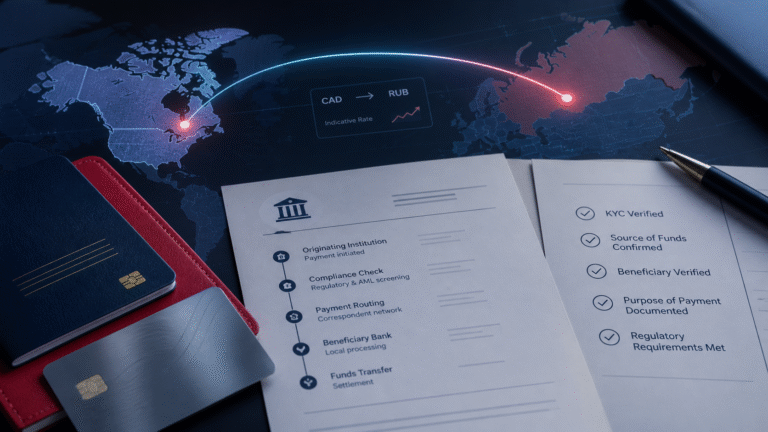
Direct answer: You may be able to send child support to Russia from abroad when the payment is lawful in your country and the sender, recipient, banks and intermediaries pass the required checks. Use the exact purpose shown in the maintenance order or agreement, confirm the recipient bank first, and keep evidence for every payment.
Check a family-support route before you fund it
NoWALL can review the sender country, currency, amount, payment purpose and Russian recipient-bank details, then explain an available payment arrangement and the records likely to be requested. Banks and regulated payment partners make the final compliance decision, so each route must be confirmed for the specific payment.
Child support is not an ordinary gift. It may arise from a court order, a notarised agreement or a private arrangement, and the payment record can matter later in a family-law dispute. At the same time, the transfer crosses a payment system affected by sanctions, bank restrictions and changing provider coverage.
The safest practical approach is to separate two questions. First, what does the maintenance obligation require? Second, which lawful payment route can deliver the money to the named recipient and produce a clear receipt? A successful transfer answers both.
Which routes can be considered?
No route works for every family. Availability depends on the sender’s jurisdiction, the recipient bank, the currency, the amount and the institutions involved. Confirm the complete chain before sending.
| Route type | When it may fit | What to verify | Main record to keep |
|---|---|---|---|
| Supported bank transfer | Regular payments backed by an order or agreement | Recipient bank, intermediaries, currency and payment wording | Bank confirmation with reference and beneficiary |
| Regulated payment arrangement with RUB payout | Personal family support where the corridor is supported | Sender eligibility, recipient bank, payout amount and limits | Provider receipt plus proof of recipient credit |
| Transfer to a Russian bank account | Recipient can receive rubles to a named account | Account holder name, bank BIC and route acceptance | Receipt showing the account and payment purpose |
| Card-linked ruble receipt | A supported route pays to an account linked to a card | Issuing bank and required details, not only the MIR logo | Receipt identifying the recipient and transaction |
| Cash or informal intermediary | Rarely suitable for an obligation that must be proved | Licensing, identity, written terms and traceability | Often inadequate; avoid undocumented arrangements |
A familiar brand is not proof that the corridor is open. The route must accept the sender, the family-support purpose and the recipient’s bank on the day of payment. Compare the amount credited in rubles, the expected timing, the refund process and the quality of the receipt, not just the advertised fee.
Start with the maintenance document
Read the court order, settlement or written agreement before choosing a route. Record the amount, currency, due date, payment frequency, named recipient and any required reference. If the document specifies a bank account or method that no longer works, obtain family-law advice about changing the payment instructions instead of quietly substituting a method that may not satisfy the obligation.
Cross-border enforcement rules are country-specific. The Hague Conference child-support section explains the international framework and directs users to the relevant Central Authority where the 2007 Convention applies. Do not assume that the Convention or a reciprocal-enforcement arrangement covers Russia and your country; check the current status and get local advice for the actual order.
How to prepare a traceable payment
1. Confirm who must receive the money
Use the beneficiary named in the order or agreement. If another person asks to receive the payment, obtain written confirmation and legal advice before changing the beneficiary. A convenient substitute account can create both compliance questions and a dispute over whether support was paid.
2. Collect the recipient’s bank details
Ask for the account holder’s full legal name, bank name, BIC and the account or card-linked details required by the route. Check the issuing bank rather than relying on a card logo. Our guide to checking a Russian recipient bank explains why the bank and payment chain matter.
3. Use an accurate payment purpose
Describe the payment truthfully, for example “child support for August 2026 under order dated [date]” or the wording advised by your bank or lawyer. Do not call maintenance a gift, salary or invoice payment. Consistent references make reconciliation easier and help distinguish family support from commercial activity.
4. Screen the parties and payment chain
Personal support is not automatically prohibited, but it is not exempt from all checks. The US Treasury’s OFAC FAQ 1202 says personal, non-commercial remittances are generally not the target of US sanctions on Russia, while also requiring that payments not involve blocked persons or otherwise prohibited activity.
EU senders must apply the EU rules relevant to them. The European Commission’s updated payment-services FAQ explains the scope of current restrictions, and its sanctions resources page links to the EU Sanctions Map and consolidated financial-sanctions list. UK senders should use the current Russia sanctions statutory guidance and UK Sanctions List. When the facts are uncertain, ask the bank, a regulated provider or a qualified sanctions adviser before funding.
5. Confirm the final ruble amount and timing
Ask for the sending amount, exchange rate or margin, provider charge, possible intermediary deductions and estimated rubles credited. If the order fixes the amount the recipient must receive, fees and exchange-rate movements may affect whether the obligation is fully met. Our guide to Russia transfer fees and FX costs shows how to compare quotes.
6. Preserve a complete evidence trail
Save the quote, funding confirmation, transfer receipt, transaction reference, recipient confirmation and any bank correspondence. Keep a simple payment log with the due date, amount due, amount sent, currency, amount received and status. Screenshots alone can be hard to authenticate later; download formal statements or receipts where possible.
Documents and details checklist
- sender’s full legal name, residence and identity document;
- recipient’s full legal name and relationship to the child;
- court order, notarised agreement or signed maintenance arrangement;
- due amount, currency, frequency and payment reference;
- recipient bank name, BIC and required account details;
- source-of-funds evidence, such as payslips or bank statements;
- proof of relationship if requested by the provider;
- written instructions for any change of beneficiary or account;
- previous receipts and a schedule of payments already made.
The provider may request only part of this package, or ask for additional information. Prepare documents before the due date because manual compliance review can delay the payment. See the broader document checklist for transfers to Russia.
Risks that matter for child-support payments
A route can fail even when the purpose is legitimate
A payment may be delayed or returned because a bank is unsupported, the beneficiary name does not match, an intermediary rejects the transfer, the purpose is vague or the provider’s policy changes. A legitimate family purpose does not require a financial institution to process the payment.
Late payment may have legal consequences
A transfer delay does not necessarily pause the underlying obligation. If a due date is close, notify the recipient in writing, preserve evidence of the failed attempt and seek legal advice about an acceptable alternative. Do not wait for a return to disappear from the pending balance before documenting what happened.
Third-party accounts weaken the evidence
Paying a friend, agent or unrelated account holder may make the transfer harder to screen and harder to prove as child support. Use the named recipient whenever possible. If a court, lawyer or competent authority instructs a different method, keep that instruction with the receipt.
Splitting payments is not a compliance solution
Do not divide a payment to avoid limits or review. It can trigger additional checks and produce a confusing record. If the required amount exceeds a route limit, find a route designed for the amount or obtain advice on a documented payment plan.
If a transfer is already stuck, use our guide to delayed and returned Russia payments before sending the same amount again.
Frequently asked questions
Is child support a personal remittance?
It is normally a personal, non-commercial family payment, but the legal classification and sanctions treatment depend on the sender’s jurisdiction and the facts. The route must still screen the recipient, banks and intermediaries.
Can I write “gift” as the payment purpose?
Not if the money is child support. Use an accurate reference that connects the payment to the order or agreement. Mislabeling can create compliance, tax and family-law problems.
Can child support be sent to a MIR card?
A supported arrangement may credit rubles to the account linked to a MIR card, but the card logo alone does not establish availability. Check the issuing bank, recipient details and current route. Read our MIR card receipt guide.
What if the order names an account that no longer accepts transfers?
Ask the recipient for current written instructions and obtain family-law advice if the order fixes a specific method. Keep evidence of the unavailable route and any approved replacement instructions.
What proof should I keep?
Keep the maintenance document, payment quote, formal receipt, bank statement, transaction reference, recipient confirmation and correspondence about delays or account changes. Maintain a dated payment schedule.
Does a successful first payment guarantee the next one?
No. Sanctions lists, bank policies, intermediaries and route limits can change. Reconfirm the route before each payment, especially after a bank-detail change or a long interval.
Freshness note: This guide was reviewed on August 14, 2026. Sanctions, bank policies, enforcement arrangements and provider coverage can change. Recheck official sources and obtain jurisdiction-specific legal advice where needed.