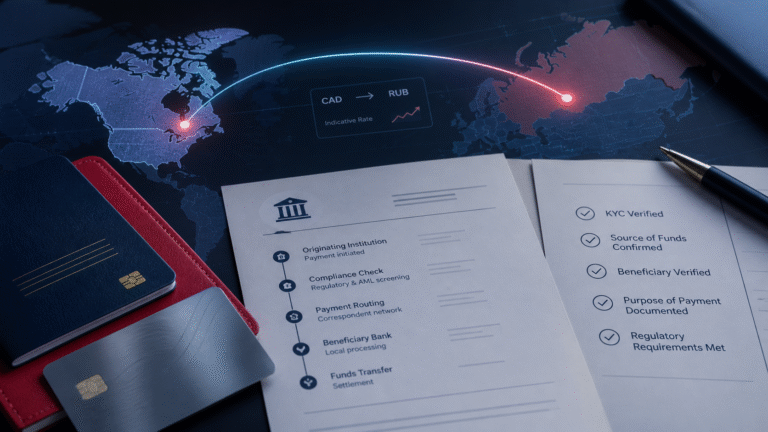
For most transfers to Russia, choose the receipt method only after the provider confirms the recipient bank and the exact payout route. A bank-account transfer usually offers clearer records and better support for invoices; a card credit can be simpler for personal payments. Neither option is universally available, and the card’s issuing bank still matters.
NoWALL can review the sender country, amount, purpose and Russian recipient bank, then explain whether an account or card-based receipt route is currently practical. You receive the details and documents to prepare before funding. Banks and regulated providers make the final approval decision. Ask NoWALL to review your payment.
The important distinction is not simply “bank or card.” A card is issued by a bank and normally connects to an underlying account. The real questions are which institution receives the rubles, how the recipient is identified, what reference appears, and whether the complete chain supports that payment today.
Bank account or card: the practical difference
| Receipt option | Usually suits | Details commonly needed | Main limitation |
|---|---|---|---|
| Credit to a Russian bank account | Invoices, contractor payments, salary, larger or recurring transfers | Full beneficiary name, bank name, BIC, account number, purpose and supporting documents | The provider and every bank in the route must support the institution and currency |
| Credit linked to a Russian bank card | Personal support and some smaller consumer payments | Card or linked-account details, recipient name and issuing bank; requirements vary by route | A valid card number does not prove that an international or arranged payout is available |
| Specialist ruble payout | Personal or documented commercial cases where a provider has a supported local settlement route | Sender and recipient identity, purpose, funding source and provider-specific bank details | Availability, limits, timing and documentation can change |
| Traditional international bank transfer | Cases where the sender bank confirms a reachable beneficiary and correspondent chain | Full account details, SWIFT/BIC data, currency, purpose and bank documents | Correspondent restrictions or an unsupported recipient bank can cause rejection or return |
An account credit gives a clearer audit trail because the instruction identifies the beneficiary account and bank. It is often the better starting point for a payment tied to a contract, invoice or employment record. A card-linked payout may ask for fewer visible fields, but the provider must still identify the issuing bank, verify the recipient and explain how the final ruble credit works.
When a bank-account transfer is the better fit
Choose account details when the payment needs a formal record. This includes supplier invoices, contractor fees, salary, loan repayments and recurring support where both sides want consistent statements. Account instructions also make it easier to compare the recipient name, bank, BIC and purpose before sending.
A bank-account route is particularly useful when the recipient needs to show where the money came from or connect it to an invoice. Ask what sender name and payment reference will appear on the Russian statement. If an intermediary or local payout partner is used, that name may differ from the person who originally funded the transfer.
Account details do not make a route automatically available. The sender’s bank may decline the destination, a correspondent may not carry the currency, or the receiving institution may not accept the proposed transfer type. Confirm the complete path before you send, not only whether the Russian account is active.
When a card-linked credit may be more convenient
A card route may be practical for personal transfers when the provider explicitly supports the issuing bank and can identify the cardholder correctly. The recipient may see the ruble credit quickly and avoid handling foreign-currency account instructions.
Do not assume that “MIR card accepted” describes every MIR card. MIR is the payment system, while the issuing bank remains the institution that holds the account and applies receipt rules. A provider may support cards from selected banks and reject others. Our separate guide explains what to check before sending money to a MIR card from abroad.
Never send a card PIN, one-time password, online-banking password or CVV security code. A legitimate recipient-information request should not need credentials that authorize spending. If the route asks only for a card number, still request the issuing bank’s legal name so it can be screened and confirmed.
Recipient details to collect before choosing
Ask the recipient to copy details from their banking app or official account document. Transliterated names, shortened bank names and old card details create avoidable repair requests.
For an account credit
- Recipient’s full legal name exactly as held by the bank
- Whether the recipient is an individual, sole proprietor or company
- Recipient bank’s full legal name and Russian BIC
- Account number and any correspondent-account field requested
- Account currency and whether conversion to rubles is automatic
- Accurate payment purpose and required reference
- Contract, invoice or relationship evidence when relevant
For a card-linked credit
- Cardholder’s full legal name
- Issuing bank’s full legal name
- Card scheme and the provider-requested card or linked-account details
- Confirmation that the card is active and can receive the proposed credit type
- Expected ruble amount, limits and any receiving fee
- No PIN, CVV, password or one-time code
For either option, prepare the sender’s identity, address, source of funds, amount, currency and honest purpose. See the complete documents checklist for transfers to Russia if the payment is large, recurring or commercial.
How to compare quotes for the two routes
Compare what the recipient receives, not just the fee shown beside the order. One route may charge a visible service fee while using a tighter exchange rate; another may advertise a low fee but deliver fewer rubles.
- Fix the same funding amount. Compare both options using the exact amount and currency leaving the sender.
- Ask for the expected ruble credit. Confirm whether it is fixed, indicative or recalculated when funds arrive.
- List every deduction. Include provider, funding, intermediary, receiving and card-related charges.
- Check the timing definition. Find out whether the estimate begins at order creation, funding receipt or compliance approval.
- Understand the return path. Ask where a failed payment returns, in which currency and with which deductions.
The guide to the cost of sending money to Russia provides a fuller comparison method. If timing matters, allow extra time for identity, purpose and bank checks; a fast payout stage does not mean the entire transfer is instant.
Restrictions still apply to both options
Changing from an account number to a card number does not remove sanctions or compliance checks. The provider may screen the sender, recipient, issuing or receiving bank, intermediaries, beneficial owners and payment purpose. A payment can be legally permitted yet unavailable through a particular provider or bank.
For US-related payments, OFAC FAQ 1202 says personal, non-commercial remittances are generally not the target of US Russia sanctions, provided a transaction does not involve blocked persons and is not otherwise prohibited. That statement is not a blanket approval for every bank, recipient or purpose.
EU rules and provider obligations also continue to change. The European Commission published updated guidance on payment services under Article 5b(2) in March 2026. Senders should check the rules that apply to their residence, nationality, business and payment chain rather than relying on the recipient method alone.
Mainstream provider coverage is narrower than many readers expect. Wise lists Russia among unsupported locations and says customers cannot send or receive money to or from them. Western Union says its Russia operations remain suspended. A card option offered elsewhere should not be presented as a Wise or Western Union route.
Red flags that should stop the payment
- The recipient name does not match the account or cardholder name.
- The issuing bank cannot be identified or is different from the bank named by the recipient.
- You are asked to label an invoice as family support or use a false purpose.
- An unrelated third party is introduced without a documented reason.
- The provider will not explain who delivers the rubles or how a failed transfer returns.
- You are told to split a payment to avoid a limit or review.
- Someone requests a PIN, CVV, password or one-time security code.
Pause when information conflicts. Correct the beneficiary record and repeat the bank check before funding. The step-by-step guide to checking a Russian recipient bank covers official list searches, ownership concerns and provider confirmation.
A simple decision process
- Define the real purpose. Personal support and a commercial invoice need different records.
- Identify the recipient bank. Do this even when the recipient prefers a card credit.
- Ask which receipt methods are supported today. Give the provider the sender country, currency, amount, purpose and bank name.
- Compare the final ruble amount and return terms. Do not choose on headline speed or fee alone.
- Use the method that leaves the right evidence. For business payments, this will often be an account credit with a clear reference.
- Reconfirm immediately before sending. Bank access, provider coverage and limits can change.
If both routes are available, convenience can decide a small personal transfer. For a formal or recurring payment, prioritize clear beneficiary details, statement records and consistent documents. No receipt method guarantees acceptance or protects a payment from later review.
Frequently asked questions
Is sending to a Russian card faster than sending to a bank account?
It can be, but only after the provider approves the payment and supports the issuing bank. Compare the full time from funding to available rubles, not only the final payout stage.
Can I send money using only a MIR card number?
Some supported routes may request a card number, but you should still identify the cardholder and issuing bank. A MIR card number alone does not confirm current route availability or compliance acceptance.
Which option is better for paying a Russian invoice?
A bank-account credit is usually easier to connect to an invoice, contract and payment reference. Confirm the beneficiary company, bank details, ownership, purpose and required documents before paying.
Does a card credit avoid sanctions checks?
No. The provider can still screen the sender, recipient, issuing bank, intermediaries and payment purpose. Changing the receipt format does not change the legal or compliance obligations.
What should I do if a card route is unavailable?
Ask whether the recipient has another supported account in their own name, then repeat the complete bank and route check. Do not use an unrelated person or disguise the purpose.
Freshness note: checked on 22 July 2026. Sanctions rules, payment-service coverage, Russian bank access and payout methods can change without notice. Reconfirm the complete route before every transfer.