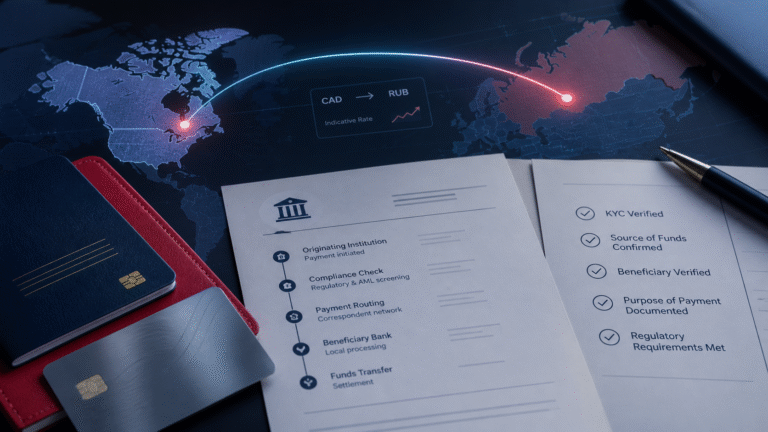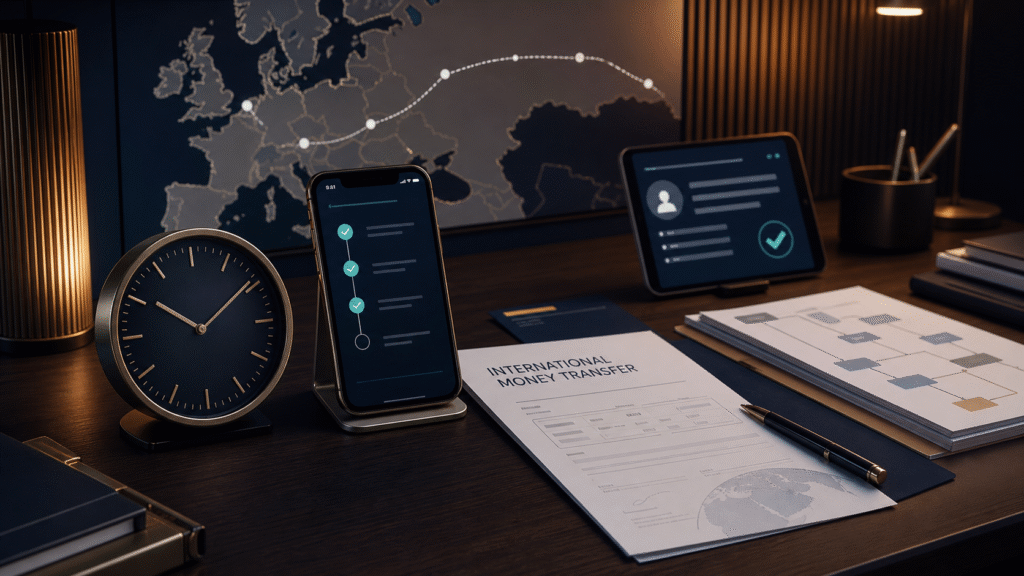
A money transfer to Russia may arrive the same day, but a realistic estimate is often one to five business days after the route and documents are approved. Timing depends less on the “send” button than on funding, compliance review, currency conversion, intermediary banks and the final ruble credit. Treat any estimate as conditional until the recipient confirms receipt.
NoWALL can review the sender country, currency, amount, payment purpose and Russian recipient-bank details before you fund a transfer. You receive a route-specific estimate, document checklist and explanation of how receipt will be confirmed. Banks and regulated providers retain the final approval decision. Ask NoWALL to check your route.
Typical transfer times to Russia
There is no single settlement time for payments to Russia in 2026. A route advertised as “instant” may describe only the provider’s own processing stage. It may exclude the time needed to receive your funding, review the transaction, convert currency or credit the recipient’s Russian account.
| Route | Practical timing range | What usually controls the clock |
|---|---|---|
| Specialist transfer with ruble payout | Same day to 3 business days after approval | Funding arrival, identity checks, payout window and recipient-bank processing |
| International bank transfer | 2 to 7 business days, sometimes longer | Correspondent banks, currency route, sanctions screening and repair requests |
| Business invoice or contractor payment | 3 to 10 business days after a complete file | Contract review, beneficial-owner screening, payment purpose and bank documents |
| Card or account payout through an arranged route | Often same day to 3 business days after approval | Issuing bank support, recipient-name match, limits and domestic ruble settlement |
These are planning ranges, not promises. Weekends, public holidays, cut-off times and an information request can extend any route. A transfer is complete only when the recipient sees an available balance, not when the sender sees “processed.”
What happens between sending and receipt
1. Your payment reaches the provider
Bank transfer funding may take longer than card funding, especially when sent after the bank’s daily cut-off. The sender name normally needs to match the customer or contracting party. A third-party payment can be paused or returned because the provider cannot link it cleanly to the transfer order.
2. The transaction passes compliance checks
The provider may screen the sender, recipient, banks, owners and payment purpose. Russia-linked payments often need more context than a domestic transfer. A review can be automatic, manual or escalated to a bank in the chain. It is not possible to predict every review in advance.
Rules depend on the sender’s jurisdiction. US persons should consult current OFAC guidance on noncommercial personal remittances and other applicable sanctions. EU senders should check the European Commission’s current payment-services sanctions guidance. A permitted purpose does not force a bank or provider to accept the route.
3. Currency is converted and the payout is released
The quote may involve EUR, GBP, USD, AED, TRY or another funding currency before a ruble payout. Ask when the exchange rate becomes final: when you create the order, when funds arrive or when the payout is executed. This matters both for timing and for the amount the recipient receives.
4. The Russian bank credits the recipient
The final institution may apply its own checks or wait for a domestic settlement window. The recipient’s account type and currency also matter. A MIR card number does not by itself prove that the issuing bank or underlying account accepts the proposed route; see our guide to sending money to a MIR card from abroad.
Why “instant” routes can still be delayed
Provider coverage is a frequent source of confusion. Wise currently lists Russia among unsupported countries and says customers cannot send or receive money to or from those locations. Its policy also notes that transactions can be cancelled or refunded and that information requests can place transfers on hold. Check the current Wise supported-country guidance rather than relying on an old transfer estimate.
Western Union’s official notice says its Russia and Belarus operations were suspended in 2022. A historical delivery promise therefore does not describe a current Russia route. See the company’s Russia and Belarus service notice.
Other common delays include:
- A recipient name that does not exactly match the bank account
- An incomplete BIC, account number, address or payment reference
- A vague purpose such as “services” with no contract or invoice
- A sanctions-list false positive that requires identity documents
- A correspondent bank refusing the currency or Russia-linked payment
- The recipient account accepting rubles but not the proposed incoming transfer type
- A payment created before a weekend or public holiday
- A rate change, limit or source-of-funds question that must be resolved first
Details and documents that prevent avoidable delays
Collect the complete file before sending. Correct information does not guarantee approval, but it reduces repair requests and makes a review easier to answer.
- Sender’s full legal name and current address
- Recipient’s full legal name exactly as held by the Russian bank
- Recipient bank’s legal name, BIC and account details
- Recipient type: individual, sole proprietor or company
- Honest and specific payment purpose
- Source-of-funds evidence, such as a bank statement or payslip, if requested
- For family support, evidence of relationship where relevant
- For business payments, contract, invoice, service description and acceptance record
- Expected funding currency, payout currency and target amount in rubles
- A phone number or email for prompt information requests
For a fuller preparation list, use our guide to the documents needed to send money to Russia. Before releasing a large or urgent payment, also check the Russian recipient bank and confirm that every intermediary supports it.
How to estimate the arrival date
- Start with approval, not order creation. Ask whether the quoted time begins when you place the order, when funding clears or when compliance approves it.
- Count business days in every relevant country. Include the sender’s bank, provider and Russian receiving bank.
- Add document-review time. For a new sender, large payment or business invoice, allow time to answer questions.
- Ask about conversion and payout windows. A provider may release rubles only during local banking hours.
- Define completion. Use “available in the recipient’s account” rather than “sent,” “accepted” or “processed.”
For example, an order funded late on Friday may not clear until Monday. If the provider requests an invoice on Tuesday and approves it Wednesday, a quoted one-business-day payout may reasonably arrive Thursday. The elapsed time is almost a week even though the payout stage took one day.
How to track a transfer without creating confusion
Keep the order number, funding receipt, amount, currency, creation time and every status message. If a bank transfer is involved, ask the sending institution for the appropriate payment reference or trace information. Share references through the provider’s secure channel, not in public messages.
Use precise questions:
- Has my funding been received and matched?
- Is compliance review complete, or is a document outstanding?
- Has the payout been released to the next bank?
- Which institution currently holds or is reviewing the payment?
- What reference can the recipient give their bank?
- When does the return process begin if the route cannot complete?
A status marked “complete” by an intermediary may mean its part is finished, not that the beneficiary has been credited. Ask the recipient to check both the account balance and any pending incoming payment.
When a delay becomes a problem
Contact the provider as soon as the stated window expires, or earlier if the transfer details are wrong. Do not create a second payment merely because the first one is slow; duplicates are harder to recover. If documents are requested, reply through the official channel and keep the payment purpose consistent with the original transaction.
If the provider confirms a rejection or return, ask which fee and exchange rate will apply, where the money will be returned and how long the return may take. Our guide to transfers that are delayed, rejected or returned explains the most common failure points.
Risks and compliance checks
Never hide the Russian destination, use an unrelated recipient or mislabel a business payment as family support to make it appear faster. These steps can trigger a freeze, rejection or account restriction and may breach applicable law. Screen the people, banks and purpose under the rules that apply to the sender and every institution involved.
Time estimates are operational guidance, not legal advice. Sanctions and provider policies change, and banks may make different decisions about similar payments. NoWALL can help map an available route and the questions to resolve, but it cannot guarantee acceptance or a fixed delivery date.
Frequently asked questions
Can a transfer to Russia arrive on the same day?
It can, particularly when funding, compliance approval and ruble payout all happen within local operating hours. Same-day delivery should be treated as a possibility, not a guarantee.
Do weekends count toward a transfer estimate?
Usually not when the route depends on banks or manual compliance review. Count business days across the sender country, provider location and Russia, and check local holidays.
Why is my payment under compliance review?
The provider or a bank may need to verify identity, source of funds, recipient details, ownership, payment purpose or sanctions-list matches. Ask exactly which document or fact is missing.
Does “processed” mean the recipient has the money?
Not necessarily. It may mean only that one institution released the payment. Completion should mean that the recipient sees an available balance in the correct account.
Should I resend if the first transfer is late?
No. Trace the first payment before creating another. A duplicate can also be delayed and may leave you trying to recover two transfers.
Freshness note: checked on 20 July 2026. Sanctions rules, bank access and provider coverage can change without notice. Reconfirm the full route and timing before every payment.