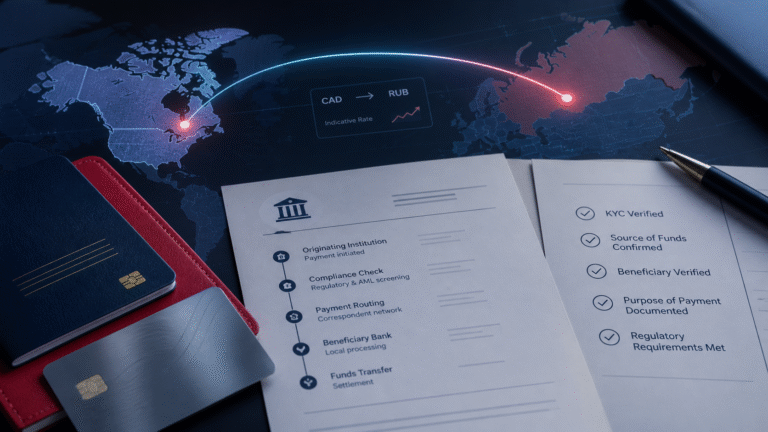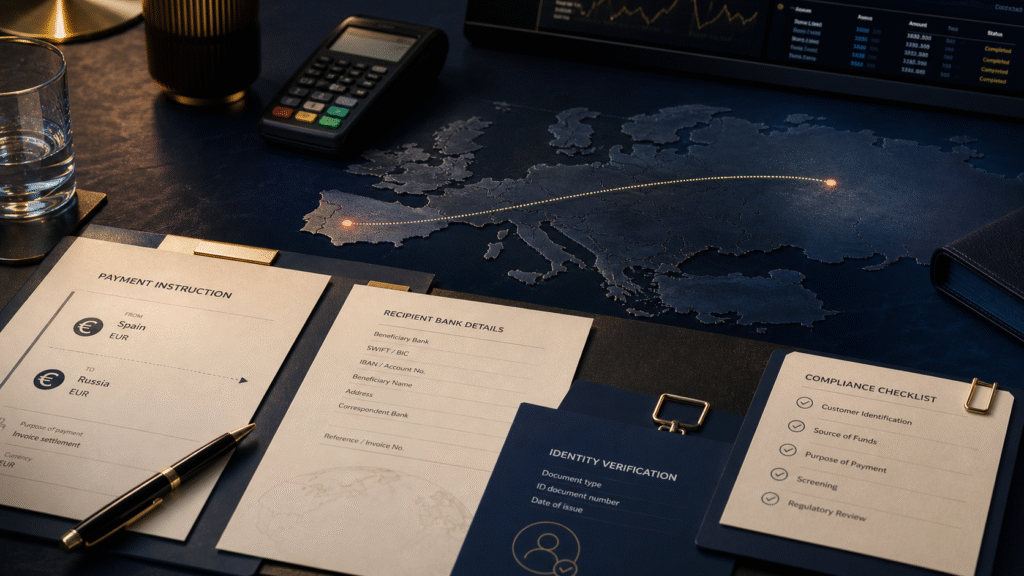
Sending money from Spain to Russia in 2026 is possible only when a bank or regulated provider supports the exact Spanish sender, payment purpose, recipient and Russian bank. Start by checking EU restrictions, beneficiary details, fees, currency conversion and refund terms. Do not fund a route until every intermediary confirms it can handle the transaction.
Unsure whether your Spanish bank, conversion provider and Russian recipient bank form a workable chain? Share the sender profile, euro amount, reason for payment, beneficiary details and preferred settlement. NoWALL will map the questions to resolve before funding and outline available arrangements. Any institution in the chain may still request documents or decline. Check your route.
A transfer that starts in Madrid, Barcelona or elsewhere in Spain may cross several systems before the recipient sees rubles. The Spanish bank or payment provider, a correspondent, the conversion partner and the Russian receiving bank can each apply separate rules. A familiar euro transfer screen therefore does not prove that the Russia corridor is open.
What makes a Spain-to-Russia transfer different?
Spain follows EU sanctions rules, while banks also apply their own risk policies. Some Russian banks face transaction restrictions, and some payment services cannot be provided to certain Russian nationals, residents or entities. The payment purpose matters too: family support, repayment of a personal expense and a supplier invoice do not use the same compliance file.
The practical question is not simply whether “transfers to Russia” exist. You need to know whether the route accepts a sender resident in Spain, the funding bank and currency, the named recipient, the receiving bank and the truthful purpose of this specific payment.
Routes to compare before sending
| Possible route | When it may fit | What to confirm | Main limitation |
|---|---|---|---|
| International bank transfer | Your Spanish bank can reach the named Russian bank for the stated purpose | Supported currency, correspondent chain, payment wording, charges and return process | A bank or intermediary may decline the party, bank, currency or purpose |
| Regulated specialist provider | The provider explicitly supports Spain-to-Russia settlement for your use case | Spanish onboarding, recipient coverage, delivered amount, identity checks and refund terms | Country access at the sender side does not prove Russia payout is available |
| Documented local ruble delivery | A disclosed provider accepts euros and arranges a traceable domestic payout | Legal entities involved, quote, conversion rate, final payer name and proof of delivery | Opaque third parties weaken the audit trail and increase fraud risk |
| Commercial payment route | You are paying a Russian company, freelancer or contractor | Contract, invoice, service category, tax records, sanctions screening and recipient ownership | A consumer remittance flow may prohibit business payments |
| Cash, gift cards or an unrelated person | Not a sound default for a traceable transfer | Do not use these to hide the payer, recipient or Russia connection | Loss, fraud, weak records and possible compliance concerns |
Wise currently lists Russia among the countries and regions where it does not support sending or receiving money. Its official availability guidance is a useful reminder to verify the destination rather than assume a provider works because it is available in Spain.
Run a recipient check before asking for a quote
Start with the person or company, not just a card number. The recipient name should match the account holder, and the bank details should come from a recent, trusted source. If the recipient changes bank or asks you to pay another person shortly before transfer, stop and verify the request through a separate communication channel.
Recipient details checklist
- full legal name exactly as held by the receiving bank;
- date of birth or company registration data if the provider requests it;
- residential or registered business address;
- account number or domestic card-linked account details;
- current bank name, address and BIC/SWIFT where required;
- receiving currency and any correspondent instructions;
- clear relationship to the sender and truthful payment purpose;
- a recent bank confirmation for a new or changed beneficiary.
Spanish customers may be familiar with beneficiary-name verification for euro transfers. The Bank of Spain explains how this check works, but it should not be treated as confirmation that a Russian account or an intermediary payout is covered. Ask the selected provider what beneficiary matching it performs on the actual destination leg.
For a fuller preparation list, use the documents needed to send money to Russia guide before submitting personal information.
Prepare documents that match the real purpose
A clean file reduces avoidable questions, but it does not guarantee approval. The sender’s identity, source of funds and reason for payment should be consistent across the bank statement, provider form and supporting documents.
For family support or another personal payment
- passport or Spanish/EU residence document;
- recent proof of address;
- bank statement showing the source of funds;
- recipient identity and relationship evidence when requested;
- a short, accurate explanation of the payment;
- supporting record for reimbursement, rent, education or medical costs where relevant.
For an invoice or professional payment
- signed contract and invoice naming the real parties;
- specific description of goods or services;
- delivery, milestone or acceptance evidence;
- company and beneficial-owner information where requested;
- source-of-funds and tax records appropriate to the payer;
- screening results and any licence or legal opinion the transaction requires.
Do not label a business payment as a gift or family transfer. If you are paying a supplier, use the dedicated guide to paying an invoice to Russia from abroad.
Check EU restrictions and every bank in the chain
EU rules are not a blanket answer for every transfer. They combine listed-party measures, transaction bans, restrictions on certain payment services and anti-circumvention provisions. The European Commission’s current payment-services guidance explains Article 5b(2) and relevant exemptions. Its central page of Russia sanctions questions and answers links the latest guidance by topic.
Screen the sender, recipient, beneficial owners where relevant, Russian bank, correspondents, provider, payment purpose and any controlled sector or territory connection. A recipient who is not listed may still use a bank the route cannot serve. Conversely, a lawful personal payment can still be declined under a bank’s internal policy.
Never add an unnecessary third country or unrelated person to disguise the destination. If the legality is unclear, pause and obtain advice from a sanctions professional qualified for Spain and the transaction type.
Calculate the delivered amount, not only the upfront fee
Compare quotes on the same basis: euros paid, all charges, exchange rate, rubles or other currency delivered, timing and refund value. A route with a low visible fee can cost more if its exchange-rate margin is wider or an intermediary deducts charges.
- amount debited in euros;
- sender-bank and provider fee;
- correspondent and recipient-bank deductions;
- EUR conversion rate and quote-validity period;
- exact amount expected at the destination;
- who pays charges under OUR, SHA or BEN instructions;
- refund currency, timing and non-refundable costs.
The Bank of Spain’s transfer-fee explanation describes percentage fees, minimum charges and OUR/SHA/BEN allocation. For a cross-border Russia route, ask whether additional intermediary or conversion costs fall outside the Spanish bank’s quoted fee. The broader NoWALL guide explains how to compare the total cost of sending money to Russia.
A safer step-by-step workflow
- Define the payment. Record whether it is personal support, reimbursement, salary, contractor work or an invoice.
- Verify the recipient. Match the name, account holder, bank and currency using a trusted source.
- Screen the transaction. Check the parties, banks, purpose and applicable EU restrictions.
- Confirm the entire route. Ask the provider about Spain funding, intermediaries and the exact Russian destination.
- Build the document file. Keep identity, source-of-funds and purpose evidence consistent.
- Compare delivered value. Record fees, exchange rate, deductions, timing and refund terms.
- Send only after confirmation. Save the quote, payment reference and provider communication.
- Collect proof of receipt. Reconcile the amount delivered and retain records for tax or accounting needs.
If a transfer is delayed or returned, do not resend the same instruction immediately. Ask which institution stopped it and why, correct the actual issue, and use the guide to delayed and returned Russia transfers.
Frequently asked questions
Can I send money from a Spanish bank account to Russia?
Possibly, but only if the Spanish bank and every intermediary support the named Russian bank, recipient, currency and payment purpose. Ask for route-specific confirmation before sending; access can differ between banks and transactions.
Can I send euros directly to a Russian card?
A card number alone is not enough to prove a route exists. Confirm the underlying recipient account, supported receipt currency, conversion method, bank coverage, fees and the name that will appear to the recipient.
Is a family transfer from Spain automatically allowed?
No automatic conclusion applies. The parties, banks, amount, purpose and current restrictions still need review. Keep evidence of the relationship and source of funds if the bank or provider requests it.
How long does a Spain-to-Russia transfer take?
Timing depends on onboarding, document review, bank cut-offs, intermediaries, currency conversion and recipient-bank processing. Treat an estimate as conditional and ask when a trace or refund can begin.
What happens if the transfer is rejected?
Request the rejection reason, return reference, refund currency, deductions and expected date. Do not change the purpose or use another person solely to avoid the original review.
Freshness note: Reviewed on 15 July 2026. Sanctions rules, bank routes, provider coverage and document requirements can change. Confirm the current legal and operational position before each transfer.