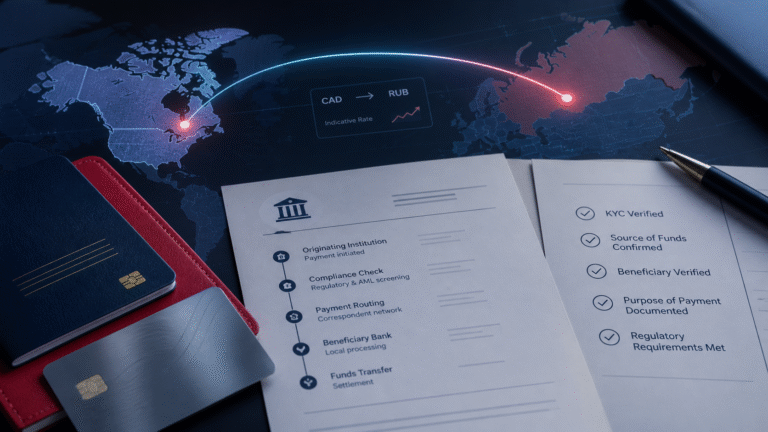
Converting USDT to rubles in 2026 requires more than finding an exchange rate. You must confirm the token network, lawful payment purpose, provider eligibility, recipient identity, Russian bank and final RUB amount before transferring. Use a traceable route with written terms; crypto does not remove sanctions, anti-money-laundering or bank checks.
Check the complete route before sending USDT
Share the sender country, USDT network, amount, payment purpose and Russian recipient details with NoWALL. The team can review an available conversion and ruble-payout arrangement, explain the information likely to be requested and provide a quote. Acceptance remains subject to provider, compliance and bank checks.
The most important question is not whether USDT can be sold somewhere. It is whether one documented chain can accept your specific funds and deliver the agreed ruble amount to the correct recipient. A quoted price is useful only when you also know the supported blockchain, fees, payout method, screening conditions and what happens if the payment cannot be completed.
USDT-to-ruble routes to compare
| Route | When it may fit | Confirm before transferring | Main risk |
|---|---|---|---|
| Regulated exchange with fiat withdrawal | The exchange accepts your jurisdiction, identity and intended Russian withdrawal method | Account eligibility, USDT network, RUB market, recipient-bank support, limits and withdrawal fee | The exchange may not serve Russia or may restrict the receiving account |
| Specialist conversion and ruble payout | A provider can review the parties, wallet history, purpose and Russian bank | Legal provider entity, wallet address, fixed or indicative RUB amount, payout timing and return terms | Sending before the provider approves the exact transaction |
| Peer-to-peer marketplace | The platform provides identity controls, escrow and a clear dispute process | Counterparty name, payment-account ownership, platform rules, proof requirements and fraud safeguards | Third-party payments, chargebacks, stolen funds or an account freeze |
| Direct private counterparty | Only where the party, source of rubles and legal basis are independently verified | Identity, ownership of both wallets and bank accounts, written terms and transaction evidence | Weak recovery rights, fraud and an unexplained bank credit |
A route that worked for another person may not accept your residence, nationality, wallet history, amount or recipient bank. Never send USDT to an address copied from an old chat. Obtain a fresh instruction for the exact network and verify it through the provider’s established channel.
Start with the token and network
USDT exists on several blockchains. The same ticker does not mean every deposit address accepts every version. If a provider gives you a TRON address and you send an Ethereum-based token, the transfer may not be credited and recovery may be impossible or expensive.
Match five technical details
- the asset is USDT, not another token with a similar name;
- the sending and receiving networks are identical;
- the destination address is current and copied exactly;
- any memo, tag or additional identifier is included when required; and
- your wallet has enough native network currency to pay the blockchain fee.
Use the network name written by the receiving provider, not an assumption based on address appearance. When permitted, a small test transfer can catch an address or network mistake. It cannot guarantee that the balance of a larger transaction will pass later screening.
Define who receives the rubles and why
Write the real purpose in plain language before requesting a quote: converting your own savings, supporting family, paying a contractor or settling an invoice. These are not interchangeable. A personal payout route may reject commercial funds, while a business route may require a contract, invoice, ownership information and evidence that services were delivered.
Crypto is not outside financial restrictions. OFAC FAQ 1021 states that US sanctions obligations apply to virtual-currency transactions as well as traditional currency. The European Commission’s crypto-assets FAQ likewise explains that prohibited transactions remain prohibited when crypto-assets are used. Do not use wallets, third parties, false descriptions or transaction splitting to conceal a restricted party or purpose.
Details and documents to prepare
A provider may ask for more information after reviewing the wallet and payout. Preparing it early helps resolve name matches and connects the USDT transfer to the final ruble credit.
Sender and wallet information
- full legal name, residence, identification and contact details;
- source of funds and source of USDT, with exchange or purchase records;
- sending wallet address and evidence that you control it;
- USDT network, amount and transaction history relevant to the payment;
- honest purpose and relationship to the recipient; and
- supporting contract, invoice or family-relationship evidence where relevant.
Recipient and payout information
- recipient’s full legal name exactly as held by the bank;
- whether the recipient is an individual, sole proprietor or company;
- Russian bank’s full legal name and BIC;
- account or provider-requested card details and the account currency;
- expected RUB amount and accurate payment reference; and
- contract, invoice, employment or other basis for a commercial payment.
Never disclose a wallet seed phrase, private key, banking password, card PIN, CVV or one-time code. A legitimate provider may request proof that you control an address, but it does not need credentials that allow it to take your assets. For broader preparation, see the documents checklist for transfers to Russia.
How to compare the real conversion cost
Compare quotes using one USDT amount and the net rubles due to the recipient. The visible service fee is only one component.
- Confirm the pricing basis. Ask whether the RUB rate is fixed when the order is created, when USDT receives blockchain confirmations or when compliance review finishes.
- List every deduction. Include network gas, provider spread, service fee, payout charge and any receiving-bank deduction.
- Check quote expiry. A short-lived market quote may need to be refreshed before funding.
- Define completion. Determine whether the order is complete at blockchain receipt, provider approval or final bank credit.
- Read return terms. Ask whether a failed payout is returned in USDT or fiat, to which account, and after which costs.
Calculate the effective rate as net rubles received divided by USDT sent. Then compare timing, documentation and recovery terms as well as price. Our guide to fees, FX and hidden costs explains the same received-amount method for other Russia payment routes.
Compliance and operational risks
Sanctions and provider eligibility
Rules depend on the sender’s jurisdiction, parties, ownership, services, banks and purpose. The OFAC virtual-currency guidance recommends a risk-based sanctions compliance approach. EU users should check the Commission’s current payment-services FAQ, which addresses crypto-asset services and Russia-linked customers. UK guidance also confirms that financial sanctions apply to cryptoassets; see the FCA’s joint regulatory statement.
A transaction may be lawful yet unsupported by a particular exchange, bank or payout partner. Check the rules that apply to you and seek qualified advice where a party, activity or amount creates uncertainty.
Wallet screening and delayed credit
Providers may review blockchain exposure, source of funds and prior wallet activity. A deposit can receive network confirmations but remain unavailable while checks continue. Ask what evidence is needed and do not send additional funds merely to “unlock” a balance; that is a common fraud pattern.
Third-party bank payments
A ruble credit from an unrelated individual can be difficult to explain and may breach platform terms. Confirm who will appear as the bank sender and whether the provider permits that settlement model. For a business payment, the payout record should connect cleanly to the contracting parties and invoice.
Irreversibility and address fraud
Blockchain transfers generally cannot be recalled like a bank instruction. Verify the address, network and provider identity before signing. Treat last-minute address changes as suspicious and confirm them through a separate trusted channel.
A practical conversion sequence
- State the sender, recipient, country, payment purpose, amount and desired RUB payout.
- Check the parties, provider and Russian recipient bank under the applicable rules.
- Prepare identity, source-of-funds, wallet and payment-basis records.
- Obtain the supported USDT network, fresh address, quote expiry and written return terms.
- Compare the net RUB amount, total cost, screening stage and realistic timing.
- Verify the address independently and use a test transfer when the provider permits it.
- Save the order, transaction hash, wallet confirmation, payout receipt and recipient evidence.
If the recipient needs rubles on a bank card, remember that the issuing bank matters more than the MIR logo. Read how RUB receipt to a MIR-linked account works. For a wider non-crypto comparison, see how to send money to Russia in 2026.
Frequently asked questions
Can I legally convert USDT to rubles?
It may be lawful, but the answer depends on your jurisdiction, the parties and owners, provider, wallet history, Russian bank and payment purpose. Crypto does not override sanctions or other financial rules.
Which USDT network should I use?
Use only the network specified for the receiving address. USDT on TRON, Ethereum and other networks is not interchangeable at the deposit stage. A network mismatch can make recovery difficult or impossible.
Can rubles be paid directly to a MIR card?
A provider may support ruble credit to the bank account linked to a MIR card, but the issuing bank and exact payout format must be confirmed. The card logo alone does not establish availability.
Why is my USDT deposit confirmed but the RUB payout pending?
Blockchain confirmation proves that tokens reached an address; it does not prove that provider screening or bank payout is complete. Ask which review stage is pending and what evidence is required.
What proof should I keep?
Keep the quote, provider instruction, sending-wallet record, transaction hash, source-of-funds documents, exchange receipt, ruble payout confirmation and evidence that the correct recipient was credited.
Freshness note: reviewed on 22 July 2026. Sanctions, provider access, blockchain fees, exchange rates and Russian bank acceptance can change without notice. Recheck the complete route immediately before every conversion.