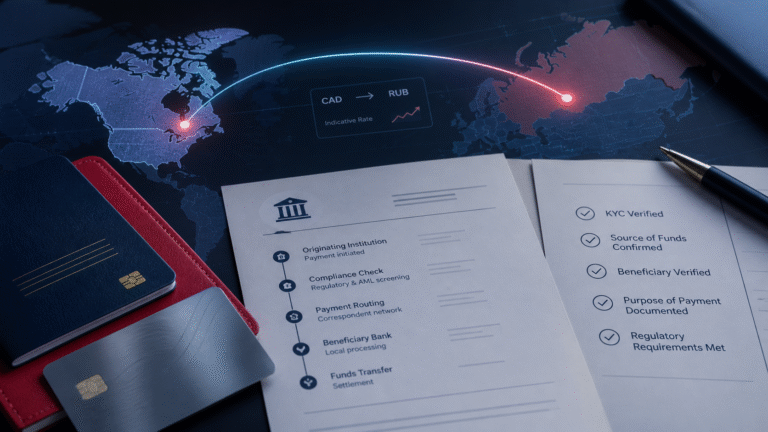
You can pay a Russian freelancer or contractor from abroad in 2026 only through a route that supports the real commercial purpose, both parties and the recipient bank. Before sending, confirm contractor status, contract and acceptance records, sanctions screening, currency, fees and tax documentation. A personal-transfer label should never replace accurate business records.
Have a contractor ready to invoice but no confirmed payment route? NoWALL can review the sender country, amount, contract, service description and Russian recipient-bank details, then explain current operational options and likely document requests. Banks and regulated providers make the final approval decision. Request a route review.
Freelance payments sit between payroll and an ordinary supplier invoice. The worker may be an individual, a registered sole trader or a company, and that status changes the contract, account details and records the payer may need. The payment method should follow the real relationship rather than whichever checkout form happens to accept the transfer.
First decide whether this is freelance work or employment
A contract calling someone a freelancer does not settle their legal status. Control over hours, exclusivity, supervision, equipment, integration into the business and the worker’s financial independence may all matter under the laws connected to the parties. Misclassification can create payroll, tax and employment-law obligations even if the cross-border payment itself succeeds.
Ask local tax or employment advisers to review the relationship when the person works continuously like a team member. For a genuine independent contractor, the file should show a defined service, fee, delivery terms and acceptance process. For an employee, use a lawful payroll or employer arrangement rather than disguising salary as a freelance invoice.
Routes for paying a Russian contractor
| Possible route | Best fit | Records to prepare | Main limitation |
|---|---|---|---|
| International bank transfer | The sender bank can reach the contractor’s bank for the stated service | Contract, invoice, acceptance evidence, beneficiary and bank details | A correspondent or receiving bank may reject the currency, party or purpose |
| Regulated specialist payment provider | The provider supports commercial payments to the exact Russian recipient | Business verification, source of funds, service description and recipient status | Consumer routes may prohibit business use or certain professional services |
| Local ruble delivery through a disclosed partner | The provider documents foreign funding and domestic settlement | Quote, partner identity, payment basis, receipt and refund terms | The payer still needs a defensible commercial record and clear counterparty chain |
| Employer-of-record or compliant payroll service | The relationship is employment rather than independent work | Employment data, payroll instructions and required tax information | Availability, onboarding and Russia coverage vary by provider and jurisdiction |
| Personal card or unrelated third party | Not an appropriate default for contractor fees | Do not use it to conceal the payer, payee or purpose | Weak accounting trail, fraud risk and possible compliance concerns |
Do not route a payment through an employee, friend or third country simply to make the transaction look unrelated to Russia. A defensible route identifies the real payer, contractor, service, payment processor, conversion point and final recipient.
Build a contract file that explains the payment
The contract and payment instruction should tell the same story. A bank reviewer should be able to see what was delivered, why the amount is due and who is entitled to receive it. Avoid vague descriptions such as “consulting” when a precise and accurate description is available.
Core commercial documents
- a signed contract naming the legal parties and their addresses;
- a clear scope of work, milestones, fee, currency and payment schedule;
- an invoice or payment request that matches the contract;
- timesheets, delivery records or milestone evidence where relevant;
- an acceptance certificate, approval email or other proof that the work was accepted;
- termination, refund and intellectual-property terms appropriate to the project;
- tax forms or residency evidence required by the payer’s jurisdiction.
Keep the original service description intact when talking to a bank or provider. Renaming software development, design, marketing or another service to fit a generic category can create inconsistencies and delay review.
Recipient and bank details
- the contractor’s full legal name and registered status;
- tax or business identifier when applicable;
- residential or registered business address;
- account holder name, account number and receiving currency;
- bank’s current legal name, address and BIC/SWIFT where required;
- current correspondent instructions or domestic payout details;
- a bank letter or account confirmation for a first or changed beneficiary.
Pay the account belonging to the contracting party unless a legitimate, documented arrangement says otherwise. A last-minute request to use another person’s card or account should pause the payment and trigger verification. The broader document checklist for transfers to Russia can help organise the file.
Screen the service as well as the names
Compliance is not a country-only check. Review the contractor, beneficial owners where relevant, Russian bank, intermediaries, service, customer sector, end use and any sanctioned territory connection. A permitted party can still be involved in a restricted service or an otherwise prohibited transaction.
The European Commission maintains consolidated Russia sanctions FAQs and current payment-services guidance. Its guidance includes restrictions that can affect payment and e-money services provided to Russian residents and entities, so EU businesses should not assume that a provider available at home can serve a Russian contractor.
US-connected businesses should use the OFAC Russia sanctions program page and current lists. OFAC’s separate FAQ on personal remittances does not turn contractor fees into personal payments: commercial compensation needs analysis based on its actual parties and purpose.
UK businesses can consult the government’s financial sanctions guidance for Russia. If the work involves regulated professional services, controlled technology, defence-related parties, crypto-assets or a possible licence, obtain qualified advice before committing to the payment.
Why a familiar payment app may still fail
A provider may support the payer’s country but exclude Russia, the recipient bank or commercial use. Wise currently lists Russia among places where users cannot send or receive money in its country availability guidance. Other services can impose different restrictions by residence, account type, service category and payout bank.
Confirm all four points before onboarding a route: it accepts the payer and funding method, permits a contractor payment, supports the named Russian beneficiary and bank, and provides records suitable for the payer’s accounts. A currency appearing in an app does not confirm an active commercial corridor.
Calculate the real cost and amount due
Agree whether the contract amount is gross or net of bank and provider charges. The worker should not discover after delivery that intermediary deductions reduced the fee unless the contract clearly assigns those costs.
- funding amount and currency;
- exchange rate, rate source and quote-validity period;
- sender, provider, correspondent and recipient-bank fees;
- expected ruble amount or credited foreign-currency amount;
- who absorbs deductions and exchange differences;
- processing estimate and document-review time;
- refund currency, timing and non-refundable charges.
For recurring work, decide how exchange-rate changes affect future milestones. Reconfirm the route when the contractor changes bank, legal status or location; a successful earlier payment does not approve a changed transaction.
A practical contractor-payment workflow
- Classify the relationship. Confirm that independent contracting is appropriate.
- Define the work. Sign a contract with clear deliverables, fee, currency and acceptance terms.
- Verify the payee. Match the contract, invoice and bank account holder.
- Screen the transaction. Review the parties, banks, service, end use and applicable restrictions.
- Confirm the route. Ask every involved provider whether it supports the exact commercial payment.
- Compare settlement. Record fees, conversion, delivered amount and return terms.
- Document completion. Keep acceptance evidence, payment confirmation and the contractor’s receipt.
If the payment is a conventional supplier invoice rather than individual freelance work, use the full guide to paying an invoice to Russia from abroad. If a submitted transfer is pending or returned, do not resend it unchanged; diagnose it with the guide to delayed and returned transfers to Russia.
Frequently asked questions
Can I pay a Russian freelancer to a personal bank card?
Only when that format is lawful, matches the contractor’s registered status and is accepted by the payer’s accounting rules and payment provider. For business expenses, an account in the contracting party’s name usually creates a clearer record than an unexplained card transfer.
Can I label a contractor fee as a personal remittance?
No. The purpose should describe the real transaction. Personal-remittance rules do not automatically apply to compensation for services, and a false label can create bank, tax and sanctions-compliance problems.
What should the payment purpose say?
Use an accurate description tied to the contract and invoice, such as payment for a specified service and milestone under a dated agreement. Follow the bank’s format without hiding the nature of the work.
Do I need an invoice from an individual freelancer?
Requirements depend on the contractor’s status and the payer’s jurisdiction. At minimum, keep a contract, payment request, evidence of completed work and any tax or residency documents your adviser requires.
Can I make recurring monthly payments through the same route?
Possibly, but repeat use is not guaranteed. Recheck provider coverage, bank details, limits and documents for each payment cycle, especially after any change in amount, service, recipient status or regulation.
Freshness note: Reviewed on 14 July 2026. Sanctions rules, provider coverage, bank routes and documentation requirements can change. Confirm the current legal and operational position before each payment.