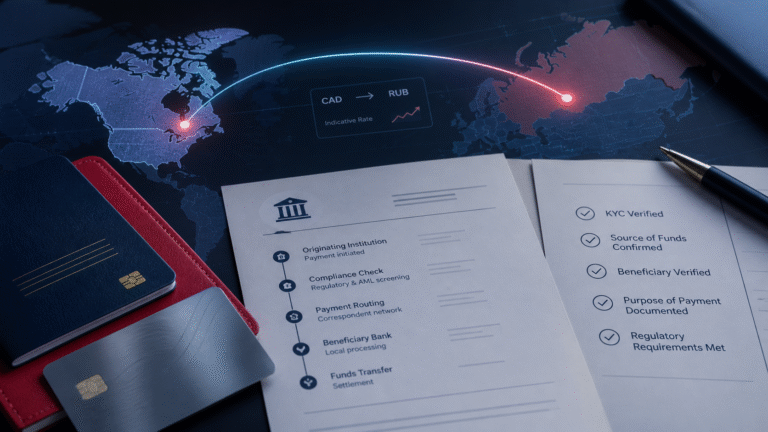
Direct answer: The cost of sending money to Russia is rarely just the advertised transfer fee. The real total includes the provider charge, exchange-rate margin, intermediary or receiving-bank deductions, and the cost of a returned payment. Compare the exact amount the recipient should receive, not only the fee shown at checkout.
Need a route and cost check before you pay? NoWALL can review the sender country, currency, recipient bank and payment purpose, then explain the available route, expected amount in rubles and required details before you commit. Availability and final terms depend on compliance checks and the banks involved.
A quote that says “€10 fee” may still be more expensive than a quote with a higher visible fee. The difference can sit in the exchange rate, a correspondent bank deduction or the rate applied when the recipient bank converts the payment. Routes to Russia also need extra screening, so an apparently cheap payment can become costly if it is delayed or returned.
What makes up the total cost?
Use this simple calculation when comparing offers:
Total cost = sender fee + exchange-rate cost + bank deductions + funding cost + return risk.
The most useful number is the final amount credited to the recipient. Ask for that amount in rubles, together with the exchange rate and all known fees, at the same time on the same day. A comparison made on different days can be misleading because currency markets move.
| Cost item | Where it appears | What to ask |
|---|---|---|
| Transfer fee | Checkout or invoice | Is it fixed or percentage-based? |
| Exchange-rate margin | Difference between a reference rate and the offered rate | What rate will be used, and when is it locked? |
| Intermediary-bank fee | Deducted while the payment moves between banks | Can correspondent banks take charges from the principal? |
| Recipient-bank fee | Deducted before or after crediting | Does the Russian bank charge for incoming funds or conversion? |
| Funding fee | Card, bank or cash payment stage | Will the funding method add a separate charge? |
| Return cost | Applied after rejection or cancellation | Which fees are refundable, and at what exchange rate? |
Why the exchange rate can matter more than the fee
A provider may advertise a low fee while using a rate that delivers fewer rubles. To see the difference, compare the provider’s offered rate with a reasonable market reference at the moment of the quote. The gap, multiplied by the amount sent, is the exchange-rate cost.
For example, suppose two compliant routes quote the same €1,000 payment. Route A charges €8 but delivers 87,000 RUB. Route B charges €20 but delivers 89,500 RUB. If timing, eligibility and risk are comparable, Route B leaves the recipient with 2,500 RUB more despite the higher headline fee.
The European Central Bank publishes reference rates for information, but it has suspended its EUR/RUB reference rate because it cannot set a representative rate under current market conditions. That makes a same-time, recipient-amount comparison especially important for ruble transfers. A retail quote will also differ from a reference rate because it includes execution and service costs.
Typical routes and where costs can appear
| Route | Possible advantage | Cost or risk to examine |
|---|---|---|
| Direct bank transfer | Clear banking record and familiar process | Limited bank coverage, intermediary deductions, screening delays and return fees |
| Specialist payment service | One quoted recipient amount and guided checks | Service margin, route availability and quote expiry |
| Card-to-card or card receipt | Convenient for some personal payments | Issuer restrictions, recipient-bank acceptance, limits and card funding fees |
| Cash or informal arrangements | May appear accessible | Poor documentation, fraud exposure, uncertain rate and serious compliance concerns |
Mainstream brands should not be assumed to support Russia. Wise states that Russia is not a supported country and that users cannot send or receive money to or from unsupported locations. Check the provider’s current official rules rather than relying on an old comparison page. See the Wise country availability notice for its present position.
A practical way to compare quotes
- Fix the scenario. Use the same sender country, funding currency, payment amount, recipient bank and purpose for every quote.
- Record the timestamp. Rates and availability can change during the day.
- Write down the total paid. Include card or bank funding charges, not just the service fee.
- Write down the expected recipient amount. Ask whether it is guaranteed by the quote or only estimated.
- Check possible deductions. Confirm whether intermediary and receiving banks can reduce the amount.
- Compare the failure terms. Ask what happens to fees and currency conversion if the payment is returned.
If one offer cannot state the expected recipient amount, it is not directly comparable with a firm all-in quote. A cheap route with unclear deductions may be suitable in some cases, but the uncertainty should be treated as part of its cost.
Recipient details and documents to prepare
Accurate information reduces preventable delays. The exact request varies by payment type, but a sender may need:
- recipient’s full legal name exactly as held by the bank;
- bank name, account number and relevant bank identifiers;
- recipient address or contact details where required;
- clear payment purpose, such as personal family support or settlement of a specific invoice;
- sender identification and current address;
- evidence of source of funds for larger or unusual payments;
- contract, invoice or supporting commercial documents for business payments;
- confirmation that neither the recipient nor the bank is subject to applicable restrictions.
For a fuller preparation list, read documents needed to send money to Russia. If the recipient only gives a card number, also review the limitations explained in our guide to sending money to a MIR card from abroad.
Compliance checks affect price and timing
Sanctions do not make every personal payment to Russia automatically unlawful, but the parties, banks, purpose and jurisdiction all matter. OFAC says that personal, non-commercial remittances are generally not the target of US sanctions, provided they do not involve blocked persons and are not otherwise prohibited. The full wording is in OFAC FAQ 1202.
EU rules have also changed. The European Commission’s payment-services sanctions guidance addresses specific payment and e-money services under Article 5b(2) of Regulation 833/2014. Eligibility can depend on nationality, residence, legal status, the service provided and an available exemption. A provider may therefore decline a payment even when the sender believes the underlying purpose is legitimate.
Screening can create extra document requests or delays, but attempts to disguise the recipient, purpose or ownership can create much greater legal and financial risk. Use accurate descriptions and do not split payments to avoid limits or checks.
The hidden cost of a returned transfer
A returned payment can lose money in several places. The outgoing fee may be non-refundable. Intermediary charges may already have been deducted. Conversion back to the original currency can happen at a different rate. The recipient’s bank may also charge before rejecting the payment.
Before sending, ask for the return policy in writing and verify the Russian bank and payment details. Our guide to why transfers to Russia are returned or delayed explains common failure points. For commercial payments, use the more specific checklist in paying an invoice to Russia from abroad.
How to reduce cost without increasing risk
- Compare the amount received, not the promotional fee.
- Use one accurate payment rather than repeated trial payments unless a small test is agreed and permitted.
- Ask whether the quote is fixed and how long it remains valid.
- Choose the correct payment purpose and submit complete documents promptly.
- Confirm recipient-bank acceptance before funding a large transfer.
- Avoid unlicensed intermediaries and offers built around concealing the transaction.
No single route is cheapest for every sender. Currency, amount, recipient bank, purpose and compliance profile change the result. A transparent route may cost more on the first line of the quote while delivering more rubles and carrying a clearer return process.
Frequently asked questions
How much does it cost to send money to Russia?
There is no universal price. The total depends on the amount, currencies, funding method, provider, recipient bank and possible intermediary deductions. Compare the total paid by the sender with the confirmed or estimated ruble amount received.
What is an exchange-rate margin?
It is the difference between a reference or wholesale rate and the rate offered for the transfer. That difference can be a larger cost than the visible fee, especially on higher-value payments.
Can a recipient bank deduct a fee?
Yes, depending on the route and the bank’s tariffs. Intermediary banks may also take deductions. Ask whether the quoted recipient amount is net of all known bank fees.
Is a personal transfer to Russia allowed?
It may be allowed, but rules depend on the sender’s jurisdiction, the people and banks involved, and the purpose. Screen all parties and obtain professional advice if the case is unclear.
Why can the refunded amount be lower than what I sent?
Some fees may not be returned, banks may deduct charges, and a second currency conversion can use a different rate. Read the return terms before authorising the payment.
Freshness note: This article was reviewed on 14 July 2026. Provider availability, sanctions rules, bank acceptance and exchange rates can change quickly. Recheck the route and official guidance before each transfer.