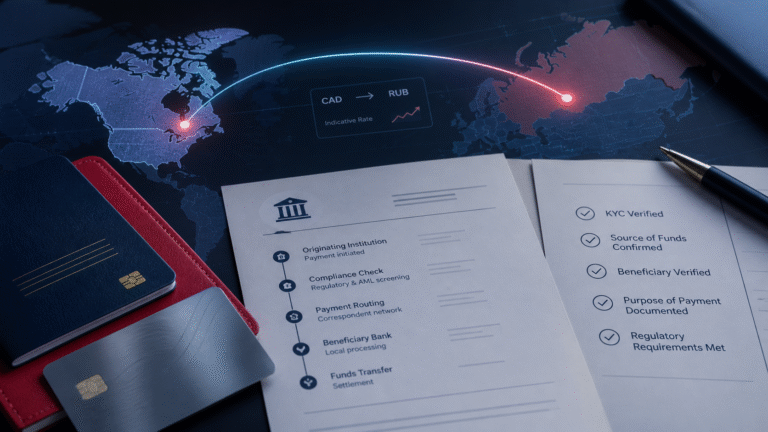
Yes, money can reach a MIR card from abroad in 2026, but usually not as a direct international card-to-card payment. The workable route must support the sender’s country, the recipient’s Russian bank and ruble delivery. Confirm the bank, recipient details, fees and compliance checks before sending, then test with a small amount.
Need the route checked before you pay? NoWALL can review the sender country, funding currency, recipient bank and intended payment purpose, then explain the available delivery format and quoted costs. A route is confirmed for the specific transfer; approval and timing can still depend on banks and compliance checks.
A MIR card is the recipient’s access point to a Russian bank account. It is not, by itself, an international transfer network available to every foreign bank. That distinction matters: a transfer may be funded abroad, converted into rubles and delivered through a supported partner, while the final credit appears on the account linked to the recipient’s MIR card.
What “send money to a MIR card” actually means
MIR is Russia’s national card system. The Bank of Russia says the National Card Payment System launched MIR and supports domestic card infrastructure. Once rubles are credited to the Russian account, the recipient can normally use the linked card for domestic purchases, cash withdrawals and transfers allowed by their bank.
The cross-border part happens before that domestic card use. Depending on the route, the payment may be delivered in one of three ways:
- to the account linked to the MIR card;
- to the card through a transfer provider that explicitly supports that Russian bank and card type;
- to the recipient’s Russian bank through another supported rail, followed by a domestic transfer.
A 16-digit card number alone may be insufficient. Some routes need the recipient’s full name, phone number, bank name, account number or other bank details. Ask what the selected route requires before sharing sensitive information.
Routes to compare before sending
| Route | What the recipient provides | Main advantage | Main check |
|---|---|---|---|
| Supported transfer provider with card delivery | Name, Russian bank and card details requested by the provider | Simple recipient experience when the corridor is active | The exact sender country, funding method and recipient bank must be supported today |
| Bank-account transfer | Account holder name and complete bank details | Clearer payment record for larger or documented transfers | Sender, intermediary and recipient banks must accept the route |
| Partner-assisted ruble delivery | Identity and recipient details appropriate to the purpose | Can separate foreign funding from domestic ruble settlement | Provider identity, quote, refund terms and compliance process |
| Domestic transfer after funds reach Russia | Phone number and selected Russian bank, or card/account details | Fast local delivery where both Russian banks support it | This does not solve the international funding step on its own |
Russia’s Faster Payments System, or SBP, is a domestic account-to-account system that lets participating banks transfer by phone number. The Bank of Russia’s SBP guide explains that both banks must participate. A foreign sender should not assume that entering a Russian phone number in an overseas banking app creates access to SBP.
Check the recipient bank, not only the MIR logo
Two MIR cards can have different cross-border outcomes because they were issued by different banks. The bank is the regulated institution holding the account, running compliance checks and deciding whether a particular incoming route is available. The logo tells you which card system is used; it does not confirm that the issuer can receive a payment from your country.
Before paying, ask the recipient to confirm:
- the full name of the issuing bank and the cardholder;
- whether the account is active and able to receive rubles;
- whether the bank accepts the proposed provider or transfer rail;
- whether the phone number is linked to the correct bank for a domestic SBP transfer;
- the correct account details if card-number delivery is unavailable;
- any limits or verification requests shown in the bank app.
Do not choose a route simply because it accepts a 16-digit number on the first screen. Confirm the recipient name and bank before authorization. If the provider cannot show who receives the money, how rubles are delivered or what happens after rejection, stop and request clarification.
Details and documents you may need
Requirements vary by amount, sender country and payment purpose. Personal support is not documented in the same way as a contractor fee or commercial invoice. Prepare enough information to explain the transaction honestly.
For a personal transfer
- sender’s identity and contact details;
- recipient’s legal name and relationship to the sender;
- recipient bank and the card, phone or account details requested by the route;
- source of funds, especially for a larger or unusual transfer;
- a clear purpose such as family support, reimbursement or personal expenses.
For work or business-related money
- contract, invoice or other basis for payment;
- description of the goods or services;
- legal names of the parties and beneficial-owner information where requested;
- recipient company or sole-trader bank details rather than a personal card, when appropriate;
- tax or completion documents required by the parties.
For a broader preparation list, see documents needed to send money to Russia. Commercial payments should follow the workflow in the guide to paying an invoice to Russia from abroad.
Sanctions and compliance checks still apply
A personal remittance is not automatically prohibited, but neither is it automatically permitted. The sender, recipient, banks, provider, payment purpose and any underlying goods or services all matter.
For US-linked transfers, OFAC FAQ 1202 says personal, non-commercial remittances are generally not the target of US sanctions, provided the transaction does not involve blocked persons and is not otherwise prohibited. That statement is not a blanket approval for every Russian bank or every payment.
EU senders and providers should consult the European Commission’s current payment-services guidance and consolidated Russia sanctions FAQs. Banks may also apply their own risk policies, request documents or decline a route even when a payment is not categorically banned.
Check the legal position in the sender’s jurisdiction and screen the recipient bank immediately before payment. If the transfer concerns a company, controlled goods, professional services, securities, crypto-assets or a sanctioned region, get appropriate legal or compliance advice.
Fees, exchange rates and the amount received
Compare the final ruble amount, not a headline fee. A route advertised with a low fee can still be expensive if it uses a weak exchange rate or adds a delivery charge.
Ask for these figures in one quote:
- the amount charged in the funding currency;
- the exchange rate and how long it is locked;
- all provider, bank and delivery fees;
- the exact or estimated ruble amount the recipient will receive;
- the normal delivery window and the outside limit;
- the refund method, currency and deductions if the transfer fails.
For a first transfer, use a modest test amount after completing the same checks you would use for the full payment. A successful test reduces operational uncertainty, but it does not guarantee that a later or larger transfer will pass without additional review.
A practical sequence that reduces mistakes
- Identify the real purpose. Separate family support from salary, freelance work, an invoice or a purchase.
- Confirm the recipient bank. Record the bank’s current legal name and the exact delivery details it accepts.
- Check the sender-side route. Confirm that the provider accepts your country, identity, funding currency and payment method.
- Review restrictions. Screen the parties and bank, and check whether the purpose or underlying transaction needs extra review.
- Compare the delivered amount. Include exchange rate, all fees and refund terms.
- Send a test payment. Verify the recipient name before authorization and keep the receipt.
- Recheck before scaling up. Limits and banking routes can change, so obtain a fresh quote for the main transfer.
If a bank has already returned a payment, do not resend it unchanged. First identify whether the failure came from the recipient details, intermediary route, bank policy, compliance review or unsupported purpose. The guide to returned or delayed transfers to Russia covers that diagnosis.
When a MIR card route is the wrong choice
Card delivery may be unsuitable for a corporate invoice, a payment that requires a formal bank trail, or a recipient whose issuer is not supported. It may also be the wrong format when the provider cannot name the delivery partner or give clear refund terms.
In those cases, compare an account-based route instead. Start with the legal and bank checks in Is It Legal to Send Money to Russia in 2026?. Country-specific readers can also review the current guides for transfers from France and Italy.
Frequently asked questions
Can I transfer from a foreign Visa or Mastercard directly to a MIR card?
Do not assume a normal international card-to-card transfer will work. It is possible only when a provider explicitly supports the sender’s card, country, recipient bank and MIR delivery. Confirm the route and recipient before entering card details.
Is the MIR card number enough to receive money?
Sometimes, but many routes need more information. You may be asked for the cardholder’s full name, phone number, issuing bank or complete account details. Use only the data requested by a verified provider.
Can a transfer arrive in euros or dollars on a MIR card?
The card is linked to an account, and the available currencies depend on the issuing bank and delivery route. Many consumer routes quote a final ruble amount. Confirm the settlement currency and conversion rate before payment.
Is sending money to a MIR card legal?
The card type alone does not decide legality. The answer depends on the sender’s jurisdiction, the banks and other parties, the payment purpose and applicable restrictions. Screen the route and do not send to blocked persons or for prohibited activity.
How long does a transfer to a MIR card take?
Some supported routes deliver quickly, while compliance checks or bank processing can take longer. Treat timing as an estimate until the provider confirms the specific corridor, and keep the transaction reference until the recipient confirms credit.
Freshness note: Reviewed on 13 July 2026. Payment corridors, bank participation, limits and sanctions guidance can change. Reconfirm the route immediately before sending.