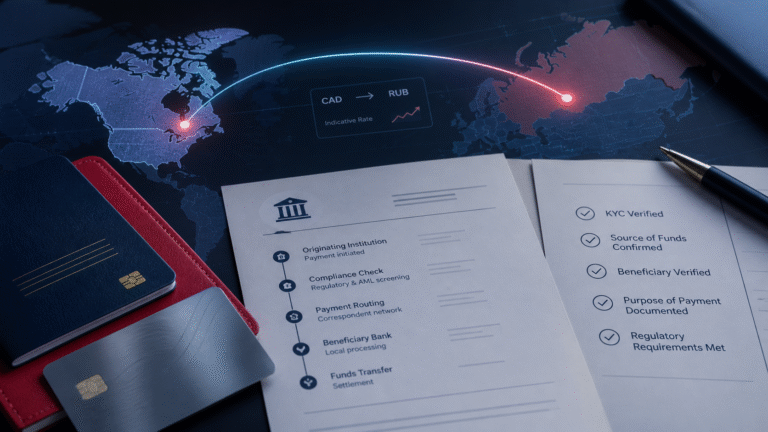
Sending money from France to Russia in 2026 may still be possible for a permitted purpose, but ordinary French bank transfers and familiar remittance apps often do not support the route. Before paying, check the recipient, Russian bank, currency path, provider coverage and EU sanctions position. Approval is always transaction-specific.
Planning a transfer from a French account? NoWALL can test the proposed EUR funding, beneficiary bank, amount, reason for payment and evidence against routes available at the time of review. You receive a practical route check, while the institutions handling the funds remain responsible for approval. Ask NoWALL to check the route.
What works from France to Russia in 2026?
There is no single route that works for every French sender or Russian recipient. A transfer can be lawful but operationally unavailable because a bank, correspondent institution or payment provider declines Russia-linked transactions. The reverse is also true: technical availability does not make a restricted payment lawful.
Start by defining the real purpose. Family support, a personal obligation, property expense, tuition and a commercial invoice require different evidence and may face different restrictions. Then check the recipient and bank before comparing fees.
| Option | When it may fit | What to confirm | Main limitation |
|---|---|---|---|
| Direct transfer from a French bank | The bank supports the recipient bank and payment purpose | EUR acceptance, SWIFT/correspondent chain, fees and required documents | Many institutions apply stricter internal policies than the legal minimum |
| Regulated specialist payment route | A compliant provider has a disclosed route to the recipient | Licensing, exact beneficiary, exchange rate, delivered amount and refund process | Coverage varies by bank, purpose, currency and amount |
| Card or account-based receipt in Russia | The provider expressly supports that bank and card or account type | Whether receipt is to an account, card or another instrument | A MIR or other card number alone does not prove international reachability |
| Consumer transfer app | Only when its current country rules explicitly allow Russia | France funding, Russia delivery and commercial-use restrictions | Major familiar services remain unavailable for this corridor |
| Cash or informal intermediary | Not a sound default for a traceable cross-border payment | Identity, licensing, receipt and legal basis | Fraud, loss, weak records and serious compliance risk |
A route through another country is not automatically safer or permitted. Do not hide the Russian beneficiary, change the payment purpose or use someone else’s account to avoid screening. A legitimate provider should be able to explain who handles the funds, where conversion occurs and what the recipient receives.
Why French banks may refuse the transfer
France applies EU restrictive measures, and French financial institutions must also meet anti-money-laundering and customer due-diligence obligations. Banks can restrict a corridor more broadly than sanctions law requires because they assess correspondent access, operational risk and their own risk appetite.
A refusal does not necessarily mean the payment itself is illegal. Common reasons include an unsupported Russian bank, a blocked institution in the payment chain, unclear purpose, missing source-of-funds evidence, inconsistent recipient details or no available correspondent route for the chosen currency.
Ask for the exact reason and status. “Russia transfers are not supported” is different from “the beneficiary is sanctioned” or “the documents are incomplete.” If funds have already left, use our guide to delayed and returned transfers to Russia before sending again.
Recipient details and documents checklist
Ask the recipient to obtain fresh details directly from the Russian bank. Do not reuse an old receipt or assume the 16-digit card number is enough. Depending on the route, you may need:
- recipient’s full legal name exactly as recorded on the account;
- date of birth and address, if requested;
- account number and the currency the account can receive;
- full bank name, address and domestic bank identifiers;
- SWIFT/BIC and intermediary details when applicable;
- a clear, truthful payment purpose;
- proof of the relationship or obligation behind the transfer;
- sender identity, French address and source-of-funds evidence.
For family support, a provider may ask how the parties are related. For rent, property costs or debt repayment, keep the agreement and calculation. A business payment may require a contract, invoice, delivery or acceptance evidence, company documents and beneficial-owner information.
Names, dates, amounts and descriptions must agree across the instruction and evidence. The full NoWALL transfer document checklist explains what banks usually look for and how to prepare a clear source-of-funds trail.
EU and French compliance checks
Do not rely on a general statement that “personal transfers are allowed” or that “all Russia payments are banned.” EU measures are targeted but extensive. They can affect designated people and entities, ownership and control, particular banks, services, goods, financing arrangements and indirect transactions.
The European Commission maintains current consolidated FAQs on sanctions against Russia and Belarus. Its separate guidance on payment services covers restrictions affecting certain payment, e-money and crypto-asset services. Because these rules change, check the latest version on the day of the transaction.
France’s Direction générale du Trésor explains the economic and financial sanctions applied in France and provides a secure sanctions service for companies that need to submit a transaction-authorisation request with supporting documents.
Screen the recipient, the bank and any beneficial owner against current lists. Also check the underlying reason for payment. If the transfer involves goods, professional services, a company, a designated person or a licence question, obtain qualified advice rather than treating a payment provider’s availability as legal clearance. Our guide on the legality of transfers to Russia gives a practical starting framework.
Why familiar providers may not be an option
Provider coverage is a separate question from sanctions. Wise currently lists Russia among locations where customers cannot send or receive money in its country availability guidance. Western Union has also published its suspension of operations in Russia and Belarus.
Do not assume another app works simply because it accepts a French debit card or shows RUB in an interface. Confirm all four parts: funding from France, the specific Russian recipient bank, the real payment purpose and the final receipt method. Read the provider’s business-use rules if the transfer pays for goods or services.
EUR funding, ruble receipt and total cost
A French sender will often fund in euros, while the recipient expects rubles. Ask where conversion happens and whether the quoted rate is fixed or indicative. The cheapest headline fee may not produce the highest delivered amount.
- Amount and currency debited from the French account
- Exchange rate and quote validity
- Provider fee and any bank or intermediary deductions
- Expected amount and currency credited in Russia
- Estimated processing window after all documents are accepted
- Refund currency, timing and deductions if the payment is returned
Compare the complete cost for the same delivered amount. Keep the quote, receipt and payment reference. For larger or recurring transfers, confirm whether the provider will request additional evidence at a threshold or after a change in payment pattern.
A safe sequence before sending
- Write down the true purpose, amount, sender and final beneficiary.
- Check the recipient and bank against current EU and French sanctions resources.
- Obtain current recipient-bank details and confirm the receipt currency.
- Prepare identity, source-of-funds and purpose-specific documents.
- Ask the bank or regulated provider to confirm the complete route in writing.
- Review the delivered amount, fees, timing and return terms.
- Send once the facts, documents and instruction all match.
If the route changes before execution, repeat the checks. A different intermediary, recipient account or currency can change both the compliance analysis and the chance of successful delivery.
Frequently asked questions
Can I send money from a French bank account to Russia?
Possibly, but only if the French bank supports the payment purpose, recipient bank, currency and full intermediary chain. Many banks do not offer the route even when the underlying payment is not prohibited.
Can I send euros directly to a Russian account?
Only when the recipient account, Russian bank, sending institution and any correspondent banks can process EUR for that transaction. Ask the recipient bank for current instructions rather than relying on an old transfer.
Can I send money to a MIR card from France?
A MIR card number does not by itself provide an international transfer route. Use a provider only if it explicitly supports receipt to that card and bank, or obtain the underlying account details for an approved bank route.
Is a personal transfer from France automatically exempt from sanctions?
No. The purpose may be personal, but the recipient, owners, banks and payment chain still require screening. Provider coverage and internal bank policy must also be checked separately.
Will a successful test payment prove the route works?
No. A larger or later payment may trigger different controls, and splitting transfers to avoid review is not acceptable. Confirm the full amount and purpose before sending.
Last reviewed: 13 July 2026. Sanctions rules, provider coverage, bank policies and correspondent routes can change. Confirm the current position with the institutions handling your payment before sending funds.