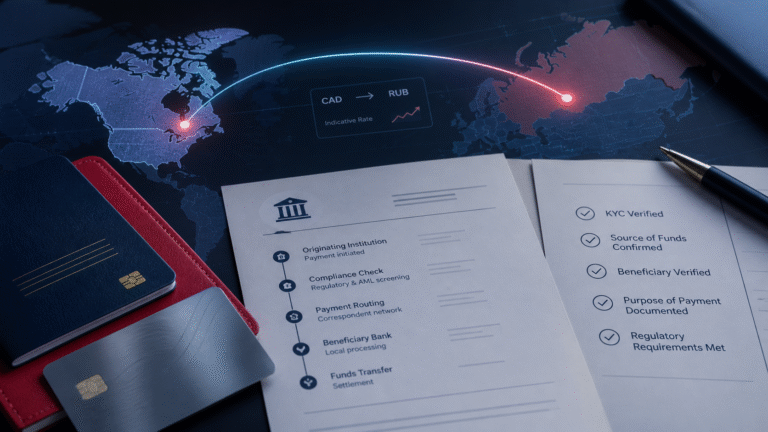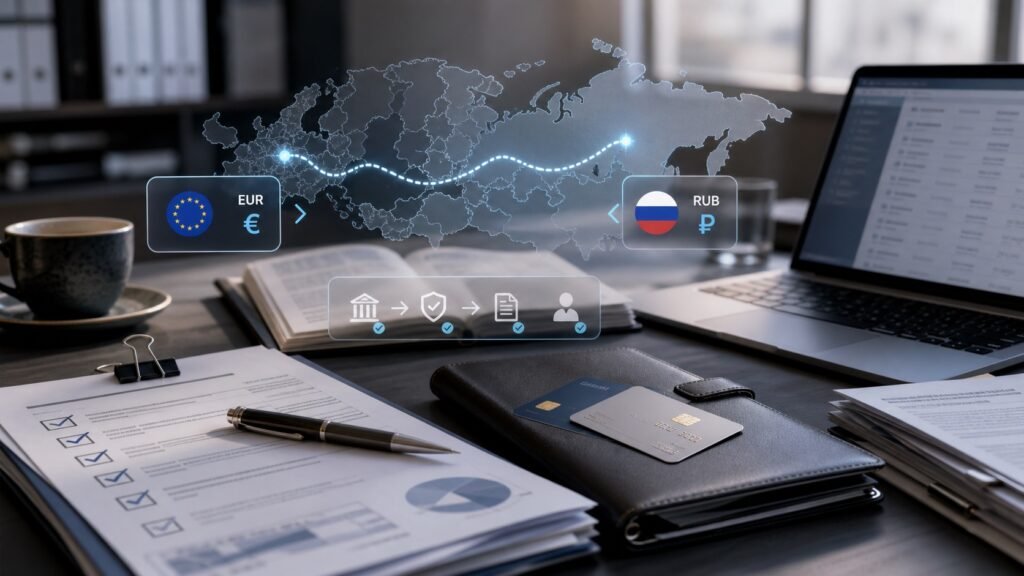
Last updated: July 8, 2026. Sending money from Germany to Russia is still possible in some cases, but it needs a route check before money moves. German and EU sanctions rules, provider restrictions, correspondent-bank risk, Russian recipient-bank acceptance, documents, and the final ruble receipt all matter.
Short answer: a Germany-to-Russia transfer may work when the sender, recipient, bank, payment purpose, and documents pass checks on both sides. It should not be treated as a normal SEPA or card transfer. Start by confirming the Russian recipient bank, the payment reason, the currency path, and what happens if a bank returns the payment.
NoWALL helps with the practical check before you send funds: sender profile in Germany, Russian recipient details, bank or card acceptance, payment purpose, documents, timing, fees, and ruble receipt. The goal is not to force a blocked route, but to identify whether a workable and compliant payment path exists.
Why Germany-to-Russia transfers need extra checking in 2026
A few years ago, many people expected a foreign transfer to Russia to be a simple bank instruction or a consumer money-transfer app. In 2026, that expectation is risky. SEPA is a euro-zone payment system and does not by itself solve a Russia payout. A German bank may accept a euro payment instruction, but correspondent banks, sanctions screening, provider rules, and the Russian receiving bank can still stop or return the transfer.
The practical question is not only «can I send euros?» It is «can this specific payment reach this specific Russian recipient for this specific purpose without using a prohibited party or unsupported route?» That is why the safest starting point is a route review rather than a blind payment attempt.
What usually has to be checked first
Before choosing a method, collect the details that banks and payment providers normally need. Missing or vague information increases the chance of a compliance hold, delay, or return.
- Sender details: name, country of residence, source of funds, and whether the payment is personal or business-related.
- Recipient identity: full name or legal entity name in Russia, relationship to sender, and matching bank-account or card details.
- Recipient bank: bank name, account or card format, whether the bank is subject to sanctions or unsupported by the route.
- Payment purpose: family support, personal transfer, invoice, salary, contractor payment, refund, or another documented reason.
- Documents: invoice, contract, proof of relationship, salary agreement, service agreement, or other evidence depending on the use case.
- Currency path: whether the sender pays in EUR and the recipient receives RUB, or whether another intermediate currency is involved.
- Return plan: what fees, timing, and documents apply if a bank refuses or returns the payment.
Germany to Russia payment options in 2026
No single route fits every case. The right option depends on who is sending, who receives the money, the payment reason, the Russian bank, and the amount. The table below is a practical way to compare options before sending.
| Option | When it may fit | Main checks | Common risk |
|---|---|---|---|
| Specialist payment route | Personal support, family payments, selected invoice or contractor cases where the route can be pre-checked. | Sender profile, recipient bank or card, payment purpose, sanctions screening, documents, final RUB receipt. | The route may be unavailable for a particular bank, recipient, amount, or purpose. |
| Traditional bank transfer | Documented business or personal cases where both banks and any intermediaries can support the payment. | Recipient bank status, correspondent path, purpose wording, invoice or contract, return conditions. | Long review, intermediary-bank rejection, high fees, or returned funds. |
| Mainstream transfer apps | Usually not a dependable choice for Russia in 2026, because many providers restrict Russia-related activity. | Official destination support, account eligibility, recipient country rules, currency availability. | The provider may not support Russia, even if the app works for other countries. |
| Crypto or stablecoin route | Only for users who understand wallet risk, local rules, counterparty checks, and conversion to rubles. | Legal position, exchange and wallet controls, counterparty risk, recipient conversion method, documentation. | Volatility, fraud, exchange restrictions, loss of funds, and poor document trail. |
| Cash or informal handoff | Generally unsuitable for documented cross-border payments or business purposes. | Legality, safety, identity checks, proof of payment, customs or cash reporting obligations. | No reliable audit trail, fraud risk, and difficult dispute handling. |
Why Wise, Western Union, and normal app transfers may fail
Many searchers start with a familiar provider and only look for alternatives after the payment screen fails. That is understandable, but Russia is no longer treated like a standard destination by several mainstream services.
Wise states restrictions for customers based in Russia, and Western Union announced the suspension of operations in Russia and Belarus. Even when a provider website has old landing pages or general information about international transfers, the decisive question is whether the provider currently supports the exact Germany-to-Russia route, the sender profile, the recipient bank, and the payout method.
If a mainstream app does not support Russia, trying to work around its controls is a bad idea. It can lead to account closure, stuck funds, or a compliance report. Use official support information, not forum anecdotes, as the starting point.
Sanctions and compliance checks for German senders
Germany applies EU sanctions, and banks also run their own risk controls. A transfer can be legitimate in purpose and still be delayed if the bank cannot get comfortable with the recipient, the bank, the industry, the documents, or the route. For US-touching payments, OFAC rules may also matter if a US person, US bank, US dollar clearing, or US-controlled party is involved.
For most private senders, the key checks are practical: do not send to a sanctioned person or entity, do not use a restricted bank route, do not disguise the purpose, and do not split a payment to avoid review. For businesses, the bar is higher. Invoices, contracts, goods or services, end users, and ownership structures may all need review.
Documents that make the transfer easier to review
Good documents do not guarantee acceptance, but they make a legitimate payment easier to understand. They also help if a bank asks follow-up questions after the payment has been initiated.
For personal or family support
- Sender and recipient full names.
- Recipient bank or card details in Russia.
- Clear explanation of the relationship and reason for support.
- Proof of source of funds if the amount is material.
- Any supporting evidence requested by the provider or bank.
For invoices, freelancers, and contractors
- Invoice with legal names, amount, currency, date, and service description.
- Contract or order confirmation.
- Payment purpose that matches the invoice and contract.
- Recipient company or individual details.
- Evidence that the payment does not involve a prohibited party, goods, or service.
How ruble receipt and MIR card payout fit in
Many Russian recipients care less about the sender’s euro route and more about the final receipt: can they receive rubles, to which bank or card, and when can they use the money? That final step should be checked before the sender pays. A route that looks possible on the German side can still fail if the Russian bank or card cannot receive the payout.
MIR card receipt may be relevant for some Russian recipients, but it should not be assumed to work from abroad automatically. The sender should confirm the supported payout format, recipient bank, limits, fees, and whether the recipient name matches the account or card details.
Common reasons payments are delayed, rejected, or returned
Returned payments are expensive because they waste time and may create extra fees or exchange-rate losses. The most common causes are not mysterious.
- The recipient bank is sanctioned, unsupported, or too risky for the route.
- The payment purpose is vague, inconsistent, or looks commercial when it is described as personal.
- The sender cannot explain the source of funds or relationship to the recipient.
- The provider no longer supports Russia but the sender uses outdated instructions.
- An intermediary bank refuses the payment after the sender’s bank has already accepted it.
- The recipient details do not match the bank account or card holder.
- The transfer amount triggers extra review and documents are not ready.
A safer step-by-step approach
- Define the payment. Is it personal support, an invoice, salary, contractor pay, or another purpose?
- Check the parties. Screen the sender, recipient, bank, and any company involved.
- Confirm the payout. Decide whether the recipient needs RUB, bank-account receipt, or card receipt.
- Prepare documents. Match the paperwork to the payment purpose before initiating the transfer.
- Compare routes. Look at fees, timing, supported banks, return rules, and document requirements.
- Start with a controlled amount where appropriate. For a new route, avoid sending a large payment before the route is proven.
- Keep the trail. Save confirmations, invoices, bank questions, and provider replies.
For a broader overview, read NoWALL’s guide on how to send money to Russia. If your first question is legal risk, start with whether it is legal to send money to Russia in 2026. If the sender is in another country, the UK and USA guides cover separate checks.
FAQ
Can I send money from Germany to Russia by normal bank transfer?
Sometimes, but it depends on the recipient bank, intermediary route, payment purpose, sanctions screening, documents, and the sending bank’s risk policy. A German bank accepting the instruction does not guarantee that the payment will reach Russia.
Does SEPA work for sending money to Russia?
No. SEPA is designed for euro payments within the SEPA area. Russia is not solved by SEPA access, so a Germany-to-Russia payment needs a separate route and payout check.
Can I send euros and have the recipient receive rubles?
That may be possible through a supported route, but the conversion path, fees, rate, recipient bank, and final RUB receipt must be checked first. Do not assume that a euro debit from Germany means a successful ruble payout in Russia.
Is it legal to send family support from Germany to Russia?
Family support is not automatically prohibited, but it still needs sanctions and bank checks. The recipient, bank, payment purpose, and documents matter. If the payment involves a sanctioned party, restricted bank, or disguised purpose, the risk changes.
What should I do if my transfer to Russia was returned?
Ask the sending bank or provider for the return reason, keep all payment documents, and do not immediately resend through another route with the same weak details. First check the recipient bank, purpose wording, documents, and route support.
Sources and freshness note
This article was reviewed on July 8, 2026. Russia-related payment rules and provider availability can change, so check official sources before sending money. Useful starting points include European Commission guidance on payment services under Russia sanctions, OFAC FAQ 1202, OFAC Russia-related sanctions FAQs, Wise restrictions for customers based in Russia, and Western Union’s Russia and Belarus suspension notice.