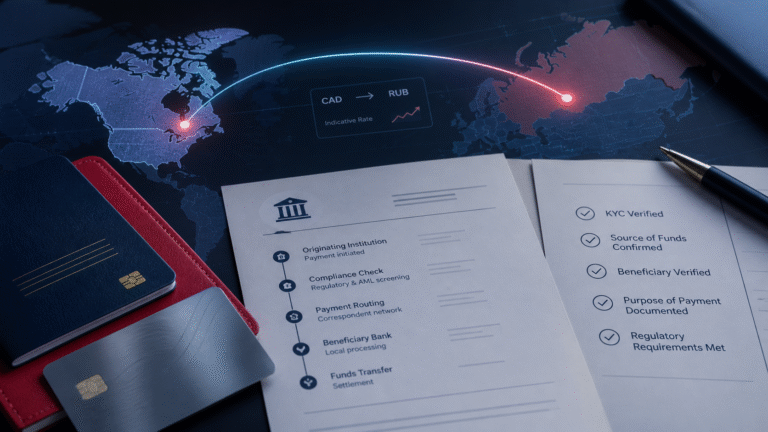
Last updated: July 6, 2026. Sending money to Russia in 2026 is not automatically illegal, but it is no longer a normal cross-border payment. The answer depends on who sends the money, who receives it, which banks are involved, what the payment is for, and whether any sanctions or bank restrictions apply.
Short answer: in many cases, personal transfers to Russia can still be possible if they do not involve sanctioned parties, prohibited services, restricted banks, or misleading payment purposes. The practical problem is banking: even a lawful payment can be delayed, rejected, or returned if the route is not checked before sending.
How NoWALL helps: NoWALL checks the route before a client sends funds: sender country, recipient details, payment purpose, currency, documents, and the likely acceptance path on the Russian side. That does not remove legal or bank compliance checks, but it helps avoid blind transfers into a route that is likely to fail.
Is sending money to Russia legal in 2026?
There is no single global rule that says every transfer to Russia is illegal. Sanctions are targeted: they can apply to specific people, entities, banks, services, sectors, goods, and payment purposes. A family-support payment to an individual is different from paying a sanctioned company. A personal remittance is different from settling a commercial invoice for restricted goods.
The safest way to think about it is simple: legality is only the first gate. The second gate is bank acceptance. A transfer may be lawful in principle but still fail because a bank, intermediary, payment provider, or recipient bank refuses the route.
| Question to check | Why it matters | What to prepare |
|---|---|---|
| Who is the recipient? | Sanctions screening can apply to people, companies and banks. | Full name, bank, account/card details, relationship to sender. |
| What is the payment for? | Personal support and commercial payments are treated differently. | Plain payment purpose, invoice, contract or supporting explanation. |
| Which banks touch the payment? | Sender, intermediary and recipient banks can all reject a route. | Bank names, currency, possible correspondent path. |
| Which country is the sender in? | US, EU, UK and other regimes use different sanctions rules. | Sender country, residency, bank location and currency. |
| Can the Russian side receive it? | Some routes fail at the final crediting stage. | Recipient bank status, ruble conversion plan, backup details. |
What sanctions actually affect money transfers to Russia?
Sanctions usually do not work like a blanket ban on every private payment. They restrict certain counterparties, banks, services, and types of economic activity. For example, US persons must consider OFAC rules and sanctioned-party exposure. EU-based senders must consider EU restrictions, including rules around payment services and Russian-related transactions. Other countries may have their own restrictions.
For a normal person trying to support family, the key questions are whether the sender is allowed to make the payment, whether the recipient is allowed to receive it, and whether the chosen bank route is available. For a business, the check is wider: the invoice, goods or services, counterparty, ownership, sector, and payment purpose all matter.
Official guidance is the only safe starting point. OFAC publishes Russia-related FAQs, including guidance on personal, non-commercial remittances. The European Commission publishes sanctions FAQs for EU restrictions, including payment-services questions. Provider pages from Wise and Western Union also show why many mainstream consumer routes no longer work for Russia.
When a personal transfer may be possible
A personal transfer is more likely to be workable when the sender can clearly explain the purpose and the recipient is an individual, not a restricted organization. Common examples include family support, helping with living expenses, returning personal funds, or sending money to yourself or a close relative.
Even then, the details matter. A bank may ask why the money is being sent, how the sender knows the recipient, where the funds came from, and whether the payment is connected to business activity. Vague descriptions such as “services,” “consulting,” or “goods” can create extra questions if the real payment is personal support.
Personal transfer checklist
- Full legal name of the recipient.
- Recipient bank or card details, checked before sending.
- Sender country and bank.
- Currency and expected conversion route.
- Simple payment purpose, written truthfully.
- Relationship to the recipient, if relevant.
- Backup plan if the first route is rejected.
When a payment needs stronger checks
Some transfers need more than a basic personal-remittance check. Business payments, invoice payments, contractor fees, salary payments, real-estate-related transfers, and payments involving companies require a closer look. The issue is not only whether money can technically move. The issue is whether the payment purpose, counterparty, bank and documents can pass compliance review.
If a payment is connected to a business invoice, prepare the invoice, contract, description of goods or services, counterparty details, and evidence that the transaction is not connected to a prohibited activity. If the payment is for a freelancer or contractor in Russia, prepare the service description and make sure the sender is not mislabeling the transfer as family support.
Why mainstream providers often do not solve the problem
Many users first try familiar names such as Wise, Western Union, PayPal, Revolut or a normal SWIFT transfer. The difficulty is that several mainstream providers have suspended or restricted Russia-related services, while banks have tightened screening for Russian routes. That means “legal” and “available through my usual app” are not the same thing.
Wise publishes restrictions for customers based in Russia and does not operate like a normal Russia remittance rail. Western Union announced the suspension of operations in Russia and Belarus in 2022. Banks may still review and reject payments based on internal risk appetite, even where a narrow legal route exists.
| Route type | What to check first | Main risk |
|---|---|---|
| Bank transfer | Sender bank, recipient bank, currency, payment purpose. | Intermediary or recipient-side rejection. |
| Money transfer provider | Whether Russia service is currently supported. | Provider suspension or unsupported destination. |
| Card or ruble payout | Recipient bank/card acceptance and limits. | Final crediting failure or unclear conversion. |
| Crypto-to-fiat route | Local rules, counterparty risk, conversion path. | Compliance, volatility, fraud and documentation gaps. |
| Invoice payment | Counterparty, goods/services, sanctions exposure. | Commercial compliance refusal. |
What banks usually look at
Banks and payment providers usually screen more than the country name. They may check the sender, recipient, bank, currency, payment description, past transaction pattern, source of funds, and the stated reason for the payment. If the explanation is unclear, the transfer can be paused for questions or returned.
For Russia-related transfers, the review can be stricter because banks do not want to process a transaction that later turns out to involve a sanctioned party or prohibited activity. That is why route planning matters before the sender presses “send.” The practical goal is to make the payment understandable, documented and routed through a path that can actually be processed.
How to check a transfer before sending
- Identify the exact purpose. Is it family support, your own funds, salary, contractor payment, invoice settlement or something else?
- Check the recipient. Confirm the recipient name, bank, account or card details, and whether the bank can receive the intended currency or ruble payout.
- Check the sender side. The sender country and bank determine which sanctions rules and internal bank policies may apply.
- Prepare documents. Personal transfers may need a simple explanation; business payments need invoices, contracts and counterparty details.
- Choose the route. Do not assume a provider works just because it worked years ago. Confirm the route for the current date.
- Start with a realistic amount. For a new route, a smaller first payment may reduce operational risk, but it still needs a truthful purpose and proper checks.
How NoWALL approaches Russia-bound payments
NoWALL does not promise that every payment can be processed. That would be the wrong promise for a restricted market. The useful work is checking the route before money is sent: country, currency, recipient bank, documents, purpose, and practical payout options on the Russian side.
This is especially useful when the sender has already hit a dead end with a familiar provider, when a bank asks questions, or when the recipient needs rubles rather than a foreign-currency wire. A checked route is not a guarantee, but it is safer than guessing.
Sources and further reading
Related NoWALL guides can help with the next step: see the broader guide on how to send money to Russia, the business guide for international invoices and subscriptions, and the salary-focused article on paying salaries to Russia from abroad.
- OFAC FAQ 1202 on personal, non-commercial remittances
- OFAC Russia-related sanctions FAQ topic page
- European Commission FAQ on payment services and Russia sanctions
- Wise restrictions for customers based in Russia
- Western Union notice on Russia and Belarus
FAQ
Is it illegal to send money to Russia in 2026?
Not automatically. A transfer may be possible if it does not involve sanctioned parties, prohibited activity, restricted banks or misleading payment purposes. The sender’s country, recipient, bank route and payment reason all need to be checked.
Can I send money to family in Russia?
Family-support payments can be possible in some cases, but the route still needs screening. Be ready to explain the relationship, purpose, sender bank, recipient bank and source of funds if a bank asks.
Does Wise work for transfers to Russia?
Wise has Russia-related restrictions and should not be assumed to work like a normal remittance provider for Russia-bound transfers. Check Wise’s current help page and consider alternative routes before sending.
Does Western Union send money to Russia?
Western Union announced the suspension of operations in Russia and Belarus in 2022. Users should check the current official status and avoid relying on outdated instructions.
Can a bank reject a legal transfer to Russia?
Yes. Banks and intermediaries can reject or return payments because of internal risk rules, sanctions screening, missing documents, unclear payment purpose or unsupported recipient-bank routes.