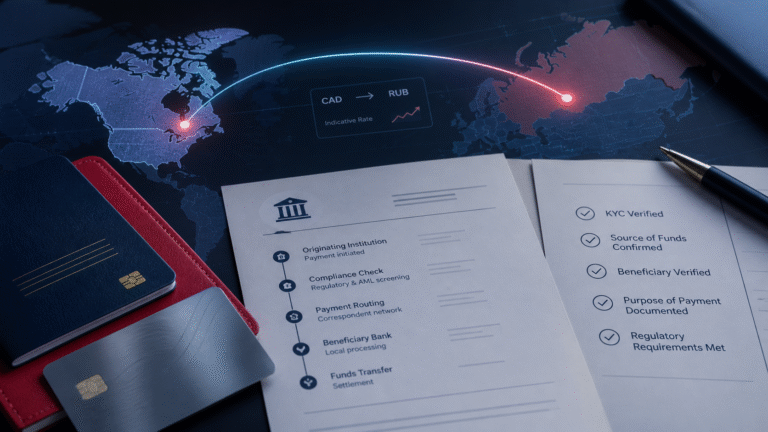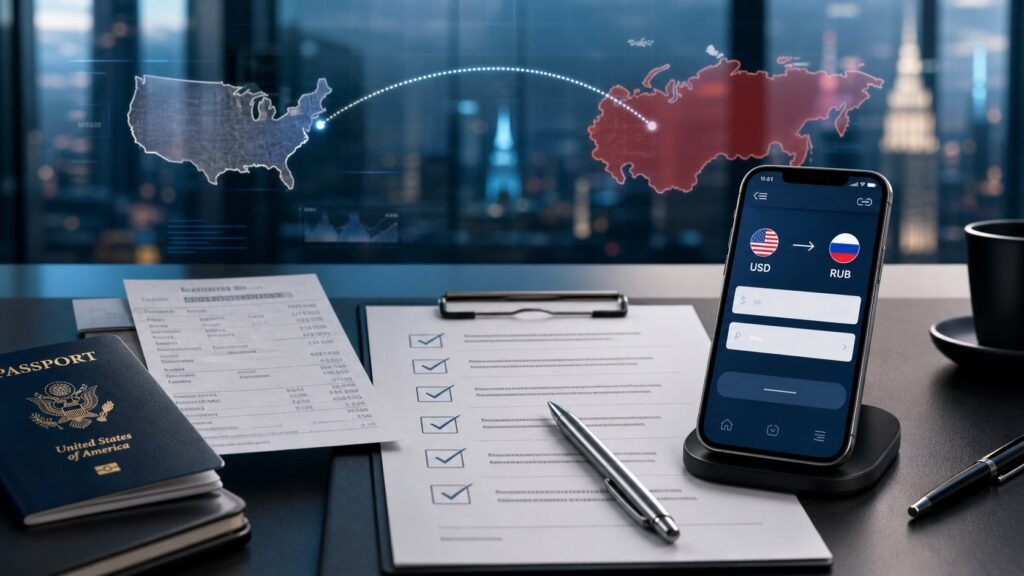
Last updated: July 7, 2026. Sending money from the USA to Russia is still possible in some carefully checked cases, but it is not a normal app-to-app transfer anymore. The sender must think about US sanctions rules, provider restrictions, recipient-bank acceptance, payment purpose, documents, fees, and what happens if a bank returns the money.
Short answer: a US-to-Russia transfer may work when it is a lawful personal or business payment, the recipient and bank are not blocked, the route is supported, and the payment purpose is documented. The risk is operational: Wise, Western Union and many banks no longer treat Russia as a standard destination.
How NoWALL helps: NoWALL checks the payment route before you send funds: US sender profile, Russian recipient details, bank or card acceptance, purpose of payment, documents, currency conversion, and likely ruble receipt. We do not promise that any payment will pass. We help you avoid sending money into a route that is likely to fail.
Can you send money from the USA to Russia in 2026?
There is no single button that works for every US sender and every Russian recipient. A family-support transfer to an individual, a payment to your own Russian account, a contractor payment, and an invoice settlement all raise different questions. The route also depends on which US bank or provider is used, which Russian bank receives the funds, and whether any sanctioned party is involved.
For US users, the first check is not only price. It is whether the route is allowed and supported. OFAC has stated that personal, non-commercial remittances are generally not the target of US sanctions on Russia, but that does not mean every bank or provider will process them. Banks can still reject transactions that involve blocked persons, restricted banks, unclear purposes, or internal risk limits.
The practical question is therefore: can this specific sender, payment purpose, provider, currency and recipient bank work together today? If one link in that chain fails, the transfer may be delayed, rejected, or returned after fees and exchange-rate losses.
US-to-Russia route options in 2026
| Route type | When it may fit | Main checks | Main risk |
|---|---|---|---|
| Bank transfer | Documented personal support, own-account transfers, or some business payments. | US bank policy, recipient bank status, payment purpose, intermediary path. | Rejection by a bank or intermediary even when the purpose is legitimate. |
| Specialist payment route | Cases where a normal bank or consumer app does not support Russia. | Licensing, compliance process, payout method, fee and refund rules. | Poorly checked providers can create fraud, delay or documentation problems. |
| Ruble card or account receipt | Recipient needs local spending power in Russia. | Russian bank/card acceptance, conversion path, name matching, limits. | Final crediting can fail if the recipient bank or card is not suitable. |
| Business invoice payment | Supplier, contractor or service payment with a clear commercial basis. | Counterparty, ownership, goods or services, invoice, contract, sanctions exposure. | Higher compliance burden and greater chance of document requests. |
| Crypto-to-ruble route | Only where the sender understands legal, tax, counterparty and volatility risks. | Jurisdiction rules, wallet history, exchange controls, recipient conversion. | Fraud, price movement, account freezes and weak proof of funds. |
If you are comparing options, start with the scenario, not the brand name. “I need to support family in Moscow” is different from “I need to pay a Russian legal entity for services.” The best route for one case can be unsuitable for the other.
Why Wise, Western Union and normal apps often do not work
Many US senders first try familiar international transfer brands. That is understandable, but Russia is no longer a normal destination for many mainstream services. Wise publishes Russia-related restrictions and its US Russia transfer page still points users toward a waiting list rather than a live RUB transfer route. Western Union says its Russia operations are suspended across all channels.
Normal bank wires can also be difficult. A bank may accept the instruction, ask for documents, reject it before sending, or let an intermediary bank stop the payment. The sender may not always get a detailed explanation, especially where a bank is applying internal risk policy rather than a simple public rule.
This is why “try it and see” is expensive. If the payment is returned, the sender may lose time, bank fees, intermediary fees, and money on currency conversion. It is better to check the route, recipient bank and documents before the first transfer.
What US sanctions checks mean for personal transfers
Personal support is not the same as sanctions evasion. A US person can still need to support a parent, spouse, child, friend, or their own living expenses in Russia. OFAC FAQ 1202 is useful because it explains that personal, non-commercial remittances are generally not the target of US Russia sanctions, while also making clear that transactions involving blocked persons or otherwise prohibited activity remain a problem.
In practice, the sender should be ready to explain the purpose in plain language. “Family support for living expenses” is clearer than a vague label such as “transfer.” If the money is not family support, do not pretend it is. Mislabeling a business payment as a personal gift can create bigger problems than a direct explanation supported by documents.
Personal transfer checklist
- Full legal name of the Russian recipient.
- Recipient bank, account or card details, checked for current acceptance.
- Relationship to the recipient, if the payment is family support.
- Payment purpose written truthfully and simply.
- Source of funds, such as salary, savings, sale proceeds or tax documents.
- Expected currency conversion and final ruble receipt method.
- Refund route if the payment is rejected.
Documents and recipient details to prepare
Document requests are normal for sensitive routes. The goal is to make the transfer easy to understand: who is sending, who is receiving, why the money is being sent, where the funds came from, and which bank will receive them.
| Scenario | Useful documents | Extra caution |
|---|---|---|
| Family support | ID, recipient details, relationship explanation, source-of-funds proof. | Keep the purpose consistent with the real relationship and amount. |
| Own-account transfer | Proof that both accounts belong to you, source of funds, bank details. | Name matching and recipient-bank acceptance matter. |
| Contractor or freelancer payment | Contract, invoice, service description, tax or business records. | Do not disguise it as a personal transfer. |
| Supplier invoice | Invoice, contract, goods or services description, counterparty details. | Check sector, ownership, bank and goods/services restrictions. |
| Ruble card receipt | Recipient card/account data, bank name, expected payout currency. | Confirm the card or bank can receive the intended payout. |
If you use a specialist payment company rather than your bank, check that it is a real regulated money-services business and that it explains fees, exchange rates, refund rules and delivery timing before you pay. FinCEN’s MSB registration information is a useful starting point for understanding what US money-services registration means. Registration does not guarantee that a provider is right for your transfer, but a route with no transparent compliance process is a warning sign.
How to choose a safer route before sending
- Define the payment purpose. Personal support, own funds, salary, contractor fee and invoice payment need different checks.
- Screen the recipient side. Confirm the recipient name, bank, account or card, and whether the bank can accept the route.
- Check the provider. Do not assume a well-known service supports Russia. Verify its current status and refund rules.
- Prepare proof before the bank asks. Source of funds and purpose documents reduce back-and-forth.
- Compare total cost, not just fee. Include FX spread, intermediary fees, payout fees and possible return costs.
- Test the operational path carefully. A smaller first payment can reduce exposure, but it still needs a truthful purpose and proper documents.
For a wider country-neutral overview, see NoWALL’s guide on how to send money to Russia. If your concern is legal rather than operational, start with whether it is legal to send money to Russia in 2026. If your sender is in Britain, the UK-specific guide covers a separate GBP-to-Russia route check.
Risks that are easy to miss
The biggest mistake is treating “not obviously banned” as “safe to send.” A route can be legal in principle but still fail because a provider does not support Russia, a bank refuses the intermediary path, a recipient bank cannot credit the account, or the payment purpose is too unclear for review.
- Provider suspension: a familiar brand may no longer support Russia transfers.
- Recipient-bank mismatch: the Russian account or card may not fit the selected payout method.
- Compliance questions: the sender may need to prove source of funds and payment purpose.
- Business exposure: companies, sectors, goods and services require deeper sanctions review.
- Return losses: a returned payment can come back late and smaller after fees or FX changes.
- False descriptions: vague or misleading payment purposes can make a review worse.
How NoWALL checks USA-to-Russia payments
NoWALL starts with the real payment, not a generic list of apps. We look at the sender country, payment purpose, amount, currency, recipient bank, documents, and practical receipt method in Russia. If the case looks like family support, we check it as family support. If it is an invoice or contractor payment, we check it as a business payment.
That distinction matters. A route that is reasonable for a family remittance may be wrong for a supplier invoice. A ruble card payout may be useful for one recipient and unsuitable for another. The right question is not “what always works?” The right question is “what can be checked for this exact sender and recipient before money moves?”
Sources and further reading
- OFAC FAQ 1202 on personal, non-commercial remittances to or from Russia
- OFAC Russia-related sanctions FAQ topic page
- FinCEN: Money Services Business registration
- Wise US page for sending money to Russia
- Western Union Russia and Belarus FAQ
FAQ
Can I send money from the USA to Russia in 2026?
Sometimes, but it depends on the sender, recipient, bank route, payment purpose and documents. A lawful personal transfer can still fail if a provider or bank does not support the route.
Is a family remittance to Russia allowed under US sanctions?
OFAC states that personal, non-commercial remittances are generally not the target of US sanctions on Russia. The transfer still must not involve blocked persons, prohibited activity or unsupported banks.
Does Wise send money from the USA to Russia?
Wise should not be assumed to support US-to-Russia transfers. Its US Russia transfer page points users toward a waiting list for RUB transfers, and Wise also publishes Russia-related customer restrictions.
Does Western Union send money to Russia?
Western Union says its operations in Russia are suspended across all channels. Users should rely on the current official status rather than older instructions.
What documents do I need for a USA-to-Russia transfer?
Prepare ID, recipient details, payment purpose, source-of-funds proof, and documents matching the scenario. Business payments usually need invoices, contracts and counterparty details.