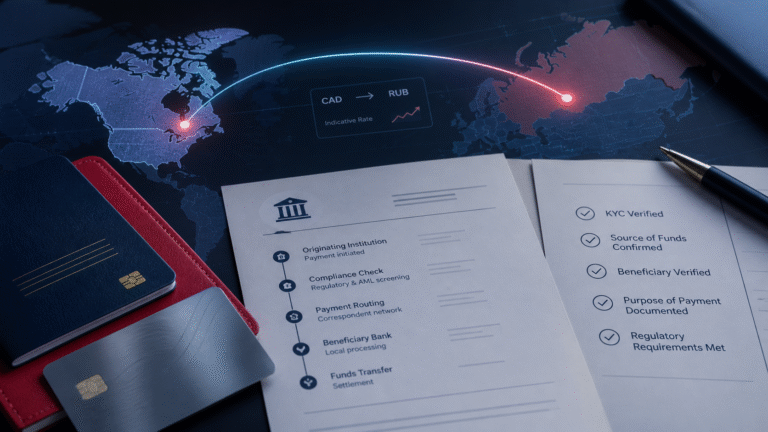
Last updated: July 7, 2026. Sending money from the UK to Russia is still possible in some situations, but it is not a normal card-to-card or app transfer anymore. UK sanctions, bank risk controls, provider exits, and Russian-side acceptance rules all matter before you send.
Short answer: a UK-to-Russia transfer should start with a route check, not with a payment button. Confirm the recipient, Russian bank, purpose, documents, currency path, and whether any UK or international sanctions restrictions apply. If a bank or provider cannot support the corridor, forcing the payment usually increases delay or return risk.
How NoWALL helps: NoWALL reviews the payment route before funds move: sender country, recipient details, payment purpose, expected ruble receipt, bank acceptance, and documents. This does not remove bank or legal checks, and it is not a promise that every payment will pass. It helps you understand whether the route is realistic before you expose money to a return loop.
Why UK to Russia payments need extra checks in 2026
The main problem is not simply currency conversion. Since 2022, many mainstream payment routes into Russia have become unavailable, restricted, or highly manual. A transfer that looks simple in a UK banking app may fail because an intermediary bank refuses the corridor, the recipient bank is restricted, the payment purpose is unclear, or the provider no longer serves Russia.
For a UK sender, the risk has three layers. First, UK financial sanctions apply to UK persons and UK-linked activity, so the sender and any regulated firm must consider whether a person, entity, bank, service, or transaction is restricted. Second, the sending bank may apply its own risk rules even where a transfer is not explicitly prohibited. Third, the Russian receiving side must be able to credit the funds, often in rubles, to the specific recipient account or card.
That is why the safest practical question is not “which app is cheapest?” It is “which checked route can carry this specific payment purpose to this specific recipient without misleading the banks involved?”
UK to Russia transfer options at a glance
| Route | When it may fit | Main checks | Typical risk |
|---|---|---|---|
| Specialist checked payment route | Family support, personal transfers, invoice or contractor payments where the route is reviewed first | Recipient bank, sanctions exposure, payment purpose, documents, ruble payout method | Lower operational risk if the route is checked before payment, but still subject to bank controls |
| Direct UK bank transfer | Only if the sending bank, intermediary chain, and recipient bank can support the corridor | Bank policy, SWIFT route, sanctioned-bank exposure, payment narrative | High return or delay risk if attempted without confirmation |
| Mainstream money transfer providers | Usually not a reliable Russia option in 2026 | Provider country coverage and Russia restrictions | Often unavailable for Russia, or limited to legacy/refund information |
| Crypto-to-ruble route | Only for users who understand custody, exchange, fraud, tax, and local compliance risks | Counterparty, exchange rules, source of funds, recipient acceptance | Can be fast, but fraud and compliance risk are higher if handled casually |
| Cash carried by traveller | Rare emergency cases | Border declarations, safety, limits, proof of funds | Operationally risky and unsuitable for regular payments |
What usually does not work like it used to
Many UK senders first try familiar names. That is understandable, but Russia coverage has changed. Wise says it cannot serve customers in Russia at the moment, and its Russia corridor pages do not offer a normal live RUB transfer flow for UK senders. Western Union states that its money transfer services in Russia and Belarus have been suspended. Your own bank may also block, review, or return a payment if the Russian bank, correspondent chain, or payment purpose does not meet its controls.
Those provider exits do not mean every lawful transfer is impossible. They do mean you should avoid assumptions based on pre-2022 habits. A route that worked for a friend months ago may fail today if the bank, beneficiary details, intermediary policy, or sanctions list exposure has changed.
What to check before sending from the UK
Before you send GBP, EUR, USD, or another currency toward Russia, collect the facts that a bank or payment partner will need. Missing details are one of the simplest reasons payments are delayed.
Sender and recipient details
- Full legal name of the sender and recipient, matching ID or bank records.
- Recipient bank name, account number or card details, and the intended payout currency.
- Recipient city and contact details, where required by the route.
- Clear relationship between sender and recipient for personal transfers.
- For business payments, company registration details and the exact counterparty name.
Payment purpose and documents
- Family support, personal expense, loan repayment, invoice, salary, contractor fee, rent, education, medical cost, or another specific purpose.
- Invoice, contract, act of services, salary agreement, or supporting message when the payment is commercial.
- Proof of source of funds if the amount is large or unusual for the sender.
- Any documents needed to explain why the recipient should receive rubles in Russia.
Compliance checks
- Screen the recipient, recipient company, and Russian bank against applicable sanctions restrictions.
- Check whether the payment involves a prohibited service, restricted sector, or sanctioned bank.
- Do not disguise the purpose of payment. A vague or misleading narrative can increase bank concern.
- Confirm whether the route touches US dollar clearing, EU banks, or other jurisdictions that may add extra controls.
Personal transfers: family support and private payments
For personal support, the route review should focus on who receives the money and why. Family support, medical costs, education, rent, and other private needs can be different from payments to a company, supplier, or restricted sector. Still, banks may ask for evidence and may refuse transactions that they cannot process confidently.
A good practical file includes the sender’s ID, recipient’s full name, recipient bank details, relationship explanation, amount, frequency, and a simple purpose note. If you plan to send regular support, it is better to document the pattern upfront than to send several vague transfers that look unrelated.
Business payments, invoices, and contractors in Russia
Business payments from the UK to Russia need more care than personal support. The payment may involve a Russian company, freelancer, supplier, software service, shipping, intellectual property, professional services, or another category with its own restrictions and bank policy issues.
Before attempting an invoice payment, check the counterparty, ownership, bank, service type, goods or services involved, and payment purpose. The invoice should match the real service. The contract should name the parties clearly. If the payment is for a contractor or freelancer, make the service description specific enough for a bank reviewer to understand it without guessing.
NoWALL can help assess whether the proposed route is operationally plausible, but it cannot turn a prohibited or unsupported payment into an acceptable one. If the facts are sensitive, get legal advice before sending.
How ruble receipt usually works
Many recipients in Russia do not need GBP. They need rubles credited to a Russian account or card. That final receipt step is often where an otherwise logical payment breaks: the recipient bank may not accept the route, the card may not support the payout, the name may not match, or the intermediary may reject the transaction before it reaches Russia.
Ask the recipient for the exact bank and account/card details before choosing a route. If the recipient only gives a phone number or card number, confirm whether that is enough for the specific payout method. A checked route should define the expected payout currency, expected timing, and what happens if the receiving bank refuses the credit.
Costs, timing, and return risk
The cheapest advertised fee is rarely the full cost. A UK-to-Russia payment may include a sending fee, intermediary fee, foreign exchange spread, payout fee, and return fee if the transfer fails. Timing can also vary sharply: a checked specialist route may be predictable, while an unsupported bank transfer can sit in review and then return days later.
Ask three questions before sending:
- What amount should the recipient receive in rubles after all fees and FX conversion?
- What is the realistic timing range, including compliance review?
- If the payment is returned, which fees or FX losses can occur?
These questions are especially important for rent, medical payments, salary, supplier deadlines, and other cases where late receipt creates a real problem.
Common reasons UK to Russia transfers fail
- The recipient bank is sanctioned, unsupported, or rejected by an intermediary.
- The sender writes a vague or misleading payment purpose.
- The payment touches a provider that no longer supports Russia.
- The amount or frequency triggers source-of-funds review.
- The recipient name does not match the account or card record.
- The route depends on a currency or correspondent bank that will not process the corridor.
- The payment is commercial but lacks an invoice, contract, or service description.
A safer workflow before you send
- Define the real purpose of the payment.
- Collect recipient bank/card details and supporting documents.
- Check sanctions exposure for the recipient, bank, and payment type.
- Confirm which currency the recipient should receive.
- Compare route options by acceptance probability, not only by fee.
- Send only after the route, payout method, timing, and return rules are clear.
If you are unsure, ask NoWALL to review the route first. A short check before sending is usually easier than tracing a returned cross-border payment after it has already moved.
Useful official sources
- GOV.UK Russia sanctions statutory guidance
- OFSI financial sanctions guidance for Russia
- Wise Help Centre: Russia account restrictions
- Western Union: sending money to and from Russia and Belarus
- OFAC Russia sanctions program information
Related NoWALL guides
- Is it legal to send money to Russia in 2026?
- General guide to sending money to Russia
- How to pay salaries to Russia from abroad
FAQ
Can I send money from the UK to Russia in 2026?
Sometimes, but it depends on the sender, recipient, Russian bank, payment purpose, route, and sanctions checks. Do not assume a normal app or bank transfer will work. Check the route first.
Does Wise send money from the UK to Russia?
Wise does not provide a normal Russia service in the way UK users may remember from older transfer corridors. Wise states that it cannot serve customers in Russia at the moment, so check current coverage before relying on it.
Does Western Union work for Russia transfers?
Western Union states that its money transfer services in Russia and Belarus are suspended. It should not be treated as a current UK-to-Russia transfer route.
Can a UK bank transfer to a Russian bank be returned?
Yes. A bank transfer can be delayed or returned if the sending bank, intermediary bank, or recipient bank cannot process it, or if the payment raises sanctions, source-of-funds, or purpose-of-payment concerns.
What documents do I need?
For personal transfers, prepare ID, recipient details, relationship context, purpose, and source-of-funds evidence if relevant. For business payments, prepare the invoice, contract, service description, counterparty details, and recipient bank information.